Showing posts with label baggage. Show all posts

Friday, 28 August 2015

Maximilian on the Road


A couple of years ago, I decided to branch out a little from the two areas which this blog has covered so far.

Decades back, I had some Italian Wars figures and I decided I'd have a go at the period again. I wanted to include landsknechte, but they had to be suitable for the end period of DBMM i.e. 1515. I looked at various options and the most sensible would have been to go for something from around 1500, before all the slashing took hold. I wasn't even sure if this style of clothing would be within the period.

I looked around at the sources and kept bumping into three particular period pieces made for the Emperor Maximilian. These were the paintings showing the 'Triumphzug'* (a triumphal procession), the 'Weisskunig' and 'Theuerdank'. All three were from the end of his reign with the majority of the illustrations completed by 1515. While some of the pictures are fanciful, landsknechte were shown in the slashed tunics pretty much as worn by the figures from Old Glory 15s. Some of the armoured figures have helmets which are probably a bit late but I liked them enough to include them. The trousers in the prints tend to be more fashionably ragged than the OG figures but at least the figures aren't in the much later pluderhosen.

 The figures duly sat in the lead mountain for a while but I decided to paint them to use at this year's Burton DBMM doubles competition. I'll try to take some shots of those in the next day or so.

When I used the army, I had some generic late medieval looking cars for the baggage but I didn't think they suited the army. What they needed was some of the baggage shown in the Triumphzug. When I decided to take the army to Britcon, I used the time I would normally need for last minute painting to have a go at some conversions.


 The first two wagons are more or less straight out of the bag Magister Militum examples. The only change is that I have moved the axles - medieval and early renaissance wagons seemed to put the rear axle nearer the back than seen on later types, even though much of the rest of the construction is the same.


The horses are from Irregular miniatures. I was going to use some Magister Militum figures on foot to lead the horses but the pictures show the drivers almost always riding. I cast around in the lead mountain and found some Welsh mounted longbowmen in a suitable pose. They were given a variety of greenstuff hats, puffed sleeves and capes plus a wire whip.

I thought some street furniture would look nice and used some items from this print of Nuremburg. The cross has the 'arma Christi' -  the spear and sponge from the crucifixion. It is made from strips of wood - a first attempt in plastic strip looked like it would snap as soon as was inconvenient. The stone shrine is made of greenstuff and square section polystyrene.


The last wagon uses some spare wheels which I think may be Magister Militum left over from my Flemish wagon laager.  It carries the barrel of a siege gun. The original painting shows another cart with what looks like the carriage, wheels etc. The barrel is made from greenstuff though I'd have done better to start with a plastic or wooden centre. The ropes are made from twisted wire.


So many renaissance pictures show a rather gruesome side of life that I thought I'd have a go at portraying. Breaking on the wheel was used as a punishment for various things; the offenders being tied to a wheel while they had their limbs
smashed with an iron bar then being hoisted up as a warning to others, dying a lingering death if they had not been able to bribe the torturer first for a quick end.


The wheel is a Langley offering, the victim and ravens are greenstuff. I couldn't make my mind up what to do about the wire for the flying bird - it stands out less against a wargames table. I should probably have attached the wire to the wheel instead.


Several  scenes of the Weisskunig show execution scenes. I already had a spare swordsman so I thought I'd have a go at making the victim using a wire armature. He came out a bit chubby but I was fairly pleased overall. The header picture shows the end result.


There was one thing on the Triumphzug that I really wanted to do and knew that I couldn't have got right so I needed to buy the basic figure for a conversion. One of the last scenes shows camp followers and one of them is leading a pack goat which seems to be carrying pots and pans.
I haven't yet seen anyone with one of these in their baggage so I thought it was a must. I had to wait until Britcon to get one from Donnington. He came with a goat herd who became the figure next to the goat on the painting. He has been converted to have a bit more of a stoop as well as gaining a large pack. There is some kind of creature on the pack - I'm still not sure if it is a cat, a dog or even a fox as different versions show it slightly differently. Mine does have the animal but it is so small that you wouldn't really know.

Also on the base is a pack donkey. This is an Essex mule but his pack has been made larger to fit the look of the painting. I've also extended the ears though the attempts to make the mane look like a donkey's didn't work.

I had a couple of spare pack horses and these were given the pay chests. They should be mules going by the painting but I decided to keep them as horses. The horses are by Donnington with the chests coming from one of the Donnington wagon packs and the blankets made from greenstuff. Their driver is also from Donnington with a suitable hat added.


The last couple of items are Baueda tents.
The first is painted as shown for Maximilian's meeting with Henry VIII in 1513 as in the Royal Collection.

Incidentally, according to Stow, Maximilian's tabard in the above link is black for the mourning of the Empress. Maximilian, writing in 1512, asks his daughter to ensure that mourning is worn by his family and various officials in the Netherlands. He does not seem to have cared greatly for Bianca but at least gave the appearance of mourning.


The second has the arms of Austria and Styria as shown in  Maximilian's Book of Armaments.


*The link to the Triumphzug shows the version in Spain. The German version can be found here but a search for Maximilian or similar needs to be entered. The sketches used for making the print blocks can also be seen here, with some features which didn't make it to the final version.

Thursday, 29 December 2011

More Baggage

It's been far too long since my last post so I thought I'd put up a few more photos of different types of baggage.

A while ago I made a version of de Montfort's carriage. At the time I wasn't entirely happy so I thought I'd have another go.
The draught horse is by Donnington. The rider and infantryman are Old Glory. The wheels are from Langley Models, a fantastic source for all sorts of size and type of wheel. Good service too!
For those who like such stuff, the rider bears the Lambton arms - possibly those of Sir John of Lambton Worm fame.


The lower body of the wagon is plastic card. I then bent some florists' wire to shape for tilt supports. I tried tissue but that was too porous. The original pictures also make the upper porion look quite rigid so I used thin card. I wasn't sure whether to have the ends rigid or open but I settled on making curtains out of Green Stuff. I then thought I could take advantage of the curtains and have a go at making a passenger out of Green Stuff too.


I was quite pleased with the result.

EDIT: See Schilling's Berne Chronicle for details of a similar but 15th century cart
http://www.e-codices.unifr.ch/en/list/one/bbb/Mss-hh-I0001 p.405


Some DBMM Medieval armies can have pack horses as baggage elements so I have these from Donnington. The various bits of cargo are separate so can be arranged as you wish.

The wagon behind is also Donnington and again the cargo which comes with it is separate, allowing a variety of loads.


Quite some time ago, I bought some Alain Touller Mongol Baggage. This is a nice little set with a rider, a family on foot and a few Bactrian camels.

The tent is from Baueda.


The pony and camels are pretty small compared to other companies' - not necessarily unrealistically sized but small enough to not mix well. The humans would mix pretty well with Essex and similar sized figures.


More recently, thanks to a post on TMP, I came across QR Miniatures. Most of the range is Renaissance although they also produce some Poles and Eastern Franks from the 11th century which aren't yet on the website.
I ordered some of their horses since a number of DBMM armies have pony herds for their baggage elements. There aren't many suitable horses lacking tack so I jumped at these. I was pleased with them though I'd still buy some shaggy steppe ponies if I could get them.

EDIT: Thanks to Geoff on TMP; another source of ponies are QRF's 'Yellow Ribbon' range. Some have a halter but no saddles or blankets.

Sunday, 5 June 2011

Beasts of Burden


I have a bit of a weakness for getting baggage animals for my armies, especially when I see ones I haven't seen before. Here is a bit of background for some of the beasts used in ancient armies.
Donkeys
(Rather irrelevantly, the word 'donkey' wasn't used in English until a couple of hundred years ago and is one of those which seems to have appeared from nowhere to become the common name.  (Another is 'dog' which appears in late medieval times...) The older name, which is still used for a range of related animals is the 'Ass').
Several different species of ass are found in Asia and Africa (and a species in Europe may have survived into historical times). Studies show that the likely ancestors of modern domesticated asses lived in North Africa - probably the ancestor of the Nubian and Somali asses. The Asiatic asses seem to have been hard to domesticate though they may have been used to pull Sumerian chariots. These were known by the Romans as onagers, hence the name they gave to some catapults because of their kick. The Greek name - which in English is hemione - literally means 'half-ass'...
 There are various references to asses in Ancient texts and it isn't always clear which species is meant. Biblical references include dometicated asses. Pliny refers to Cappadocian mules which can bear young  - these are likely Asiatic (probably Syrian) Wild Asses.
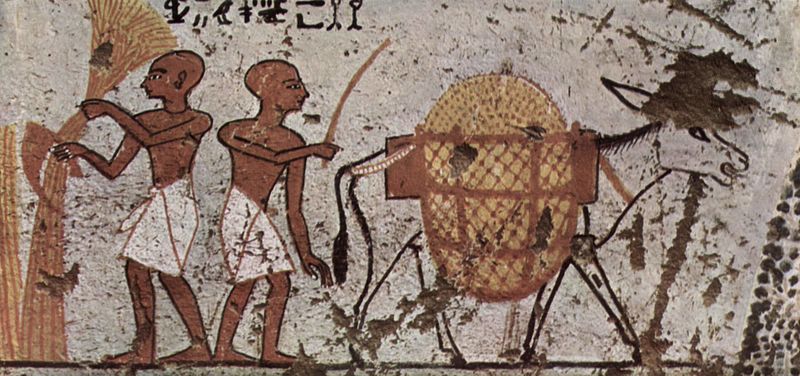
Donkeys were commonly used as beasts of burden, especially where horses were in short supply for the breeding of mules. Other than the Egyptian painting at the start of this ramble, there are some Greek images of baggage donkeys such as here .

Despite their common use in Ancient times the number of 15mm donkeys available is very limited. I used some from Tin Soldier.  There is a single pose and no variation in load, though the heads and legs are fairly easy to bend as can be seen from my photo. If I hadn't been in a hurry to get these painted I might have put some green stuff baggage on some for variety. Tin Soldier figures can have a slight cartoony feel to them and these remind me a little of those in Disney's Pinocchio. I rather like them though :)  The drivers are from Xyston. Other bases use women and children from the Thracian range.

Mules 

Mules are of course a cross between a horse and a donkey - to be specific a female horse and male donkey. They are almost always infertile - so much so that the rare instances of a female mule bearing a foal was considered portentous. Mule use requires a decent number of breeding mares and some societies have not had the horses to spare. Egypt, for instance, seems to have used mules fairly rarely. (See here page 60) . The chariot pulling animals of Sumeria mentioned above may have been a similar hybrid though of domesticated donkeys and wild (Asiatic) asses.
  Mules have various advantages over donkeys and horses. They tend to be larger than donkeys though often not by much. The shape combines features of horse and donkey - in terms of figures the tail is like a horse's and the mane may not stick up as much.
Since I had no suitable figures at the time, I painted some of Essex's mules to look more like donkeys. These are much smaller than the Tin Soldier donkeys, and to me would be far too small against Xyston figures. [EDIT - Since posting this, Forged in Battle have released some Roman mules. I hope that Corvus Belli's mules are re-released as they looked good. I may end up getting some of AB's mules which are really nice but I fear they and the accompanying figures may be rather large].

Camels

Apadana Tribute - the BM
The Bactrian camel and the dromedary are both found being used as baggage animals in ancient times. Hybrids also found their place (see here). The most famous uses of baggage camels are when Cyrus the Great is supposed to have used his to scare Lydian horses and when the Surena carried plenty of spare arrows for shooting down Crassus's Romans. Plutarch says that Mithradates used them - he berates Sallust for saying that it was Lucullus's soldiers who first saw them and that they had previously been seen during the Pontic invasion of Greece (as well as a century earlier being used by Antiochus). These could have been either type of camel since,as in modern English, ancient usage can often refer to either form. Persian carvings show both types being brought in tribute.
Note, camels seems to have been known about in Egypt long before the Romans, since various terracotta and other images have been found there. However, these are likely to represent animals used by traders from the East rather than indicating wide use of the animal with Egypt proper. Camel drivers are mentioned in Ptolemaic documents and these do seem to have operated in the country itself rather than in Syria.

There is a nice image of a dromedary being used by Assyrians here. For my Persians, I have Bactrian camels. These are figures by Essex and have a lot of character. I think there are three variants in pose. The drivers are Xyston - various levy troops I had spare.
My pictures don't really do them justice  - there is a clearer one on Madaxeman - you'll also find some nicely done Essex dromedaries too


Alain Touller does some nice Bactrian camels with Mongol 'civilians'. They are quite a lot smaller
than other companies' offerings though I shall eventually paint them. If and when I do, I'll add them here. (EDIT - Here they are. Now OOP, unfortunately).


For my Islamic armies, I have a choice. I originally use Peter Pig's camels and drivers. Like most of their figures the drivers are small compared to other ranges. The camels are similar in size to other companies, including ones by Irregular and Tin Soldier which I haven't shown.


Though the Peter Pig beasts are decent enough figures, I got carried away and bought some of the
fairly new camels from Donnington. These have the baggage separate from the camels allowing a great deal of variety. They are the biggest of the camels I have though they don't dwarf other ranges.


Finally, here is a comparison shot of the three manufacturers:

Sunday, 22 August 2010

Flemish Fortifications

 At the battle of Mons-en-Pévèle, the Low Countries forces used their wagons as protection. They deployed on a hill in a line which which wide and thick. Their camp was behind them. Between the troops and the camp were the wagons; wheels were taken off to make it difficult for the French to shift them. DeVries and Verbruggen discuss the battle in some depth.
 These are my attempt; I used Magister Militum's wagons (they have a huge range!). The tents are Baueda - the small straw ones have since been redesigned. The camp followers and (IIRC) the pavises are from Donnington.
Once I had painted and installed the pavises, I realised I had done the arms of Ypres in reverse - they should be a red cross on white. The modern arms with a section including vair date back to the late 14th century.

See the side bar for a great webpage with loads of links to pictures of medieval carts.

I used this in my first DBMM competition this month. It counts as TF. It is quite useful as it can be placed anywhere in your deployment area, not just around the camp, and successfully helped to defend my flanks in at least two battles.

Wednesday, 7 July 2010

The de Montforts

The name of De Montfort is effectively synonymous with the 2nd Barons' War.

There were actually two families of that name prominent in the conflict, both on the same side. One branch had come over with the Conqueror and were soon given the manor of Beaudesert in Warwickshire. The other branch was headed by Simon de Montfort. They had recently arrived in England - rather ironically one of the main complaints of the party headed by Simon was the influence of foreigners on the King.

First, the de Montforts of Beaudesert. 


The head of the family was Peter de Montfort. His arms are still used by the local high school as their badge. He was a major player in the 1250s and was apparently involved in various embassies. He could also be claimed to have been the first to hold the office which became the Speaker of Parliament.

He was a leader of the party which opposed much of the King's policy and his seeming dominance by his half-brothers and other foreigners.

He and his son were captured at Northampton and so missed the fighting at Lewes. He was with Simon de Montfort at Evesham, dying in the battle there. His son, Piers, was wounded but survived, regaining his father's lands after the treaty made at Kenilworth.

Beaudesert has now effectively been absorbed by Henley in Arden, a small but pleasant town in Warwickshire near where I live. The parish of Beaudesert still exists and rather oddly the parish churches of Henley and Beaudesert are little more than 100 yards apart. The Beaudesert church still contains much of its Norman structure. (I went there for a wedding once!) It sits at the foot of a fairly long ridge which is now pretty much hidden from view by the town. However, once past the houses you can see it rise abruptly above the surroundings.

This ridge was the site of Beaudesert Castle, long since disappeared. It is, however, possible to see the earthworks which formed part of the defences and may even date back to pre-Roman times.


Here is a photo I took a couple of days ago (this was in July).
What looks like a slight depression is a substantial ditch. You can only see about half of the steps (and the treads of each one are far too high, and I'm not short!) The grass is kept short by rabbits and the main area of the castle is covered by scrub and wild flowers. A nice walk :)


This is a view of what once would have been the park around the castle. The area was once far more heavily wooded. It is quite rolling (and IMHO the best countryside in the world!) The grass looks short but was around two feet deep.


This was a patch of marsh at the foot of the ridge which I though would be useful for modelling. At least, it would be marsh if we weren't having a long dry spell round here.


The Time Team carried out an excavation of the castle which is available on 4oD, though you have to forgive them the references to the prevalence of the longbow in the Barons' Wars. I think they must have mown the whole hill top which wasn't exactly environmentally friendly!

I've added a link to the Gatehouse site, a great resource for castle hunters. It shows the position of a large number of fortifications in England and Wales, and their state of preservation as well as some pictures. I found out that a place where I used to sit around on an escaprment as a teenager was actually the site of the Beauchamp castle just outside Alcester.


The other de Montfort family was headed by Simon. 


He had come to England as a young man to claim his father's English lands - his elder brother received the French inheritance. He soon married the king's sister. Henry later claimed that Simon had seduced her and that the marriage was to prevent scandal. He certainly managed to gain  a great deal of influence at court. His career is covered by a number of websites and various books, so I won't go into detail.

Interestingly, his arms are shown by Matthew Paris as the reverse of these, as are the ones showing his gruesome end at Evesham. I have kept to the ones shown in most of the rolls and the picture of his father linked to below.
The banner is shown in a picture of his father and is said to be borne in honour of the lands at Hinckley. Some of the rolls of arms give these as the de Montfort arms.

A while before Lewes, Simon had been injured in an accident and had needed to travel in some kind of carriage. Various accounts mention this as he cunningly placed this conveyance in view while deploying for Lewes, with his banner displayed next to it. The histories say that the Royalists focussed their attentions here although the only souls contained in the carriage were three Londoners who had opposed his entry into the city. They were held inside the carriage and some accounts say that they were killed by their own side as their entreaties could not be heard.

The actual type of vehicle is debateable. At least one author believed it was suspended between two horses. Another, almost contemporary account, said it was made of iron specifically to hold the Londoners. I decided to scratchbuild a canopy on top of a Magister Militum base and wheels to create a similar effect to the one in the Lutrell Psalter. I think I have overdone shape of the top and it could perhaps do with being longer. It currently looks a bit too much like a Romany caravan!  However, it is pretty similar to this later carriage.

EDIT:
I've found a picture of a carriage which looks very similar to mine. It's in a 19th century book - the pictures aren't originals but are to help painters with getting the right look and are based on earlier source material. It was written by the same man who produced the book I used for my Flemish. The book is available as a full view in Google books here.
NEW EDIT: I passed this on to someone else and scratchbuilt a new wagon which is on another post.


Advancing on the carriage are some Legio Heroica peasants. One banner is that of St. Edward, the other is St. Edmund's. Henry had a particular reverence for these English saints, hence his choice of names for his sons. There are some nice pictures of these banners used in decoration at the now lost royal chambers of Westminster. There is a picture of them in 'A Great and Terrible King' - copies were made after the rediscovery in the early 19th century which was just before the palace was damaged by fire.


One of the only 'names' killed on the Barons' side was Simon's standard bearer, Blount. He commanded the guard left around the carriage and banner. I've put him on the same base as Simon, as I liked the heraldry :)


I don't have any pictures, but I've also painted a couple of de Montfort's (with Mirliton figures) to use with my French and Florentines. Two of Simon's sons, Guy and Simon the younger escaped from England after Evesham. They joined Charles of Anjou's invasion. Guy became Charles' Vicar-General in Tuscany and led some forces alongside a Florentine army. He gained the title of Count of Nola. However, their cousin Henry of Almain, son of Edmund of Cornwall and grandson of Henry III, passed into Italy while Edward carried on to the Holy Land. He may have had a mission to repair relations with the de Montforts but it ended in tragedy. While he was praying, the de Montfort brothers stormed into the church and hacked at him even as he clutched the altar. Pleas for mercy were met with the response that their father and brothers had been given no mercy - though it seems that Edward had actaully tried to save Simon the Elder at Evesham. While Henry lay on the church floor dying, the brothers left, but once outside they were reminded of the mutilation meted out on their father, so they returned to do the same. Henry's bones and heart were returned to England

 The two were excommunicated and forced to flee, though there are suggestions that they were not pursued as vigourously as they might have been. Simon soon died, but Guy soon returned to the favour of Charles of Anjou. He continued to work for the king though he was later captured in the war of the Sicilian Vespers and died in an Aragonese prison. For his crime against Henry, Dante placed Guy in the Seventh Circle of Hell, up to his neck in boiling blood: "Within God's bosom he impaled the heart that still drips blood beside the Thames"