Showing posts with label Plutarch's Wars. Show all posts

Thursday, 12 May 2011

Plutarch's Wars: The Shahenshah


The Persian Kings tend to be seen through the eyes of the Greek historians - generally as rather effete and luxury loving despots. Yet Xenophon praises many achievements and habits of the Persians which shows the rather ambivalent attitude which existed.
The 4th century saw the rule of four Persian Kings. Artaxerxes II and III ruled for most of the century. Artaxerxes II saw a challenge from his brother Cyrus at the start of his reign, details of which are covered in Xenophon's Anabasis. He had various further dealings with the Greeks with much playing off of one side against the other. The treaty which ended the Corinthian War was known as the King's Peace - Artaxerxes essentially threatened that he would aid those who wanted to accept the agreement against those who wouldn't.
There were various revolts by territories of the Empire against the central authority - the most successful being the Egyptians who maintained their independence through much of the century. One of Artaxerxes's attempts to regain control was led by Pharnabazus supported by the Greek Iphikrates, though the campaign failed due partly to disagreement by the two men.
 Artaxerxes III regained control of Egypt, taking two campaigns to do so. Diodorus says that he and most of his sons were murdered by the eunuch Bagoas. The sole survivor was elevated to the throne as Artaxerxes IV but he too was removed and replaced by the man who assumed the name Darius III.
 Darius was probably a case of a man having greatness thrust upon him and he doesn't seem to have been up to the job. Perhaps if he'd had time he might have made a better showing but he was up against Alexander the Great.
 It was traditional for Persian kings to be depicted in a chariot, such as this seal. Note the position of the axle. Some other depictions seem to indicate a further forward axle though there has been a lot of online discussion about this.

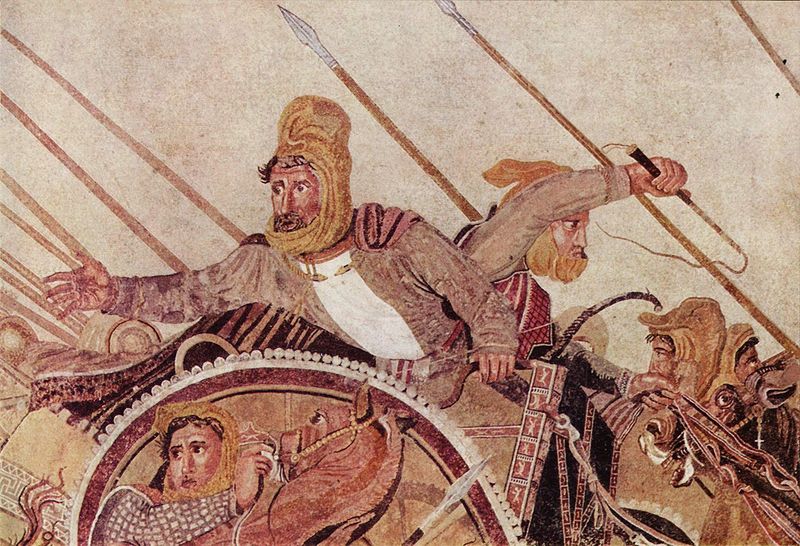
The studs on the wheels are very noticeable though the 'Alexander Mosaic' may  overexaggerate them, producing what this blog terms the marshmallow wheels.
The studs doubtless help traction but also help to fix the tyre in place. Sections of tyre have been found, including the nails, and could be bronze shaped around the wheel in a U shape rather than a shrunk on iron tyre.
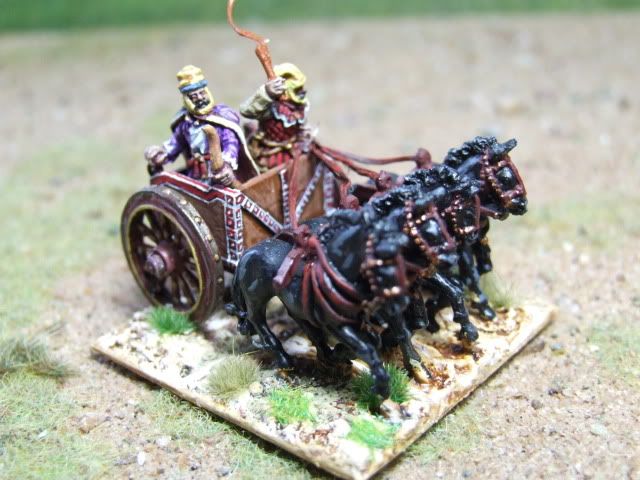
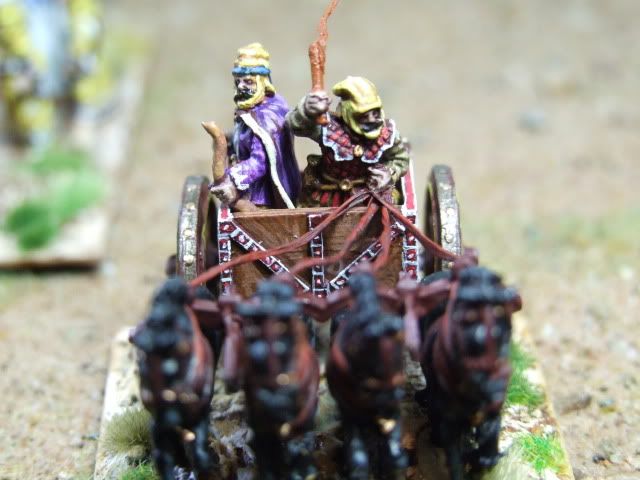
I used the Xyston chariot. The wheels in the set are smooth - I tried to show the studs by using a blob of paint which was enough to show them but quick enough to do. I tried as much as possible to use the colour scheme from the mosaic.The purple tunic with broad white stripe may well have been a royal feature, as were the upright tiara with diadem tied around. The figure wears a cloak - I think it may have been likely that the king wwould have had a coat worn as a cloak, so I could have added some arms to it.

The reins were made from dental tape. This is a bit wider than floss but probably too wide - I ended up splitting each strand in two.


 This is a bit of baggage I put together. The Greek historians could be rather snearing about the finery and family which could accompany a Persian king so I thought I'd give them something to sneer at.
I had a pack of Xyston 'Eastern levies' and some of the same company's women. The younger women has had sleeves and a veil added to make her a bit more Persian. The men have been painted using some of the designs shown on the clothes of the Immortals on brickwork of the previous century. Since these chaps are defending the tents I'm letting them keep ceremonial gear.
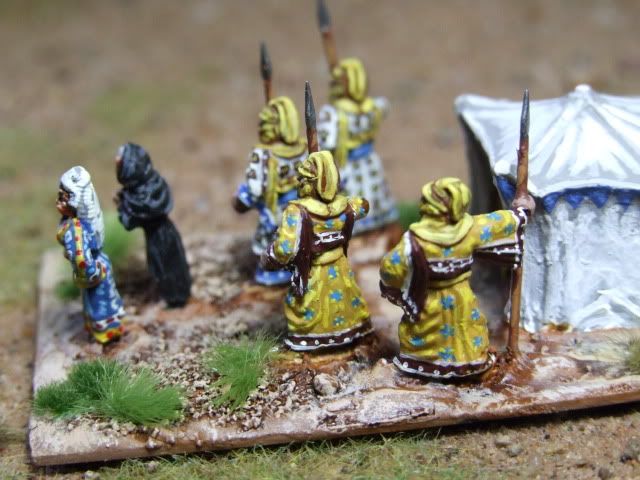
The tent is from Baueda. It is quite small compared to these rather large Xyston figures but it nice all the same. If I played something like FoG where the camp is a single large base I might be tempted to build a single grand pavillion. Part of the booty of Plataea in the fifth century was the King's pavillion which is siad to have been the model for the original Odeon in Athens. This article gives the theory that since the Odeon and the Hall of a Hundred Columns at Persepolis were of such similar size that the pavillion would have been modelled after the one and used as the model for the other. It would have been at least partly wood. Alexander's tent could well have been a similar design, though with fifty columns.  
I still have a fair few unpainted 'Kardakes' who may yet find themselves forming a second arc of honour guard.

Wednesday, 2 March 2011

Plutarch's Wars: Thracians and Mercenary Peltasts

A quick post with some of my troops which can be used with Greek and Persian armies of the early to mid 4th century BC.

These are Xyston 15mm Thracians. I think they are possibly Xyston's best with a great deal of variety - you need to go to the website to see just what a large mix is available.
They wear the traditional dress with foxskin cap - some also wear a patterned claok. This fashion seems to have gone out of style in at least part of Thracian society going by the tombs of the late 4th century. For all sorts of links and discussion about Thrace, see the Thracians Yahoo group.
The shields are handpainted but you can buy transfers for the Xyston Thracians from LBMS.

These are my attempt at Iphikratean peltasts. They are used in the Thracian, Later Hoplite Greek and Later Achaemenid Persian DBMM lists and count as fast pike.
Iphikrates was an Athenian who served as general for his own polis as serving a variety of other employers including Pharnabazus and Seuthes and, later, hisThracian father-in-law. His career is covered by Diodorus Siculus (see p.34 especially) and in less detail by Cornelius Nepos.
He is credited with introducing a form of boot which became named after him (quite appropriate as Plutarch says he was thought to be a shoemaker's son). He is also said to have reformed the arms of his men, converting hoplites into a lighter form of troop, though presumably some time after using more conventional peltasts to defeat the Spartans. There is a theory that this may have been connected with shipbourne service. The spear and sword were lengthened and the shield reduced in size. The Loeb translation renders the shape of the shield as being oval though I have seen discussion that it may be round - this being in contrast to the traditional crescent shaped pelta. Nepos also says that they received linen armour rather than metal, though he may be mistaken.
I went with a simple star symbol for the shields as this is shown in a number of places including Persian contexts. The figures are a mixture of various 15mm Xyston Greek peltasts. Many have had arms bent to a better pose for holding the long spears.

Sunday, 30 January 2011

Plutarch's Wars: Successor Generals


There were a number of interesting characters in the Successor Wars. Some had held high office under Alexander whereas others made a meteoric rise in the confusion of shifting alliances or only attained maturity as the wars raged.

The careers of these men is covered in many places, so I won't go into detail. If you are interested, then reading the appropriate Lives by Plutarch is a good place to start although by his own admission he is interested in the moral aspects rather than straightforward history.

For my Successor armies, I painted a variety of generals. I wanted at least 6 so I can field two armies at once, plus some on foot. With so many theoretical elements, I decided to add a few details to give a bit of differentiation.

 This is one of the foot generals. Figures are by Xyston. For the phalangites shields I made some transfers. The general's aspis was inspired the the decoration in the Tomb of the Erotes


The picture at the beginning of this post shows some of the mounted generals I use. All figures are by Xyston.


The central figure wears a helmet as shown on some depictions of Alexander. He gets used as Alex and as various others of the Successors.


I use this as Eumenes of Kardia. He raised a large number of Kappadokian cavalry and some of these may have formed his personal agema. I have kept them on armoured horses as may have been used by Kappadokians at Gaugamela a decade earlier.
The Xyston Kappadokian figures are a little bigger than their Macedonians which makes Eumenes look quite young!


This rear view is the figure I use for Peukestes. He was an enthusiastic supporter of Alexander's move towards mixing the Persians and Macedonians and is noted for wearing Persian dress. For these figures I used the Xyston xystophoroi figures. These are larger than most others - the cloak and feathers add to this impression. As can be seen, I removed the feathers from all except the general. I also added some sleeves and a collar to turn his cloak into the distinctive Persian coat. This is shown in Achaemenid art, is worn by Easterners in Roman art and continues to show up in the area even today - Hamid Karzai frequently wears a coat in this fashion.


I know a lot of visitors to my blog are interested in the comparison shots. Here are some Xyston cavalry alongside Old Glory 15s Seleucids.


Here are, from left, Black Hat (ex-Gladiator) Kappadokians, Essex Companions and Xyston Companions.

Plutarch's Wars: A Successor Battle

The Wars of Alexander's Successors have interested me for a long time and make for good wargames. A number histories have quite a lot of detail about the battles and the troops who fought them. The various generals have armies which are similar enough for generalship to play an even larger part than normal while each having their own quirks to make them distinctive.
We recently fought a Successor battle with DBMM at our club. The armies were equal points - 500 apiece - one being based on Antigonus One-eyed's forces (Asiatic Early Successor) and the other being Seleucid. It was similar to the clash at Ipsos which resulted in Antigonus's death. It is possible to recreate the coalition force at Ipsos using the Lysimachid list but I was slightly short of some of the necessary troops, especially the eight elephants needed for one side.
I feel Successor battles work best at 500 points (or more) as it gives you enough points to have a sizeable phalanx while still having the troops to fight a good battle on the wings.
Here are a couple of pictures - the club lighting isn't up to much and using the flash didn't improve the pics much :(

Here is the Antigonid phalanx, flanked by a vineyard. The Seleucid elephants are advancing. They should be towerless at this point but I haven't finished the basing of the ones I have - it was a last minute decision to use these armies!


The whole field near the beginning of the game. Seleucids on the right.


The clash of pike. The Seleucid argyraspides initially killed a number of enemies but overall there was enough toing-and froing that the Antigonid's were beginning to threaten the Seleucid flank. Out of shot, the rest of the Seleucid pike were beginning to beat the rest of the Antigonid phalanx.


The situation on the Seleucid left. This was the major clash of cavalry as the right was partially covered by a marsh. The Seleucids moved their right flank general and his agema to this wing. This didn't create a superiority in numbers but did improve the command situation. We had a clash of elephants as well as a swirling cavalry battle. The Seleucids broke the Antigonids but it is unlikely that many of them could have avoided pursuing the enemy from the board.
We called time here. The Seleucids didn't need to inflict many more casualties to break the Antigonid phalanx but their own left was beginning to falter and this could have had a devastating impact on their own phalanx.

Next - some photos of some Successor generals.


Thursday, 11 November 2010

Plutarch's Wars: Romans of the Late Republic

The army of the Late Republic was led by a succession of generals who have made their mark on history. Julius Caesar is of course the most famous. But this is also the period of Marius and Sulla, Lucullus and Sertorius, Antony and Crassus. It is the time when the Republic's most deadly enemies were probably its own generals but it is also the time of Spartacus and Mithridates, Tigranes and Vercingetorix, Cleopatra and Surena.
 I wasn't particularly interested in this period when I was buidling armies 25 years ago, but I liked the look of the new (at the time) Freikorps Romans and I ended up buying a few. The metal was pretty brittle then, but most of them survived in my possession unpainted for the next couple of decades.
 
Once I had built a Pontic army I decided to start painting some Romans as an enemy for them. Since I had these Freikorps figures I decided to continue using them, especially as I wasn't keen on most of the others then available.
In the past year or so, the range has been redesigned so these figures are no longer available. Their replacements look pretty good though.

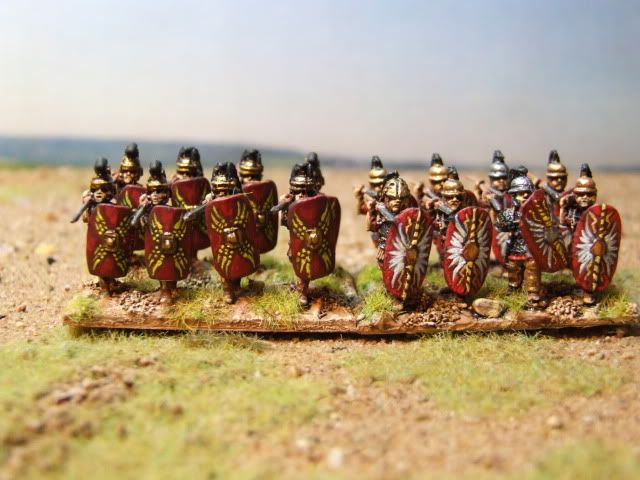
The figures were designed for the period covering the late Republic and into Augustus's reign. It isn't really clear how early the squared off oval shields began to be common, so I have included some with the others.
I painted the shield designs based on some from Armies and Enemies of Imperial Rome. Designs like this seem to have appeared on the monument to Actium so were probably used in the Civil Wars. Other shields may have been plainer and at least some seem to have had the name of their commander painted on. Actual colours are debateable though Amato's book shows a fresco with a red shield. I have some others painted with a blue background and some with black. (Incidentally, if you are interested in ancient paints, Pliny, book 35, goes into some details. Some paints would obviously be more common than others).

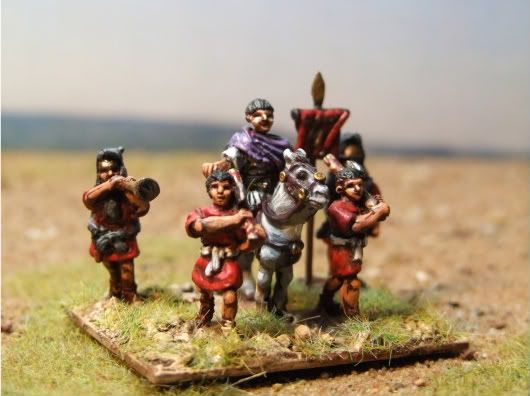
The Freikorps range includes some interesting looking generals for the Romans but unfortunately the horses are substantially smaller than most other ranges now avaible, so I have never painted mine. Instead, I have a variety of generals.

These are from the Warmodelling range. When I bought them, the company only produced Mid-Republican figures but these are equally suitable for the later period. The main feature of Warmodelling figures which lets them down a bit is that the horses tend to have stumpy legs, but from a normal wargamers viewpoint this is not as apparent. 
The legionaries from Warmodelling look pretty good although I think the shields are a bit too broad. I'm tempted by their 'auxilliaries' in the same range  for use in a Slave Revolt army which I am very slowly building.


These are from the Alain Touller range. They mix well with the other companies' figures. Their legionaries have pretty accurate looking shields although I'd prefer a wider variety in appearance.


I have a few of the Corvus Belli legionaries which will get painted some day. I'm not sure whether they will become the most experienced troops of a Slave army or a second Roman army for Civil War use. Either way, they are probably the most dynamic range of legionaries available for this period.

Plutarch's Wars: The Why and wherefore!

 Over the past couple of months I've returned to the period which first interested me in Ancient Wargaming - the Wars of Greece, pre-Imperial Rome and their neighbours.
My first ever ancient figures were 15mm Peter Laing hoplites and my first proper army were Carthaginians - again Peter Laing - put together originally using the old Airfix Guide (the so-called Purple Primer). I tried to read as much as I could about the period and my interest soon expanded to the whole Hellenistic period.

I pretty much stopped Ancient wargaming for about 10 years but when I restarted I still had quite a lot of figures which covered this same period.

One character who had interested me was Mithridates the Great. I read as much as I could about him (and managed to do a uni study on him) and as well as putting together a Pontic army, I began to have a lot more interest in this period of Roman history.

This meant that my main area of interest coincides pretty well with the period covered by Plutarch's parallel lives, most of which fall into a period just before 400BC to 1BC with the occasional later or earlier entry. Because of that, I've decided to label any posts from this older period as "Plutarch's Wars" and may well start a sister blog to help organise any links I put in.