Showing posts with label Baueda. Show all posts

Tuesday, 8 September 2015

Maximilian, the Landsknechte and the Swiss


As I said in a previous post, I have wanted to do some Italian Wars figures for a long time. 


One of the spurs was that Venexia were going out of production and the UK supplier was selling off the stock. Since these are some of my favourite looking figures, I decided to buy a good number of the various types of cavalry.

Hopefully, the range will see the light of day again but various issues have delayed their re-release by the new owners of the moulds.


The above photo is mostly of Venexia figures. Knights in sallets are from Mirliton. I gave some of these a green stuff skirt which was fashionable from around the start of the Italian Wars. 

The trumpeter is from Mirliton - he has a new hat and feathers added to give more of the 'Triumphzug' look. 
The 'candy cane' lance look is very popular with wargamers but may have been rather more restricted in reality. They do appear like this when used for banners such as in various of Diebold Schilling the Youngers illustrations.

My main sources for the troops of Maximilian are given in the last post. 


Landsknechte from Old Glory 15s. One feature that marks them as Hapsburg is that they have St Andrew's cross slashing on many of the figures.


Most of the standard bearers have the flags in a single hand as in most period pictures. Command packs are sold separately and are rather large. You may be able to negotiate buying smaller numbers with OG though if you are having a decent sized block then plenty of command adds to the look.
I mixed swordsmen and halberdiers into the front ranks for the visual appeal. They are also on some of the command stands so that the full blocks have mostly pikes to front and sides with halberds and swords around the banners and drums.


An attempt at peacock feathers.  


Talking of banners, the photography makes the shades of white stand out more than they do in real life. They also lose the texture. I've recently started using some water damaged tracing paper which has a nice crumpled texture. It also makes doing the opposite sides easier. They have sturdier than the strong tissue I used for my Byzantines. 


Old Glory crossbowmen. The red flag in the foreground was carried by the forlorn hope. The flag in the rear is carried by some of Maximilian's mercenaries in Schilling the Younger.

Luzern, Korporation Luzern, S 23 fol., p. 386 – Illustrated Chronicle by Diebold Schilling of Lucerne (Luzerner Schillling) (http://www.e-codices.unifr.ch/en/list/one/kol/S0023-2)


Old Glory arquebusiers. The flag is another carried by some of Maximilian's men in Schilling and here


Luzern, Korporation Luzern, S 23 fol., p. 521 – Illustrated Chronicle by Diebold Schilling of Lucerne (Luzerner Schillling) (http://www.e-codices.unifr.ch/en/list/one/kol/S0023-2)


Maximilian married Mary of Burgundy after the death of her father, Charles the Bold. Their daughter, Margaret, was regent of the Low Countries and was still using English archers in the early 16th century - 1500 were sent to help against Guelders for instance. (see Stow's Annals) where they joined an army of 10000. The DBMM list assumes that the Burgundian Ordonnance lance structure was still in place until the end of list in 1506, though with slightly fewer archers per knight. I think the 'MM list could be continued until the end of the covered period i.e. 1515 since Margaret continued as regent with a good deal of independence until then.

There are some archers in the 'Weiss kunig' though at least some are likely English.
The Camisado blog has a collection of Weiss Kunig plates showing archers. Some are carrying Burgundian saltires but may actually be English at Guinegatte in 1513.
In others, English seem to be shown in different costume, such as kettle hats. One plate shows the archers looking like Landsknechte.


I used Freikorp/QRF/TSS figures for these. I like them though they are slightly 'old school' compared to most of my figures. There is a mixture of Burgundian and early Tudor figures.

The yellow and red is said by Stow to be the livery of the Duke of Burgundy - perhaps Margaret's own. Poynings' men received new coats of this red and yellow along with Henry VIII's white and green. How this was arranged isn't clear, only that "these four colours were 'medled' together." They received these coats after campaigning in Guelders so did not wear them in action.


Old Glory artillery. The gun colours come from various sources including Maximilian's zeugbuch. 


When Margaret campaigned against Guelders, there were apparently 36 English serpentines as well as Poynings' archers. These are given individual names in Stow, such as the Antelope, the Cockatrice, the Mermaid, the Rose and the Normandy.


For much of the period, Maximilian and the Swiss were on opposing sides. Things particularly came to a head with the Swabian War which really ended any pretensions that the cantons were part of the Empire.

These are Khurasan figures. Some of the figures have Swiss crosses moulded onto their armour or as slashing.

Most of the standard bearers are converted pikemen. The way he holds his pike makes it easy to give him a one handed banner. Flags are hand painted.

The figures are rather smaller than the Old Glory landsknechte. This is exaggerated both by the slighter build and the very thin base of the Khurasan figures.

I only have enough Swiss to be able to provide an ally for the French. I have bought some of the Donnington Swiss for using in earlier periods. I shall paint these with far more use of cantonal colours as shown in some of the chronicles.


Friday, 28 August 2015

Maximilian on the Road


A couple of years ago, I decided to branch out a little from the two areas which this blog has covered so far.

Decades back, I had some Italian Wars figures and I decided I'd have a go at the period again. I wanted to include landsknechte, but they had to be suitable for the end period of DBMM i.e. 1515. I looked at various options and the most sensible would have been to go for something from around 1500, before all the slashing took hold. I wasn't even sure if this style of clothing would be within the period.

I looked around at the sources and kept bumping into three particular period pieces made for the Emperor Maximilian. These were the paintings showing the 'Triumphzug'* (a triumphal procession), the 'Weisskunig' and 'Theuerdank'. All three were from the end of his reign with the majority of the illustrations completed by 1515. While some of the pictures are fanciful, landsknechte were shown in the slashed tunics pretty much as worn by the figures from Old Glory 15s. Some of the armoured figures have helmets which are probably a bit late but I liked them enough to include them. The trousers in the prints tend to be more fashionably ragged than the OG figures but at least the figures aren't in the much later pluderhosen.

 The figures duly sat in the lead mountain for a while but I decided to paint them to use at this year's Burton DBMM doubles competition. I'll try to take some shots of those in the next day or so.

When I used the army, I had some generic late medieval looking cars for the baggage but I didn't think they suited the army. What they needed was some of the baggage shown in the Triumphzug. When I decided to take the army to Britcon, I used the time I would normally need for last minute painting to have a go at some conversions.


 The first two wagons are more or less straight out of the bag Magister Militum examples. The only change is that I have moved the axles - medieval and early renaissance wagons seemed to put the rear axle nearer the back than seen on later types, even though much of the rest of the construction is the same.


The horses are from Irregular miniatures. I was going to use some Magister Militum figures on foot to lead the horses but the pictures show the drivers almost always riding. I cast around in the lead mountain and found some Welsh mounted longbowmen in a suitable pose. They were given a variety of greenstuff hats, puffed sleeves and capes plus a wire whip.

I thought some street furniture would look nice and used some items from this print of Nuremburg. The cross has the 'arma Christi' -  the spear and sponge from the crucifixion. It is made from strips of wood - a first attempt in plastic strip looked like it would snap as soon as was inconvenient. The stone shrine is made of greenstuff and square section polystyrene.


The last wagon uses some spare wheels which I think may be Magister Militum left over from my Flemish wagon laager.  It carries the barrel of a siege gun. The original painting shows another cart with what looks like the carriage, wheels etc. The barrel is made from greenstuff though I'd have done better to start with a plastic or wooden centre. The ropes are made from twisted wire.


So many renaissance pictures show a rather gruesome side of life that I thought I'd have a go at portraying. Breaking on the wheel was used as a punishment for various things; the offenders being tied to a wheel while they had their limbs
smashed with an iron bar then being hoisted up as a warning to others, dying a lingering death if they had not been able to bribe the torturer first for a quick end.


The wheel is a Langley offering, the victim and ravens are greenstuff. I couldn't make my mind up what to do about the wire for the flying bird - it stands out less against a wargames table. I should probably have attached the wire to the wheel instead.


Several  scenes of the Weisskunig show execution scenes. I already had a spare swordsman so I thought I'd have a go at making the victim using a wire armature. He came out a bit chubby but I was fairly pleased overall. The header picture shows the end result.


There was one thing on the Triumphzug that I really wanted to do and knew that I couldn't have got right so I needed to buy the basic figure for a conversion. One of the last scenes shows camp followers and one of them is leading a pack goat which seems to be carrying pots and pans.
I haven't yet seen anyone with one of these in their baggage so I thought it was a must. I had to wait until Britcon to get one from Donnington. He came with a goat herd who became the figure next to the goat on the painting. He has been converted to have a bit more of a stoop as well as gaining a large pack. There is some kind of creature on the pack - I'm still not sure if it is a cat, a dog or even a fox as different versions show it slightly differently. Mine does have the animal but it is so small that you wouldn't really know.

Also on the base is a pack donkey. This is an Essex mule but his pack has been made larger to fit the look of the painting. I've also extended the ears though the attempts to make the mane look like a donkey's didn't work.

I had a couple of spare pack horses and these were given the pay chests. They should be mules going by the painting but I decided to keep them as horses. The horses are by Donnington with the chests coming from one of the Donnington wagon packs and the blankets made from greenstuff. Their driver is also from Donnington with a suitable hat added.


The last couple of items are Baueda tents.
The first is painted as shown for Maximilian's meeting with Henry VIII in 1513 as in the Royal Collection.

Incidentally, according to Stow, Maximilian's tabard in the above link is black for the mourning of the Empress. Maximilian, writing in 1512, asks his daughter to ensure that mourning is worn by his family and various officials in the Netherlands. He does not seem to have cared greatly for Bianca but at least gave the appearance of mourning.


The second has the arms of Austria and Styria as shown in  Maximilian's Book of Armaments.


*The link to the Triumphzug shows the version in Spain. The German version can be found here but a search for Maximilian or similar needs to be entered. The sketches used for making the print blocks can also be seen here, with some features which didn't make it to the final version.

Monday, 25 February 2013

Plutarch's Wars: He's Spartacus

 Spartacus is one of the most well known figures of antiquity, perhaps as familiar to many as Julius Caesar. The Kubrick film is largely to blame although his story had entered the general public perception even before that through at least two novels and also via Karl Marx into the sphere of revolutionary politics. Within the last few years, the doubtlessly highly historical drama based on Spartacus has hit television screens and there has been a burgeoning industry in both fiction and factual books on the gladiator.

 His whole career is covered in a variety of ancient sources but even then there are really very few words written about him in those books. Even adding in the other two major slave revolts, the information would cover a handful of pages. I'll put a list of the sources and some links at the end. Modern writers have expanded on this and tried to reconcile the sometimes contradictory statements with a greater or lesser degree of success.

I won't try to write a resume of the wars - there is enough online. I'll concentrate on what I did to build a 15mm wargames army for DBMM.

 There are times where the purchase of a new army creeps up on you in a number of insidious ways until, before you know it, you find yourself immersed in lead.
 The first step would have been easy to stop at. On a visit to Oxford, I looked in the window of a novelty tee-shirt shop and saw 'I'm Spartacus'. That's for me, I thought.
 The next step was that my interest in the late Republic grew. I thought the slave revolts sounded interesting, but not very practical to get an army.
 Soon after, we had a DBA competition at my club based around the late Republic. I had time, so I thought I'd give the slaves a go. After all, its only twelve elements - less than sixty figures. No problem.

 Then, I kept coming across discounted packs of Xyston figures. Some from ebay, some from a bring and buy and others from people selling off stock. Before I knew it I had well over 100 figures, mostly psiloi.
 I made a start on adding to the DBA army to get ready for a DBMM100 game although that was cancelled. Then I thought I'd get them done to play DBMM200. Before I knew it, I was suggesting to my doubles partner that we took a 500 AP army to the Burton doubles.
 That was in October I think. I already had a lot of the lead and added more to it, some of it due to Xyston bringing out more packs which I thought would mix well and partly to replace stuff I bought at Derby and promptly lost. Christmas should have seen plenting of painting time but I was struck low by various ailments so I was still basing and painting the week before the competition. It didn't help that on the final night, I checked the list and found I was a cavalry general short. I had suitable figures and managed to get him done, finishing the base at 6.30 in the morning before setting out for Burton!

The DBMM slave revolt list is split by period to represent the three major revolts, each being seen as having its distinctive features. Mine has been built for Spartacus's rebellion but I used some sources for the earlier periods for a but of inspiration.

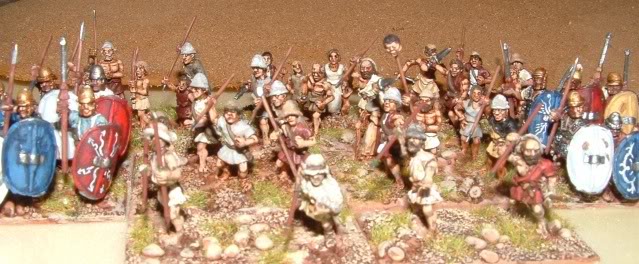
The army is composed of, in DBMM terms, ex-slaves (horde superior), ex-slaves in Roman gear (blade inferior), gladiators and veterans (blade ordinary), shepherds (psiloi inferior), Gallic and German veterans (warband ordinary and superior) and cavalry (cavalry ordinary).

The Gladiators


I steered clear of using gladiator figures for these for two reasons. One is that Plutarch says the escaping gladiators abandoned their gladiatorial equipment very quickly. Another is that the equipment of the early 1st century BC had probably not stabilised into the types which became the norm in the Imperial era. At this time they seem to have been basically the Samnite, the Thracian and the Gaul. There is even a suggestion that Spartacus was a 'Thracian' gladiator rather than being a native of the place, with the name being a pseudonym. However, most of the sources do give his origin as being Thrace.  The one bit of kit I've used which may have been gladiatorial is the Samnite shield. This is shown in various sculptures and described by Livy. Whether he is right about their origin, this shape of shield does seem to have been used by gladiators of the 1st century BC.

http://www.livius.org/a/1/romanempire/gladiators_sIBCE_mus_munchen.JPG is an intersesting 1st century BC depiction of gladiators.

UPDATE: http://archive.archaeology.org/image.php?page=0709/trenches/jpegs/gladiators2.jpg is a fairly recently recovered 1st century BC frieze of gladiators.

For those who still want to use gladiator figures, there are some useful comparison figures of various manufacturers at Irregular Wars . He also has shots of various period civilians.

 For Spartacus and one of his sub-generals I used Xyston Gallic nobles. These are very animated figures though a little smaller than the Romans and some of their other figures and have been mounted on a bit of plastic card to even out the heights. There may be differences in the build of different men but you can hardly have Spartacus being towered over by his men. I've thinned the swords somewhat and made Spartacus's curved to represent a sica. This may well be (literally) poetic licence - Sidonius's poem written half a millenium later describes the use of such a sword. The figure is also carrying the small squarish shield of a Thraex - I cut it down from a Xyston Gallic oval shield. Florus (2.8.12) describes him as a murmillo though this could also be a literary fluorish especially as the name seems to have been used for the type known as the Gaul once that province had been pacified.


 The fighters accompanying them are Principes and Triarii from the Republican Roman range. I've taken off the feathers from the helmets. There are also one or two of the Carthaginian veterans in Roman armour. I've also used some lictors - "his men brought to their leader the insignia and fasces captured from the praetors" (Florus). It helps to identify the generals from afar. One of the standard bearers has lost his hand in a previous fight (also known as a miscast).

 The rest of the ex-slaves with Roman gear are a mishmash of Xyston types. From the Roman range there are a few hastati (mostly with the armour painted out), accensi, rorarii and penal legionaries. There are some Greek hamippoi and a few peltasts in pilos. One or two are Gauls with the trousers carved off and the tunic slightly lengthened but I found this took too long to be worth the results.


The shields are mostly a mix of the Xyston Roman shields, Italian scuta, Samnite shields and a few Gallic ovals. Some have been hacked about to give that 'one unlucky previous owner' look. There are pila holes in some though these can't really be seen and wasn't worth the effort. A few have been painted to look as if the leather outer layer has begun to fall off. Exactly what Republican Roman shield designs were is the source of much debate. I've used some patterns from the early Empire, a few inspired by a later painting of gladiators and some from a Republican monument. In some cases I have painted the same design but different colours. This may have been a way of distinguishing cohortes. Some are plain red with a yellow strip across the top or either side of the boss. I've imagined these as being local troops with a shield giving the name of their city. I have no evidence for this!


 I wanted the warband to look different enough to be identified easily but still like recently freed slaves. There is a picture in the Osprey Spartacus book showing an attack by Crixus's Germans who look as if they have recently trotted over the Alps. I doubt that many would have had the time, the resources or the inclination to get themselves trousers made.
The first way I distinguished them was to use different shields. The superior warband carry a long shield which appear to be "rude shields of wicker work and the skins of animals" (Florus)
These are from Xyston's Skythian range. They look very similar to the 'ancile' - the shield of Mars. There are shields of this type shown on the Munatius Plancus mausoleum which _may_ be Gallic going by some of the other equipment also shown. The best photos I've seen are in D'Amato and Sumner.
 To increase the ease of identifying the elements and also for effect, I used quite a few velites wearing animal skins and put some dogs on the stands. More on this later...
 The ordinary warband carry round shields which again look as if covered in animal hides. "...small circular shields for themselves like those used by cavalrymen." (Sallust, Historia). They may not be rolling burning logs at the enemy but some are carrying torches to burn the property of the slave-owners or interfere with Roman fortifications. Most of these figures are either of the types of hamippoi from Xyston with a few others including some peltasts in pilos. While the felt or fur cap may be suitable for freed slaves (albeit these had freed themselves!) I had a go at converting a few by using greenstuff to give them helmets. Some are bit bulky but overall not too bad. There are also some scratchbuilt swords. My first go was to carve some out of plastic strip. These looked pretty good but it seems the superglue weakened them and they all snapped off. Instead, I squashed some wire and shaped the point.


 The horde and shepherds are mostly Xyston psiloi with the odd figure from OG15s and Mirliton which I had lying around. There are also some of Xyston's more recent releases such as Numidians and Judaeans. A few have shields and I might get around to adding some more - I have lots spare. Many of the javelins have been left with a black point - Sallust says that initially the slaves used fire to hardened the wooden points of the javelins. Later on, stocks of metal allowed new weapons to be made to supplement those captured. Some of this iron may even have been the ex-slaves' chains.

The dead Romans are some from Freikorp. I bought these when they first came out so must be around 25 years old.

 I tried to use a variety of skin tones to represent the varied origins. After working in fields for years I dare say the differences would have been less noticeable but it adds to the effect. There are various works on the origin of slaves at this point. It is likely that the majority of slaves captured by the Romans in warfare would at this time have come from the Mithridatic Wars and the related campaigns into Thrace etc. Perhaps some were taken in the early years of the Sertorian War. Those captured when young from the Teutonic invasions and the Jugurthine War may also have been capable of fighting though I suspect they would be in the minority. There was also a steady supply of slaves from outside the empire and many of these could have been captives from inter-tribal wars as well as those who were deemed surplus population. Many would have been second or later generation slaves. Pirate raids in especially the Eastern Mediterranean would have been another source.


 The shepherds were a group of slaves whose lives were rather different from those who worked the latifundia by day and were locked in barracks at night. Instead, the shepherds roamed with their sheep and were often armed to protect their flocks. More unscrupulous owners used them as a private army, raiding neighbours' property, or expected the slaves to provide themselves with food and clothing by force of arms. I feel their grading as Ps(I) in DBMM may be a bit harsh but this is part of the result of the way psiloi are counted.
 There is a description of them in one of the early wars as wearing wolf and boar skins, and being accompanied by fierce dogs. I decided that most of the more aggressive types could represent the warband - especially as Gallic slaves were favoured as shepherds. I had enough left over to mix a few into the psiloi though. My doubles partner also did a psiloi element with one shepherd and four sheep :).

Spartacus had a cavalry force, much of which was mounted on horses which they had captured and
broken. These wouldn't have been truly wild but some of the herds may have been effectively feral. Strauss puts quite a lot of emphasis on the effectiveness of these cavalry although the sources don't say a great deal. The figures are a mixture of Xyston Greeks and Judaean horsemen. Their Numidians would also mix pretty well.


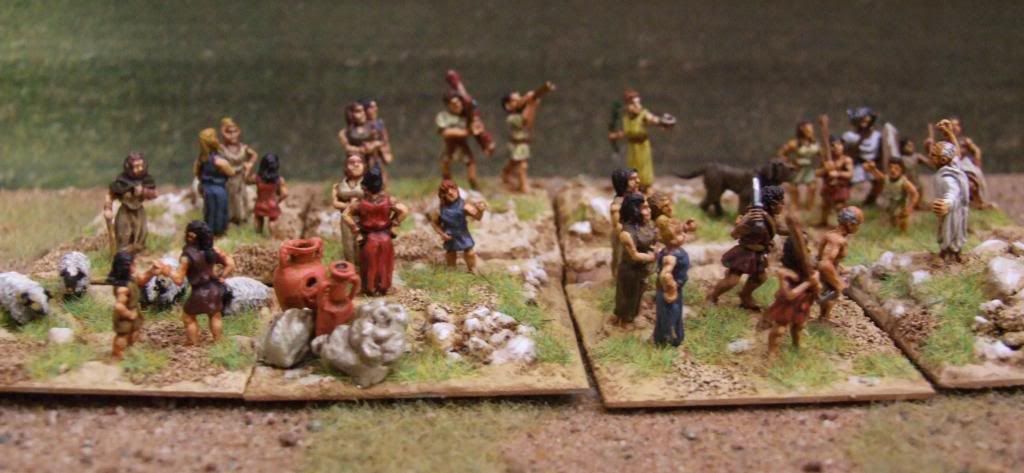
The camp is protected by a palisade. One of the Stratagems describes how the slaves evaded one Roman force by propping up bodies with the camp, giving enough time to escape. This is Baueda's palisade.


This is the first camp I've done with a bit of a story. It also helped to use up most of the female and child figures which I'd managed to acquire.


 Spartacus's wife made some prophecies. Here she is bringing down the wrath of the goddess or of Dionysus on one of the slave-owning capitalists.


So far, the army has been used in five games, all at 500AP and against opponents that are moderately close in history. I really prefer historical match-ups but in competition you can't be so choosy. The strength of the army is its size. In some games we tried to be too clever which just ended up with commands being defeated in detail. Our best results were when we massed the troops, spreading the losses. The horde are quite effective against light troops - they are probably better against light horse and cavalry than the mass of blades since they don't recoil and if they are lost the effect is less damaging. One has to be careful not to end up putting them behind other troops who then die, so the wings need protecting with something else.

Sources:
Also from Attalus, the fragments from Sallust which aren't all included above


Thursday, 29 December 2011

More Baggage

It's been far too long since my last post so I thought I'd put up a few more photos of different types of baggage.

A while ago I made a version of de Montfort's carriage. At the time I wasn't entirely happy so I thought I'd have another go.
The draught horse is by Donnington. The rider and infantryman are Old Glory. The wheels are from Langley Models, a fantastic source for all sorts of size and type of wheel. Good service too!
For those who like such stuff, the rider bears the Lambton arms - possibly those of Sir John of Lambton Worm fame.


The lower body of the wagon is plastic card. I then bent some florists' wire to shape for tilt supports. I tried tissue but that was too porous. The original pictures also make the upper porion look quite rigid so I used thin card. I wasn't sure whether to have the ends rigid or open but I settled on making curtains out of Green Stuff. I then thought I could take advantage of the curtains and have a go at making a passenger out of Green Stuff too.


I was quite pleased with the result.

EDIT: See Schilling's Berne Chronicle for details of a similar but 15th century cart
http://www.e-codices.unifr.ch/en/list/one/bbb/Mss-hh-I0001 p.405


Some DBMM Medieval armies can have pack horses as baggage elements so I have these from Donnington. The various bits of cargo are separate so can be arranged as you wish.

The wagon behind is also Donnington and again the cargo which comes with it is separate, allowing a variety of loads.


Quite some time ago, I bought some Alain Touller Mongol Baggage. This is a nice little set with a rider, a family on foot and a few Bactrian camels.

The tent is from Baueda.


The pony and camels are pretty small compared to other companies' - not necessarily unrealistically sized but small enough to not mix well. The humans would mix pretty well with Essex and similar sized figures.


More recently, thanks to a post on TMP, I came across QR Miniatures. Most of the range is Renaissance although they also produce some Poles and Eastern Franks from the 11th century which aren't yet on the website.
I ordered some of their horses since a number of DBMM armies have pony herds for their baggage elements. There aren't many suitable horses lacking tack so I jumped at these. I was pleased with them though I'd still buy some shaggy steppe ponies if I could get them.

EDIT: Thanks to Geoff on TMP; another source of ponies are QRF's 'Yellow Ribbon' range. Some have a halter but no saddles or blankets.