Showing posts with label Personalities. Show all posts

Sunday, 1 July 2012

Alphonse of Poitiers


King Louis was accompanied on crusade by his brothers, Robert of Artois, Charles of Anjou and Alphonse of Poitiers.

Alphonse was the third oldest of the brothers (of those who survived childhood) and was given a sizeable amount of power and responsibility. He helped command against the English in the Saintonge War while still in his early twenties.

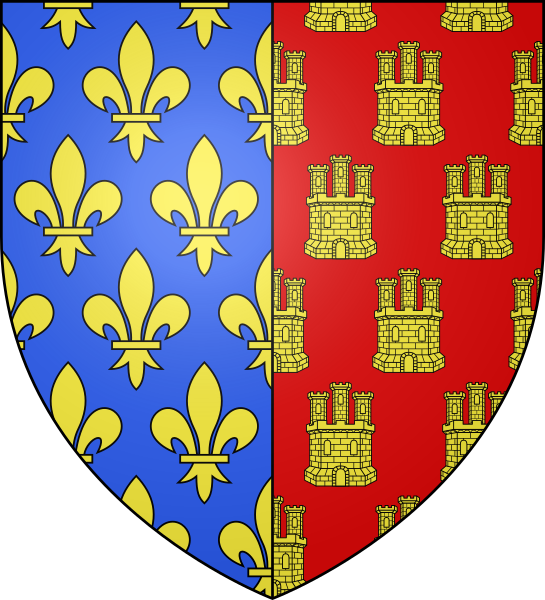
His mother was Blanche of Castile and this is represented in his arms.
Robert bore a label with the Castilian fortress on it and Charles initially had a bordure, also with the castle marked aroundit.
Blanche was seemingly a pretty formidable woman and made her mark through her sons. She was regent both in Louis's minority and again when he was abroad. He showed his respect to her in the decoration of the Sainte Chapelle in Paris- while the current decoration is a 19th century restoration it follows the likely original and for much of the surface the arms of France and Castile are scattered evenly across the walls. This chapel, incidentally, is well worth a visit. I went to watch a classical concert there and night which gives a chance to absorb the atmosphere and gaze at the decoration.

Alphonse's seal shows how the arms were portrayed on the caparison - France at the front, Castile at the back.


This layout, more than anything else, was the reason I wanted to paint the figure.


Alphonse was married to the heiress of the County of Toulouse and when his father in law died, Alphonse gained control of the county. This shows an interesting banner with the arms of Toulouse added to those of Alphonse, each portion of equal size. 

Alphonse seems to have been rather more level headed than his brother Robert. He fought well in the Seventh Crusade and returned to France to be co-regent when his mother died and Louis was still in the Holy Land. He took part in further campaigns to consolidate the gains from the English in France and then accompanied Louis on the Eighth Crusade to Tunis. This ended disastrously for the French but in a different way to the Seventh Crusade. This time, disease took many of the crusaders including Louis. Alphonse made it back to Europe where both he and his wife died.

One of his legacies was to leave the Holy See a grant of land which became the seat of the Avignon Papacy.  

Sunday, 27 May 2012

St Louis and the 7th Crusade


The latest Slingshot (281) has an article about the 7th Crusade so I thought I would put up some pictures of figures I have painted for this campaign. I won't say very much about the background of the crusade - the article covers the main points. For more detail you can go to the eyewitness account of de Joinville .  Bartlett's 'The Last Crusade' is essentially a retelling of de Joinville with some additional information.

All the figures are 15mm Mirliton.


Firstly, the king - Louis IX.
 Suffice to say that if you ever ch
oose to paint these arms then you do indeed need the patience of a saint or a liking for fleurs-de-lys.
The figure with the plain red banner is painted with the arms of Clement as shown in a stained glass window in Chartres cathedral.

He was actually marshal of France a generation before this crusade, but I liked the arms and kept his association with the flag, the famous Oriflamme.

There are various descriptions of the Oriflamme through the years and it is possible that it was replaced over the years. This site gives a potted history of its appearance and the battles where it is thought to have been carried.

Since first painting the flag I added a bit of 'brocade' effect, just to add a bit of interest.


Next is de Joinville, whose account gives us so much detail about this crusade.

 This is a slightly later illustration of de Joinville from a 14th century edition of his memoirs. It is useful for showing how the arms were carried on the horse bard.


I have chosen a figure with a kettle hat rather than a full helm. De Joinville recounts how he gave the king his own to allow the king some relief from the heat.

The figure next to him, Hughes de Trichatel, lord of Conflans, is mentioned as carrying his banner at Mansourah.


I'll put some more pictures of personalities from this crusade in my next post, including some non-French.

Wednesday, 7 July 2010

The de Montforts

The name of De Montfort is effectively synonymous with the 2nd Barons' War.

There were actually two families of that name prominent in the conflict, both on the same side. One branch had come over with the Conqueror and were soon given the manor of Beaudesert in Warwickshire. The other branch was headed by Simon de Montfort. They had recently arrived in England - rather ironically one of the main complaints of the party headed by Simon was the influence of foreigners on the King.

First, the de Montforts of Beaudesert. 


The head of the family was Peter de Montfort. His arms are still used by the local high school as their badge. He was a major player in the 1250s and was apparently involved in various embassies. He could also be claimed to have been the first to hold the office which became the Speaker of Parliament.

He was a leader of the party which opposed much of the King's policy and his seeming dominance by his half-brothers and other foreigners.

He and his son were captured at Northampton and so missed the fighting at Lewes. He was with Simon de Montfort at Evesham, dying in the battle there. His son, Piers, was wounded but survived, regaining his father's lands after the treaty made at Kenilworth.

Beaudesert has now effectively been absorbed by Henley in Arden, a small but pleasant town in Warwickshire near where I live. The parish of Beaudesert still exists and rather oddly the parish churches of Henley and Beaudesert are little more than 100 yards apart. The Beaudesert church still contains much of its Norman structure. (I went there for a wedding once!) It sits at the foot of a fairly long ridge which is now pretty much hidden from view by the town. However, once past the houses you can see it rise abruptly above the surroundings.

This ridge was the site of Beaudesert Castle, long since disappeared. It is, however, possible to see the earthworks which formed part of the defences and may even date back to pre-Roman times.


Here is a photo I took a couple of days ago (this was in July).
What looks like a slight depression is a substantial ditch. You can only see about half of the steps (and the treads of each one are far too high, and I'm not short!) The grass is kept short by rabbits and the main area of the castle is covered by scrub and wild flowers. A nice walk :)


This is a view of what once would have been the park around the castle. The area was once far more heavily wooded. It is quite rolling (and IMHO the best countryside in the world!) The grass looks short but was around two feet deep.


This was a patch of marsh at the foot of the ridge which I though would be useful for modelling. At least, it would be marsh if we weren't having a long dry spell round here.


The Time Team carried out an excavation of the castle which is available on 4oD, though you have to forgive them the references to the prevalence of the longbow in the Barons' Wars. I think they must have mown the whole hill top which wasn't exactly environmentally friendly!

I've added a link to the Gatehouse site, a great resource for castle hunters. It shows the position of a large number of fortifications in England and Wales, and their state of preservation as well as some pictures. I found out that a place where I used to sit around on an escaprment as a teenager was actually the site of the Beauchamp castle just outside Alcester.


The other de Montfort family was headed by Simon. 


He had come to England as a young man to claim his father's English lands - his elder brother received the French inheritance. He soon married the king's sister. Henry later claimed that Simon had seduced her and that the marriage was to prevent scandal. He certainly managed to gain  a great deal of influence at court. His career is covered by a number of websites and various books, so I won't go into detail.

Interestingly, his arms are shown by Matthew Paris as the reverse of these, as are the ones showing his gruesome end at Evesham. I have kept to the ones shown in most of the rolls and the picture of his father linked to below.
The banner is shown in a picture of his father and is said to be borne in honour of the lands at Hinckley. Some of the rolls of arms give these as the de Montfort arms.

A while before Lewes, Simon had been injured in an accident and had needed to travel in some kind of carriage. Various accounts mention this as he cunningly placed this conveyance in view while deploying for Lewes, with his banner displayed next to it. The histories say that the Royalists focussed their attentions here although the only souls contained in the carriage were three Londoners who had opposed his entry into the city. They were held inside the carriage and some accounts say that they were killed by their own side as their entreaties could not be heard.

The actual type of vehicle is debateable. At least one author believed it was suspended between two horses. Another, almost contemporary account, said it was made of iron specifically to hold the Londoners. I decided to scratchbuild a canopy on top of a Magister Militum base and wheels to create a similar effect to the one in the Lutrell Psalter. I think I have overdone shape of the top and it could perhaps do with being longer. It currently looks a bit too much like a Romany caravan!  However, it is pretty similar to this later carriage.

EDIT:
I've found a picture of a carriage which looks very similar to mine. It's in a 19th century book - the pictures aren't originals but are to help painters with getting the right look and are based on earlier source material. It was written by the same man who produced the book I used for my Flemish. The book is available as a full view in Google books here.
NEW EDIT: I passed this on to someone else and scratchbuilt a new wagon which is on another post.


Advancing on the carriage are some Legio Heroica peasants. One banner is that of St. Edward, the other is St. Edmund's. Henry had a particular reverence for these English saints, hence his choice of names for his sons. There are some nice pictures of these banners used in decoration at the now lost royal chambers of Westminster. There is a picture of them in 'A Great and Terrible King' - copies were made after the rediscovery in the early 19th century which was just before the palace was damaged by fire.


One of the only 'names' killed on the Barons' side was Simon's standard bearer, Blount. He commanded the guard left around the carriage and banner. I've put him on the same base as Simon, as I liked the heraldry :)


I don't have any pictures, but I've also painted a couple of de Montfort's (with Mirliton figures) to use with my French and Florentines. Two of Simon's sons, Guy and Simon the younger escaped from England after Evesham. They joined Charles of Anjou's invasion. Guy became Charles' Vicar-General in Tuscany and led some forces alongside a Florentine army. He gained the title of Count of Nola. However, their cousin Henry of Almain, son of Edmund of Cornwall and grandson of Henry III, passed into Italy while Edward carried on to the Holy Land. He may have had a mission to repair relations with the de Montforts but it ended in tragedy. While he was praying, the de Montfort brothers stormed into the church and hacked at him even as he clutched the altar. Pleas for mercy were met with the response that their father and brothers had been given no mercy - though it seems that Edward had actaully tried to save Simon the Elder at Evesham. While Henry lay on the church floor dying, the brothers left, but once outside they were reminded of the mutilation meted out on their father, so they returned to do the same. Henry's bones and heart were returned to England

 The two were excommunicated and forced to flee, though there are suggestions that they were not pursued as vigourously as they might have been. Simon soon died, but Guy soon returned to the favour of Charles of Anjou. He continued to work for the king though he was later captured in the war of the Sicilian Vespers and died in an Aragonese prison. For his crime against Henry, Dante placed Guy in the Seventh Circle of Hell, up to his neck in boiling blood: "Within God's bosom he impaled the heart that still drips blood beside the Thames"


Sunday, 23 May 2010

Henry's Brothers


Henry III's mother, Isabella of Angouleme, was betrothed when still a child to Hugh of Lusignan. Soon after John became King of England, he annulled his marriage and effectively kidnapped the 12 year old Isabella who was already considered a beauty. John married her and they had five children. The oldest was Henry and the second child was named Richard. A daughter, Joan, was betrothed to her mother's erstwhile suitor and she was sent to live at his court.
 However, when John died, Isabella returned to her lands in Angouleme and soon after married Hugh - her daughter instead being promised to Alexander of Scotland. Isabella proceeded to have another nine chidren. All fourteen of her offspring survived to adulthood - her daughters married a variety of notables including the Emperor Frederick II, Alexander II of Scotland, Raymond of Toulouse and Simon de Montfort.

Her second son, Richard, was from the age of 16 Count of Poitou and Earl of Cornwall. His Cornish lands provided a considerable amount of wealth and he became one of the richest men in Europe. He would later build his property portfolio through some shady purchases of debts. He also made a rich marriage and was paid off by the King on several occasions after rebelling.

One way in which he spent his money was on the reconstruction and expansion of the fortifications at Tintagel. This was an era which was fascinated in the stories around King Arthur and it seems that the castle was built because of the legend rather than for any strategic purpose. It is an interesting place to visit - unless you dislike heights! 

Richard went on Crusade from 1240-3 although he fought in no battles. On the way home, he met his soon to be second wife, Sanchia. She was one of four sisters - the others married Henry of England, Louis IX of France and Charles of Anjou. Soon after, the Pope offered to sell Richard the throne of Sicily. Matthew Paris says that he replied by saying "You might as well say 'I make you a present of the moon - step up to the sky and take it down'." His brother Henry had less sense, purchasing the right for his son which accomplished nothing except to strain the royal finances.

However, Richard was more tempted by the title of Emperor and bribed various Electors to acquire the crown. However, his title was challenged by Alfonso of Castile and neither could enforce their will on the Empire. Contemporary historians refer to Richard as King of the Germans and his son was known as Henry of Almain.

Richard had opposed Simon de Montfort at various points and joined the King when war broke out. He commanded a battle at Lewes but when things went badly he tried to take refuge in a windmill, coming out when the rebels threatened to set it aflame, calling "Come out you bad miller!" He remained in captivity until after Evesham.  See http://www.bl.uk/onlinegallery/ttp/luttrell/accessible/page14lge.html for a roughly contemporary windmill.

Richard's son, Henry of Almain, was later murdered by two of the de Montforts while journeying through Italy. This earned them a place in Dante's Inferno - I'll add more when I get around to posting pictures of the de Montforts.

A possible link between Richard of Cornwall's arms and those of Richard I is covered here - go to the section on 'tricky arms'. This may also explain the lion of the de Joinville/de Geneville arms (I've painted a couple of figures in variations of these arms).

Henry's ties with his Lusignan brothers were one of the causes of the Barons' War. The English nobility resented the foreigners gaining land and influence - though French was still their main language and many held French lands. The ultimate leader of the barons, Simon de Montfort, was of course of French birth himself.
Henry does seem to have favoured his half-brothers excessively - he made Aymer de Valence Bishop of Winchester despite him being decidely unqualified for the job.
Another brother was William de Valence who acquired the title of Earl of Pemboke in right of his wife. He fought at Lewes and fled into exile. He returned the following year, landing with various other Royalists and a sizeable force in William's Welsh territory. They seem to have been in communication with Gilbert de Clare and soon met up with him. He fought at Kenilworth and at Evesham. One of his postwar gains was the manor of Inkberrow which is just under ten miles from where I live.

The picture of my figures at the top of the page shows the arms of Richard and of William. The other armigerous figure bears the arms of Oddingseles. They held land at Solihull and the arms are still part of the badge of Solihull School.

Tuesday, 11 May 2010

The Beauchamps


Well over a decade ago I took part in my one and only archaeological dig at my local abbey's ruin. After a few days washing industrial slag, they asked if I would mind helping to clean some skeletons as this was the last dig for a few years and they wanted to get quite a few up.
 I then spent a couple of weeks cleaning bones, including a number of skulls. From the context, they were believed to be 13th century - as it happens the same period that I now cover in this blog. The preservation varied according to the soil - the boundary between two types passes through the site so in some cases half of the bones were very well preserved while the other half instantly crumbled.
 I think I dealt with about half a dozen skulls and some were so well preserved that even the ear bones survived, washing out as I swilled the skulls round like some kind of macabre Tom-Cruise-in-Cocktail. One particular skeleton stays in my memory. It was a man and going by his long bones he was probably around 6 feet tall. He had marks on his bones showing that he'd had a lot of muscles - the on-site experts said that they showed he had probably been a rider and likely a knight which would explain his presence in a high status part of the abbey. A number of bones had broken at some stage in his life, including a leg, some ribs and one arm I think. They had all healed very well.
 The most impressive injuries were to his head. There were two cuts in the skull, probably from a blade. One went from front to back along the top left of his skull and the other went from side to side across the upper back of his head. Although some healing had begun, the experts thought they were serious enough to have led to his death. A possible victim of Kenilworth or Evesham perhaps - the abbey lies within easy reach of both. Of course, it may have been some kind of accident or a local brawl, but I can daydream!

 What does this have to do with the Beauchamps? When I was helping there, a couple of people mentioned that the Black Dog of Arden was buried there. I knew nothing of the period then and only recently found out that he was one of the Beauchamp Earls of Warwick, dubbed with that name as an insult by a favourite of Edward II. His grave had been discovered years ago, but it was nice to know that one of the great magnates had apparently chosen to be buried in my hometown.


 The Beauchamps made their mark under Edward I, acquiring the Warwick title by marriage. Various branches gained land in the area, including at Alcester. It seems that the Beauchamp arms were originally a simmple gules, a fesse or but cross crosslets or martlets were adopted as differences - the crosses being taken from the traditional arms of the Earls of Warwick.

In the photo, Beauchamps are second, fifth and seventh from the left. I haven't worried too much about whether the arms are suitable for the Barons' War. Others in the line up include Hastings and Mortimer. Mortimer was an especially major player in the war.
One of the branches of the d'Abitot family is to the extreme left. I haven't found out much about them except that they had various branches holding lands in my area of the country and that they had some nice looking coats of arms!

Incidentally, my output of Medieval figures is on hold for a while as I'm working through a backlog of Classical period stuff (Simon de Montfort sits on my painting table half-finished!). I may set up a different blog to cover some of this stuff but continue to update Dante's Wars in my current lacksdaisical manner.


Monday, 22 March 2010

The Nobility of England


For a few months, I have concentrated on English knights of the reign of Henry III.

The reign was a period which saw some conflict in France and Wales as well as the Second Barons' War. Many of the same characters saw action in the next reign as Henry's son, Edward Longshanks, fought in Wales and Scotland.


 The figures are all 15mm by Legio Heroica. I used a mix of the early 13th century and mid 13th century ranges. The early period helmets would have been obsolete by the time of the Barons' War, so unlikely to have been worn by the nobility, but the figures are nice and it gives me more variety plus some of the poorer knights may have still used them. By Edward I's wars, helmet styles had evolved even further.

 I originally decided to just do a few English, representing my local area. However, the more I read and researched, the more carried away I became so that I have ended up with a full size army.

 A major resource which I used was British History Online. This includes many county histories. I live on the border of Worcestershire and Warwickshire and luckily these two are covered. The histories give a great deal of detail of who owned land where through most of recorded history. I think that at times the heraldry is inaccurate but it is a very useful starting point. Early Rolls is very useful for checking the heraldry though be sure to cross check as some arms vary from roll to roll. I also used Grazebrook's Heraldry of Worcestershire, trawling through to find places which were local to me and arms which were carried in Henry or Edward's reigns.

 Over the next couple of weeks I'll upload a series of photos of various figures, with a bit of gossip about many of them.


To start, here's Humphrey de Bohun, 2nd Earl of Hereford and Constable of England.
He was at times in opposition to the king, but was in the King's army at Lewes. Some books put him on the Barons' side at Evesham but this is probably a confusion with his son - also called Humphrey. The younger Humphrey can be seen to the rear. He was a commander for the Barons at Lewes and again at Evesham. He seems to have earned de Montfort's displeasure at Evesham for choosing to remain in command of the Welsh. He probably did not flee with them immediately - he was mortally wounded and died soon after the battle.


 The arms in black are those carried by the de Spineto family who held land at Coughton, about 5 miles from where I live.


Monday, 8 March 2010

Henry of Winchester

Henry of Winchester - Henry III of England - became king at a young age, crowned with a simple circlet as the crown jewels had been sold or lost in the Wash. His father, John, died while still at war with many of his barons. In some ways, this set the tone of the next fifty odd years, with frequent disagreements between the King and many of the most powerful men of the realm. Frequent political strife broke out into open warfare - the Second Barons' War. Much of the strife was down to the King's failure to recover land lost in France; the Saintoge War being the main example. Another cause of tension was Henry's attempt to buy the Kingdom of Sicily for his younger son. The cost was huge - Henry's brother had already declined the offer - and the chance of success was low. In the end, the only result was that the King was desparate for money.
 The various twists and turn of the Barons' War can be followed in many place. One old but seemingly useful source can be found here. One useful section is the appendix where participants of the two factions are named. I think there are a few errors, but handy nonetheless.
 This has a variety of primary and near secondary sources covering the War.
 Dante mentions Henry as one of the group at the base of the mountain of Purgatory, alongside some of the other characters I've covered.
  "You see the king who led the simple life

    seated alone: Henry of England—he
    has better fortune with his progeny."


  I hadn't originally intended painting an English army, but decided I'd just do a few of the local lords. I already had a fair number of Legio Heroica's figures which I started to paint as French, but I quickly decided that they wouldn't work too well alongside the French I'd already done.
 I soon found myself researching the various nobles of England and within a short time I'd commited myself to paint up a full army. I'll go into some of the sources I used another time.

 Legio Heroica do two kingly figures. The one which I used for Henry is designed for the early part of the 13th century and in theory is too early for Henry, especially for the Barons' War period. His seal show him in a full helm and riding a horse with no caparison but artistic licence was mine to take! I especially liked the pose - in DBMM Henry is an inert general and this pose leant itself to a level of inertia.

I was heavily influence by the style of painting used for this figure on the Legio Heroica site - I even copied the ermine trim.


I was intruiged by the description of a dragon standard used at Lewes. Hobilar (the magazine of the Lance and Longbow society) had a bit of a debate about whether this would have been a flag or a windsock style. After a bit of deliberation, I decided on the windsock. This was for a couple of reasons. The first was that Henry seemed interested in his Saxon predecessors - using the names Edward and Edmund for his sons was very unusual at the time. It was their saintliness which was their main draw, but he may have been aware that the Saxon kings probably carried dragon standards, as shown on the Bayeux Tapestry.

What swayed my decision finally was coming across this picture. It seems to have been from the time of Edward I, who is also known to have used a dragon standard. The picture is an illustration of the story of King Arthur, another subject which was of interest to Henry - he probably ordered the construction of the Winchester Round Table.
 I scratchbuilt the dragon using fuse wire and milliput. The first attempt was okay but I decided to try again and even then had to rebuild the head.

The arms of his standard bearer are, I think, those of the knight who held the land where our wargaming club meets.

I shall post some more pictures of the flower of English chivalry once I get the basing done!

Thursday, 13 August 2009

Spain: Royalty and Flags


This is my 15mm King of Aragon. The figures are Alain Touller with two Mirliton horses.


James I - the Conqueror, was king of Aragon through most of the 13th century. Much of his fighting was against various Muslim states, including the conquest of Mallorca and campaigning in Murcia. His life is covered by a chronicle which he authored (no doubt with the aid of a ghost writer). This is an excellent read. It is available on-line here.


He was succeeded by Peter III - the Great. He fought against rebellions at home and then led an expedition to reinstate Aragonese suzerainty over Tunis. From there, he led his army to Sicily to fight against Charles of Anjou. Peter was given a large sum of money by the Byzantine Emperor to assist this endeavour - Charles had set his sights on taking Constantinople to re-establish the Latin Empire.


At one point the two kings agreed to end the war by a duel in Bordeaux, though only Peter turned up.


The Pope excommunicated Peter for his invasion of Sicily and, declaring him deposed, a Crusade was called. This involved a huge French invasion of Peter's territory. Initially successful, the Crusade collapsed into a rout due to disease and the defeat of the French fleet.


On Peter's death, he left his Spanish possessions to his son Alfonso III and Sicily to another son, James.


Peter and Charles of Anjou are both placed by Dante outside Purgatory, singing in harmony.


Alfonso conquered Mallorca from his uncle (another James) and then Minorca from its Muslim ruler. His six year reign ended with his death at the age of 27. Dante placed him at the foot of the mountain of Purgatory with the inefficient rulers.


James of Sicily inherited the Kingdom of Aragon. In order to achieve peace with the Angevin Charles II, James agreed to give Sicily to Charles. The Sicilians disagreed and made James' brother, Frederick, king. James briefly made war on his brother which largely took the form of naval actions - James was even appointed Captain-General of the Papacy. As a further inducement, James was given Corsica and Sardinia - even though these were not in the Pope's control.

Dante is not complimentary about the Aragonese kings of Sicily

That book will show the greed and cowardice
of him who oversees the Isle of Fire,
on which Anchises ended his long life;


and to make plain his paltriness, the letters
that register his deeds will be contracted,
to note much pettiness in little space.


And all shall see the filthiness of both 
his uncle and his brother, who dishonored
a family so famous—and two crowns.
Paradiso, 19
Ferdinand IV is also criticised in the book of bad deeds, for his "life of treachery and ease."


Various chronicles cover the reigns of Peter and James. The most complete one available in English online was by Muntaner, available here. It is also a valuable source for the Catalan Company which campaigned in Byzantine lands. Others include ones by Desclot and San Juan de la Pena, though I don't know of any complete English versions of these online.


This is my representation of Don Enrique of Castile. Figures are Alain Touller.


He was a younger son of Fernando III of Castile. He fought against his brother, Alfonso X, and although initially successful he was forced into exile in England. After three years he had to leave and went to Aragon. He conquered the small Moorish Kingdom of Niebla but was again induced to leave Spain. He worked as a mercenary for the King of Tunis and then went to Italy.


There seems some disagreement as to whether he joined Charles of Anjou in time for the battle of Benevento. He certainly received the post of Senator of Rome. He considered this insufficient repayment for his support of Charles and joined Conradin's invasion, providing Spanish and Roman forces. He was in the successful van at Tagliocozzo but fled when the apparently victorious army was defeated.


He spent the next 23 years in prison and may have written the poem 'Amadis'.

For wargaming he is a most useful figure, being suitable for Castillian, Aragonese, Hafsid Berber, Medieval German and possibly Charles of Anjou's French armies.


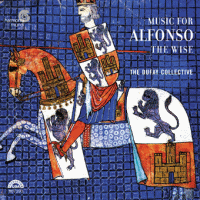
I found his arms using Wikipedia, so I hope they are accurate! I used the same style of arranging the quarters as on this picture of Alfonso X


(Picture from here)
Note the purplish hue to the lions and the cross on Enrique's flag. Even the modern Spanish arms should have a lion in purpure but they are often shown in red. The actual original colour of purpure is debateable and even the above picture probably shows a change due to time. A pruplish red is probably the safest bet, though I've used a more (probably inaccurate) lilac colour on Enrique's flag
I have also painted a Castilian king but the photo is too blurred to use. Another time perhaps!


The following pictures show a variety of types of flags in use by Spanish forces. All are 13th century.


Fresco from here


From a fresco depicting the conquest of Mallorca. The senyera - the Catalan flag - is fairly unusual in that the bars are horizontal on the flag but vertical on shields. This shape is also unusual. A similarly shaped flag from the period still exists in Valencia. The description says that the yellowing is due to age, which seems odd when so many flags are depicted with a yellow field. The conquest pennon has probaly lost a longer tail as on the above picture.
The most common, and traditional, portrayal of the flag is with 4 red pales but as can be seen this was not always adhered to.


A nice picture which not only shows flags and bards of Castilian knights but also some early jinetes. I'm planning to get some suitable figures by Essex at the weekend.

(EDIT: Seems these are actually Muslims who are fighting alongside the Christians - the two were allied at the battle depicted. They may still be a guide to how early jinetes looked if raised from e.g. mozarabs).


Tuesday, 28 July 2009

Guelphs

The Guelphs were the political opponents to the Ghibellines. They opposed Imperial control in Italy and generally supported the Pope or, later, the Angevin rulers of Naples. As with the Ghibellines, many states changed their allegiance at different times as different parties gained the ascendency. Within a city, different areas could support a different party. This was often the result of following the patronage of a great family although party differences could exist even within families.


This shows a game using my Guelph figures. The cavalry are Mirliton with Black Hat spearmen and peasants.


This shows the main Guelph standard bearer at Montaperti, Jacopo del Nacca, of the house of Pazzi. He was the victim of one of Dante's most damned characters, Bocca degli Abati. I haven't painted this individual for two reasons - one is that his arms aren't very interesting but the other is that I didn't want to put a traitor in the midst of my forces - no point in tempting fate :)
Abati was a Ghibelline from Florence but hadn't gone into exile. He was in the forces facing the Ghibelline from Siena and elsewhere at Montaperti. Once the battle, Abati made his way towards Pazzi and, without warning, struck at his arm holding the banner. The severed hand and Florentine flag fell to the ground; the Guelph cavalry facing treachery and the assault of the Germans, soon broke. The infantry were less able to escape and although they put up substantial resistance the battle ended with thousands dead.
In his poem, Dante was crossing the lowest circle of the Inferno, the circle of traitors, when he accidentally kicked the head of a sinner embedded up to his neck in ice. Dante thought he recognised the face but the traitor refused to give his name, though he alludes to Montaperti. Dante tried to get his name by pulling out the damned man's hair though he only discovered that he had been talking to degli Abati when a neighbouring soul gave away his name.


Saturday, 25 July 2009

The Emperor and the Empire


Dante's "Divine Comedy" features a number of the rulers of the Holy Roman Empire.
Frederick II is shown as a heretic, burning in a tomb on the sixth level of the Inferno. Henry VII was reserved a seat in Paradise. These two are the only ones in this period who were technically emperors, since they had travelled to Rome to be crowned. Henry's journey is shown in a splendid set of pictures made by his brother about twenty years after the event. They can be seen here
It is a great resource for heraldry although the armour is more representative of the time it was made (c.1340) rather than the period it depicts (c.1310). Fashions changed fairly quickly at this time.

Those who had been elected as ruler of the Empire bore the title "King of the Romans". Others were appointed or proclaimed as King of the Germans (rex teutonicorum), such as the sons of Frederick who had been left in control while the Emperor was campaigning in Italy and beyond. Frederick's opposition to the Pope led to the creation of Anti-kings such as Willian II of Holland.
See the sentence of deposition here

The period from 1257 to the mid 1270s was known as the Great Interregnum. There were two claimants to the throne - Richard of Cornwall and Alfonso X of Castile - but neither had any effective power in the Empire. Once Richard had died, Rudolf von Habsburg was elected as King of the Romans. He later renounced any claims in Italy and referred to himself as King of the Germans. Dante put him amoungst the negligent rulers at the base of Mount Purgatory.

He who sits highest, and the semblance bears
Of having what he should have done neglected,
And to the others' song moves not his lips,

Rudolph the Emperor was, who had the power
To heal the wounds that Italy have slain,
So that through others slowly she revives.
(Purgatory, Canto VII)

Dante's disdain aside, I decided to paint a figure as Rudolf. Charles Oman's "Art of War in the Middle Ages" has a description of the battle of the Marchfeld in which Rudolf defeated his rival Ottokar (another of Dante's negligent princes). Oman quotes from the Salzburg Chronicle which gives some useful information for painters. Rudolf was accompanied by a large red flag with a white cross, carried by the Burgrave of Nuremburg, Frederick of Hohenzollern.


Figures are Mirliton 15mm, from CC29 - Frederick II command group. Usefully, the standard bearer in this pack has the right 'horned' crest for Hohenzollern. Note the single headed eagle - the double headed eagle was used earlier but is not always used, even by Emperors.


This is a picture from Villani. The picture is supposed to be of Heinrich IV, Emperor at the end of the 11th century, but is a better representation of an emperor in Villani's time - the early 14th century.


In DBA and DBM much of the German cavalry of this period is based with double depth. (EDIT - this has changed). Various discussions on the TNE and DBMM groups suggests that this depth is not appropriate until later in the Middle Ages so the new Medieval German list is likely to lose 13th century double based elements. If it does, I shall probably rebase mine although I do like the look of them. Luckily I haven't many of them.


This represents the German mercenaries sent by Manfred of Sicily to support Siena against Florence in 1260. The story was that he initially only sent a small number with his banner (probably the eagle on white). The Sienese were dismayed by the small numbers but, according to Villani, they got the Germans drunk, promised them double pay and persuaded them to attack the Florentine camp. The Germans initially did well, catching the Florentines by surprise, but were eventually overwhelmed and Manfred's banner was dragged through the dust back to Florence.
When Manfred heard about this he sent a further 800 knights to support Siena. One of these was Walter von Astimberg, who demanded that he be allowed to lead the charge against the Guelphs at Montaperti. The figure at the front shows him, followed by his wyvern standard. Note how the wyvern faces the flagstaff - arms on the reverse of flags were reversed like this. The figure carrying Manfred's eagle is based on one of the plates from the Manesse Codex, the opponent in this plate.

EDIT: Since doing these, I have read an account of the Germans armouring their horses with leather

dettero a comperare quante cuoia erano in Siena, da fare scuola di scarpette, delle quali fecero armadure di cavagli, e similmente testiere da cavagli; e per tutti i luoghi di Siena stavano i banchi per cambiare fiorini e altre monete, e similmente orafi e dipentori; ogni gente attendeva a contentare questi soldati tedeschi, tanto erano valenti e avevano buone armi e buoni cavagli, e tutti piacevoli e da bene, sicché ogni uno si sforzava di fare cosa, che lo′ fusse a piacere, per lo grande servizio e buono aiuto, che aspettavano avere da loro.

 they immediately set about buying as much leather as there was in Siena, to make shoes, of which they made horse armour, and likewise horse headstalls; and in all the places of Siena there were banks for changing florins and other coins, and likewise goldsmiths and painters; every people tried to please these German soldiers, so valiant were they and had good weapons and good horses, and all pleasant and good, so that each one tried to do something that would please them, for the great service and good help, that they expected to have from them.


e capitano era lo franco cavaliere missere Gualtieri, con trecento cavalieri tedeschi, che parevano trecento draghi o fortissimi lioni scatenati, li quali cavalli per la maggiore parte erano coperti d′armadure. Or pensate come li loro animi erano arditi, quando erano armati e cavagli, che bene pareva a vedere uno monte d′armadura che andasse, e così seguiva l′altre schiere, non molto di lunga l′una da l′altra.

Sir Gualtieri, with three hundred German knights, who seemed three hundred dragons or very strong lions unleashed, which horses for the most part were covered with armor. Now think how bold their spirits were, when they were armed and on horseback, that it seemed very well to see a mountain of armor that was going, and so followed the other lines, not far from each other.


Allora missere Gualtieri richiese lo suo destriere delli speroni per farsi innanzi. Lo suo destriere era armato tutto d′ un′armadura di ferro, e di sopra una vesta di zendado vermiglio, tutta raccamata a draghi di seta con raggi d′oro fino, e veramente quello cavallo pareva uno drago che volesse divorare chi innanzi se li parasse, ed era lo più valoroso cavallo e ′l più forte, che a quelli dì si trovasse, e quello che più denari valeva; e missere Gualtieri era giovane e valente e bene armato e bellissimo della persona il più che fusse in fra quelli tedeschi

Then Sir Gualtieri called for spurs on his steed to go forward. His steed was fully armed with iron armor, and over it a robe of vermilion zendado, all embroidered with silk dragons with rays of fine gold, and truly that horse seemed like a dragon that wanted to devour anyone who stood before it, and it was the bravest and strongest horse that could be found that day, and the one that was worth the most money; and Sir Gualtieri was young and valiant and well armed and the most handsome of the person that there was among those Germans

https://web.archive.org/web/20190809230603/http://www.classicitaliani.it/duecento/battaglia_montaperti.htm


The leader of this group, Albrecht von Heigerloch, is again from the Manesse Codex. One of the interesting points in the original plate is that the banner bearer holds the staff in his left hand, allowing him to wield a sword. Perhaps a figure manufacturer might oblige!
There is a problem with this paint job. Like many of the plates, the arms are shown as including black. I'd already noticed that arms I knew included white had black instead - apparently the colour had oxidized and there probably aren't many places in the Codex where black is right. However, I only recently thought to check this one and the Heigerloch arms should be white over red. Checking the plate, a couple of traces of white can be seen. I like the look of the red and black combo so may leave it, but it will nag at me!
The character at the rear with the very bucket shaped helm carries the arms of Frankenstein.


This is the Archbishop of Cologne with his standard bearer Adolf of Nassau, later King of the Romans. Adolf was the Archbishop's brother in law and carried his standard at the Battle of Woerringen.
The figure of the Archbishop is a slight conversion - I added a mitre made from Milliput to the top of his helm. The story of Medieval bishops avoiding the use of swords seems to have been apocryphal - there is a picture of the Bishop of Trier splitting a man's head in two with a sword in the pictures of Henry VII journey to Italy linked to above.


EDIT: Since I posted this, DBMM has changed the classification of these Germans. They are now single based, so I have rebased them.
I have repainted Haigerloch's arms too.



Thursday, 16 July 2009

Ghibellines

The period I'm covering in this blog is characterised by the conflict between the Guelphs and the Ghibellines. These were essentially two political parties with, broadly speaking, the Ghibellines favouring Imperial control of Italy with the Guelphs opposing it. Many Guelphs saw the leadership of the Papacy as the best way of removing Imperial interference although once the Angevins took control of the Regno* they were increasingly seen as being more vital in opposing the Emperor than the Pope was.

In many cases, a city or families within a city chose the allegience of one party because their political opponents had opted to support another. When Henry VII made his journey to Rome, he found that the old rivalries having survived the previous 4 decades of minimal Imperial interference. He began by trying to treat each party equally but the Guelphs resisted him more and more, leading to open conflict.

*"the Kingdom" - Southern Italy and, at first, Sicily. More on this another time.

These are some of my Ghibelline cavalry - again 15mm Mirliton figures.


The majority are Sienese, with coats of arms taken from this book:
Montaperti . Where information on heraldry is available, I try to use it as much as possible, rather than relying on my imagination! This has led to spending too much on books just for a couple of nice pictures, plus many hours scouring the web. I like handpainting the shields although many are available as cut out and glue paper versions from Mirliton. Most of my flags are homemade although some nice ready made ones are available from various sources to download or buy. One method I have used is to paint a much larger version and scan it in to a computer, printing at a smaller size. This takes a bit of playing around until you are happy with the detail, but it can help with some of the fiddly details as well as making sure that the reverse is a correct reversed copy of the other side.

The red flag with white cross is that of one of the terzi of Siena - these are the three main areas into which Siena was divided at the time. The white and black flag is the banner of Siena. The flag with the leopard is that of the Ghibelline cavalry at Montaperti.

The leading knights are Florentine exiles, carrying the original colours of the flag which became associated with the Ghibellines. The centre one is Farinata degli Uberti, placed by Dante in the Sixth circle of the Inferno. He was excommunicated, after his death, for heresy - supposedly having denied the doctrine of life after death. He had been a leading Ghibelline in Florence and was one of the leaders at Montaperti "The rout and massacre
Which stained the stream of the Arbia red"
(Inferno, Canto X).
After Florence's defeat, the neighbouring Ghibelline states wanted to raze Florence but Farinata opposed them, putting loyalty to his city above his party allegience.

Monday, 13 July 2009

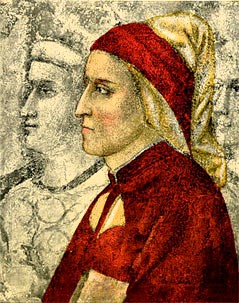
Personalities: 1 - Dante Alighieri


Dante Alighieri became one of Italy's most famous poets with his composition of the Divine Comedy.


In his youth he was a member of the Guelph party in Florence and fought as part of the avant garde at Campaldino.

Soon after, the victorious Guelphs split into two parties - the Blacks and the Whites - and eventually Dante was exiled.

When Henry of Luxembourg travelled to Italy to be crowned as Holy Roman Emperor, Dante wrote to him, demanding that the Black Guelphs ruling in Florence be removed. Henry did besiege Florence but Dante is thought to have left Henry's army, possibly to avoid attacking his home.
Wikipedia covers Dante's life in more detail:


http://en.wikipedia.org/wiki/Dante_Alighieri

You can read a roughly contemporary account of his life in Giovanni Villani's Chronicle

This is my figure of Dante (the one on the right of the photo).

The flag carried by his companion is the banner of Guelph Florence. The original flag, as later carried by Ghibelline exiles, had the colours reversed.
Figures are 15mm Mirliton.