Spartacus is one of the most well known figures of antiquity, perhaps as familiar to many as Julius Caesar. The Kubrick film is largely to blame although his story had entered the general public perception even before that through at least two novels and also via Karl Marx into the sphere of revolutionary politics. Within the last few years, the doubtlessly highly historical drama based on Spartacus has hit television screens and there has been a burgeoning industry in both fiction and factual books on the gladiator.
His whole career is covered in a variety of ancient sources but even then there are really very few words written about him in those books. Even adding in the other two major slave revolts, the information would cover a handful of pages. I'll put a list of the sources and some links at the end. Modern writers have expanded on this and tried to reconcile the sometimes contradictory statements with a greater or lesser degree of success.
I won't try to write a resume of the wars - there is enough online. I'll concentrate on what I did to build a 15mm wargames army for DBMM.
 There are times where the purchase of a new army creeps up on you in a number of insidious ways until, before you know it, you find yourself immersed in lead.
The next step was that my interest in the late Republic grew. I thought the slave revolts sounded interesting, but not very practical to get an army.
Soon after, we had a DBA competition at my club based around the late Republic. I had time, so I thought I'd give the slaves a go. After all, its only twelve elements - less than sixty figures. No problem.
I made a start on adding to the DBA army to get ready for a DBMM100 game although that was cancelled. Then I thought I'd get them done to play DBMM200. Before I knew it, I was suggesting to my doubles partner that we took a 500 AP army to the Burton doubles.
 That was in October I think. I already had a lot of the lead and added more to it, some of it due to Xyston bringing out more packs which I thought would mix well and partly to replace stuff I bought at Derby and promptly lost. Christmas should have seen plenting of painting time but I was struck low by various ailments so I was still basing and painting the week before the competition. It didn't help that on the final night, I checked the list and found I was a cavalry general short. I had suitable figures and managed to get him done, finishing the base at 6.30 in the morning before setting out for Burton!
The DBMM slave revolt list is split by period to represent the three major revolts, each being seen as having its distinctive features. Mine has been built for Spartacus's rebellion but I used some sources for the earlier periods for a but of inspiration.
The army is composed of, in DBMM terms, ex-slaves (horde superior), ex-slaves in Roman gear (blade inferior), gladiators and veterans (blade ordinary), shepherds (psiloi inferior), Gallic and German veterans (warband ordinary and superior) and cavalry (cavalry ordinary).
The Gladiators
http://www.livius.org/a/1/romanempire/gladiators_sIBCE_mus_munchen.JPG is an intersesting 1st century BC depiction of gladiators.
UPDATE: http://archive.archaeology.org/image.php?page=0709/trenches/jpegs/gladiators2.jpg is a fairly recently recovered 1st century BC frieze of gladiators.
For those who still want to use gladiator figures, there are some useful comparison figures of various manufacturers at Irregular Wars . He also has shots of various period civilians.
 For Spartacus and one of his sub-generals I used Xyston Gallic nobles. These are very animated figures though a little smaller than the Romans and some of their other figures and have been mounted on a bit of plastic card to even out the heights. There may be differences in the build of different men but you can hardly have Spartacus being towered over by his men. I've thinned the swords somewhat and made Spartacus's curved to represent a sica. This may well be (literally) poetic licence - Sidonius's poem written half a millenium later describes the use of such a sword. The figure is also carrying the small squarish shield of a Thraex - I cut it down from a Xyston Gallic oval shield. Florus (2.8.12) describes him as a murmillo though this could also be a literary fluorish especially as the name seems to have been used for the type known as the Gaul once that province had been pacified.
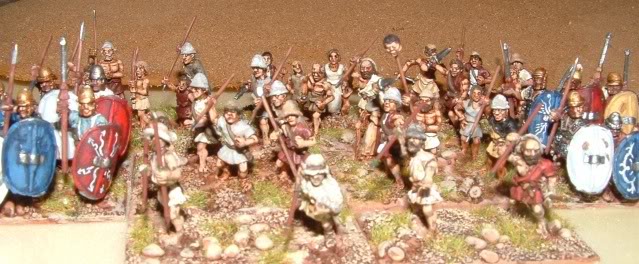
 The fighters accompanying them are Principes and Triarii from the Republican Roman range. I've taken off the feathers from the helmets. There are also one or two of the Carthaginian veterans in Roman armour. I've also used some lictors - "his men brought to their leader the insignia and fasces captured from
the praetors" (Florus). It helps to identify the generals from afar. One of the standard bearers has lost his hand in a previous fight (also known as a miscast).
The fighters accompanying them are Principes and Triarii from the Republican Roman range. I've taken off the feathers from the helmets. There are also one or two of the Carthaginian veterans in Roman armour. I've also used some lictors - "his men brought to their leader the insignia and fasces captured from
the praetors" (Florus). It helps to identify the generals from afar. One of the standard bearers has lost his hand in a previous fight (also known as a miscast).
 The rest of the ex-slaves with Roman gear are a mishmash of Xyston types. From the Roman range there are a few hastati (mostly with the armour painted out), accensi, rorarii and penal legionaries. There are some Greek hamippoi and a few peltasts in pilos. One or two are Gauls with the trousers carved off and the tunic slightly lengthened but I found this took too long to be worth the results.
 The shields are mostly a mix of the Xyston Roman shields, Italian scuta, Samnite shields and a few Gallic ovals. Some have been hacked about to give that 'one unlucky previous owner' look. There are pila holes in some though these can't really be seen and wasn't worth the effort. A few have been painted to look as if the leather outer layer has begun to fall off. Exactly what Republican Roman shield designs were is the source of much debate. I've used some patterns from the early Empire, a few inspired by a later painting of gladiators and some from a Republican monument. In some cases I have painted the same design but different colours. This may have been a way of distinguishing cohortes. Some are plain red with a yellow strip across the top or either side of the boss. I've imagined these as being local troops with a shield giving the name of their city. I have no evidence for this!
I wanted the warband to look different enough to be identified easily but still like recently freed slaves. There is a picture in the Osprey Spartacus book showing an attack by Crixus's Germans who look as if they have recently trotted over the Alps. I doubt that many would have had the time, the resources or the inclination to get themselves trousers made.
 These are from Xyston's Skythian range. They look very similar to the 'ancile' - the shield of Mars. There are shields of this type shown on the Munatius Plancus mausoleum which _may_ be Gallic going by some of the other equipment also shown. The best photos I've seen are in D'Amato and Sumner.
To increase the ease of identifying the elements and also for effect, I used quite a few velites wearing animal skins and put some dogs on the stands. More on this later...
 The ordinary warband carry round shields which again look as if covered in animal hides. "...small circular shields for themselves like those used by cavalrymen." (Sallust, Historia). They may not be rolling burning logs at the enemy but some are carrying torches to burn the property of the slave-owners or interfere with Roman fortifications. Most of these figures are either of the types of hamippoi from Xyston with a few others including some peltasts in pilos. While the felt or fur cap may be suitable for freed slaves (albeit these had freed themselves!) I had a go at converting a few by using greenstuff to give them helmets. Some are bit bulky but overall not too bad. There are also some scratchbuilt swords. My first go was to carve some out of plastic strip. These looked pretty good but it seems the superglue weakened them and they all snapped off. Instead, I squashed some wire and shaped the point.
The horde and shepherds are mostly Xyston psiloi with the odd figure from OG15s and Mirliton which I had lying around. There are also some of Xyston's more recent releases such as Numidians and Judaeans. A few have shields and I might get around to adding some more - I have lots spare. Many of the javelins have been left with a black point - Sallust says that initially the slaves used fire to hardened the wooden points of the javelins. Later on, stocks of metal allowed new weapons to be made to supplement those captured. Some of this iron may even have been the ex-slaves' chains.
The dead Romans are some from Freikorp. I bought these when they first came out so must be around 25 years old.


There is a description of them in one of the early wars as wearing wolf and boar skins, and being accompanied by fierce dogs. I decided that most of the more aggressive types could represent the warband - especially as Gallic slaves were favoured as shepherds. I had enough left over to mix a few into the psiloi though. My doubles partner also did a psiloi element with one shepherd and four sheep :).
 Spartacus had a cavalry force, much of which was mounted on horses which they had captured and
 broken. These wouldn't have been truly wild but some of the herds may have been effectively feral. Strauss puts quite a lot of emphasis on the effectiveness of these cavalry although the sources don't say a great deal. The figures are a mixture of Xyston Greeks and Judaean horsemen. Their Numidians would also mix pretty well.

The camp is protected by a palisade. One of the Stratagems describes how the slaves evaded one Roman force by propping up bodies with the camp, giving enough time to escape. This is Baueda's palisade.
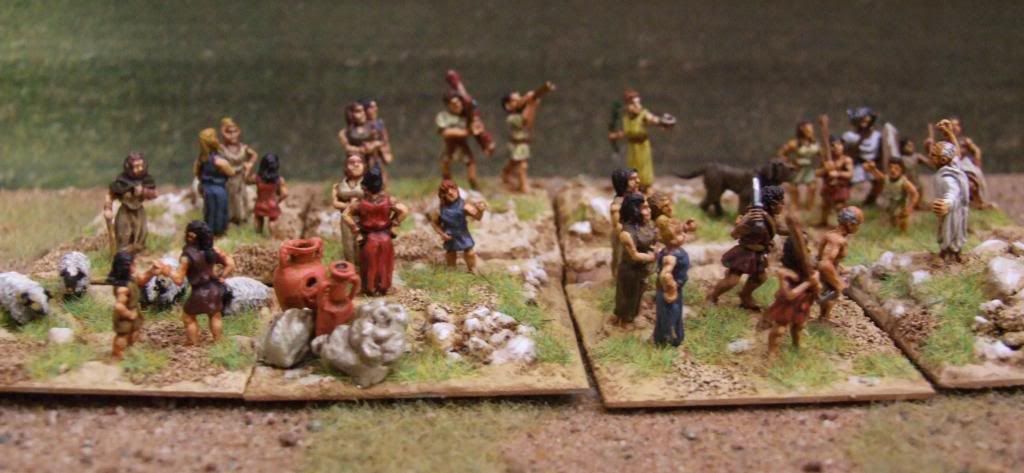
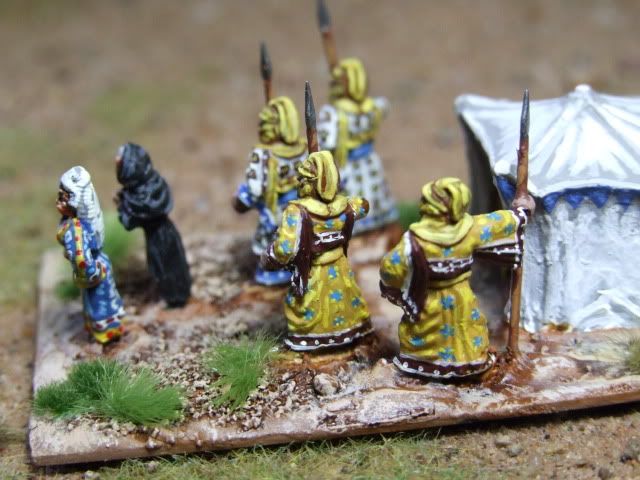
 This is the first camp I've done with a bit of a story. It also helped to use up most of the female and child figures which I'd managed to acquire.
 Spartacus's wife made some prophecies. Here she is bringing down the wrath of the goddess or of Dionysus on one of the slave-owning capitalists.
So far, the army has been used in five games, all at 500AP and against opponents that are moderately close in history. I really prefer historical match-ups but in competition you can't be so choosy. The strength of the army is its size. In some games we tried to be too clever which just ended up with commands being defeated in detail. Our best results were when we massed the troops, spreading the losses. The horde are quite effective against light troops - they are probably better against light horse and cavalry than the mass of blades since they don't recoil and if they are lost the effect is less damaging. One has to be careful not to end up putting them behind other troops who then die, so the wings need protecting with something else.

Sources:
Also from Attalus, the fragments from Sallust which aren't all included above






.jpg)