Showing posts with label crossbowmen. Show all posts

Sunday, 23 July 2017

Bohemians, Hungarians and Poles


I have been steadily replacing the pictures which were stored on Photobucket. I thought I ought to add a few new things.

Some time a year or so ago, I thought I would add a few things to my 13th century Hungarians so that I could use them as 15th century Hungarians.

The knights were obviously ought of date, so I painted some new ones. I needed some Serbians, so that was new lead. 
In fact, by the time I was finished, there was nothing from the 13th century army which was going to be used.

This post covers the infantry I used.


The best description of the 15th century Hungarian infantry is from Matthias Corvinus. Matt Haywood's useful site on Eastern European armies of this period has the information so I won't repeat it.

This sounds to me very like the Bohemians portrayed in action against Maximilian just after the end of Corvinus's reign. This has been debated on the DBMM and DBM yahoo groups in some depth so I won't go into the pros and cons.

Bohemians found their way into a number of armies after the end of the main Hussite Wars. There were various opportunities for these experienced soldiers in Germany, Hungary, Poland and with the Teutonic Knights as well as in their native land which was wrangled over by the neighbouring states and local rulers.

Even though I think these men probably fought in a similar fashion for these various employers, the DBMM lists portray them in different ways. 

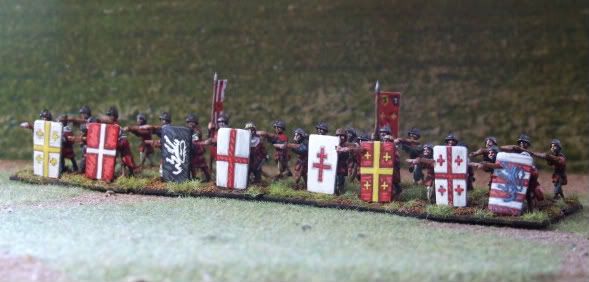
The Hungarian lists separates out the various parts described by Corvinus. The 'shield bearers' are spear elements. For these, I used Vexillia's own Polish pavise bearers. There are only two poses but it is enough IMHO. They are very easy to paint, with quite a lot of armour. 
The pavises are from Minifigs. Not only do you get quite a lot for your money but they have no stand to get in the way. The shield designs are a mix of Bohemian and Hungarian origin, including some from Maximilian's victory parade. Some have St George, St Michael or David fighting Goliath, though on the battlefield the designs are very hard to see.


Various pictures of Maximilian's battle at Schoenberg 
exist ncluding this: 

As well as the various engravings of Schoenberg (aka Wenzenbach or the Bohmenschlacht), Maximilian's tomb has an interesting representation. Maximilian and his men are shown in fashionable armour of some timeafter the battle but the Bohemian opponents are wearing more typical armour of the 1480s. The scene is dramatised but gives some idea of the variety of arms being used.
See here for another couple of portrayals of the battle as well as a discussion of the Hussite soldier (in German).


In the sidebar is a link to Uwe Tresp's work on the Bohemian soldier which covers their tactics, weaponry etc. through the 15th century.


The 'MM list also has some Blade elements. I'm currently using some of the Polish figures from QR miniatures which are part of their 13 years war range. The figures are pretty good though rather chunky compared to the Vexillia figures. Some of the other figures have what looks like a goedendag but I suspect it is an ahlspiess as shown on Maximilian's tomb. The QR figures may get replaced - I have a variety of Minifigs figures which match the size of the Vexillia figures better, and despite being old they have some character.

 The Polish, Hussite and German lists all have double based BwX with Bw behind. They appeared in the German and Hussite lists for the first time with the current edition and it caused a problem - they had inferior bow as a rear rank which isn't according to the rules. As it isn't clear what would happen in various circumstances, the tournament organisers have generally decided that they will cost and act as BwX/BwO. (Update: the DBMM lists printed by Lulu have altered the classification in this way).
For those unfamiliar with DBx terminology, BwX usually represents a thin crust of shield bearers with some kind of melee weapon protecting larger numbers of shooters.

As I had already painted the late 15th style pavises for the Hungarians, I decided to go with more straightforward heraldry for these. I could have made some sabot bases to turn the spear into the front rank of the BwX but decided to go the whole hog.

The shield devices are city militia devices according to the very nice sheets of Polish and Teutonic heraldry like here.
They have been made for the Tannenerg/Grunwald period whereas these figures are mid to late 15th century. Some are for towns which rebelled against the Teutonic Knights, allying themselves with the Polish king. In contrast to the rather busy designs on the later pavises, I used red and white designs almost exclusively.

The painting of the Battle of Orsha shows Poles using a pavise and shooter combination in 1514. There are some debatable points about the accuracy of the painting but it is good to look at anyway.


 I know comparison photos are often useful.
These are handgunners - from the left:
QR - QR, Mirliton - Donnington NE, Donnington NE - Mirliton.

The final Mirliton figure is noticeably smaller than the other figures which it came with. I think it was made for the Condotta range which has slightly smaller figures than the Swiss-Burgundian range.
 Crossbow men -
from the left:
Vexillia-Mirliton, QR - QR

Thursday, 2 September 2010

Flemish Crossbowmen and Knights


Common to a number of Low Countries cities were the guilds of crossbowmen - the Guild of Saint George. They were separate from the trade guilds and are shown in the Leugemeete fresco. There is still a Guild of St George in Ghent which has a nice bit of background.
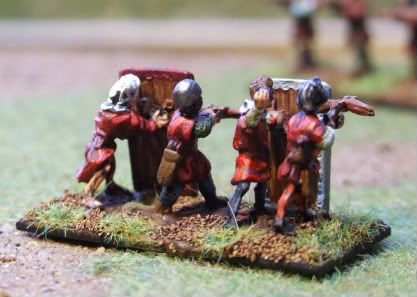
 As mentioned in this link as well as various other places such as Verbruggen, de Vigne and de Liebaart, the crossbowmen were accompanied by 'boys' who carried the pavises at a ratio of two crossbowmen to one pavise. The current draft of the DBMM Book 4 list covering the Low Countries actually suggests basing them in this way after a couple of us mentioned it on the DBMMlist.  I suspect that this ratio may have been common in Europe at the time in the period following the adoption of the pavise. David Nicolle's essay on the Genoese at Crecy suggests that the pavises left behind would have been carried by pavise bearers rather than on the back of the crossbowmen as often portrayed following a late 14th century picture.  I don't know of any evidence that the Low Countries bearers had any form of spear - certainly at the various battles where the Fleemish crossbowmen are mentioned they withdraw rather than facing hand to hand combat, suggesting a lack of defensive weaponry.

 I did try out two crossbowmen and one pavise per base but the effect was a bit sparser than I liked. It would really look best, I think, with a deeper base and one firing and one loading crossbowman per pavise. An Impetus or similar sized base would be a good place to do this, or a double depth DBMM base. After a bit of experimentation I decided to have a rank of bases with pavises and another without, giving a ratio of three crossbows per pavise.

 I spent quite a while looking for figures suitable for the pavise bearers. I actually converted a couple of Khurasan's Swiss halberdiers and would have used these but when I ordered some Welsh spearmen (bearer on the right if this picture) from Donnington I thought the pose and clothing would fit quite nicely.

 I hoped to have finished them for Britcon but ran out of time. This was quite good though, since I bought some Donnington peasants and some of those also made good bearers. 
 The figures wearing a hood actually come wielding a polearm in two hands in a sort of baseball pose. I cut off one arm and built another using green stuff in a pose as if the bearer is holding the pavise to his left.


The crossbowmen are mostly Donnington with some Touller figures, including the flag bearers. another factor which influenced my choice of basing was that I had exactly the right number of crossbowmen unpainted to do it this way, as long as I used the standard bearers.


The pavises show a mixture of arms, including those of Bruges, Ypres and Ghent.  The others are those of Guilds of St.George from various cities as well as those of Guilds of St. Sebastian. This was thoeretically a guild of archers although the fresco showed them with the same mix of weapons as other guildsmen. However I used a bit of licence and included some of their shields as I had the details and liked them.

To finish off my pictures of Low Countries figures, here are some knights. First of all mounted:


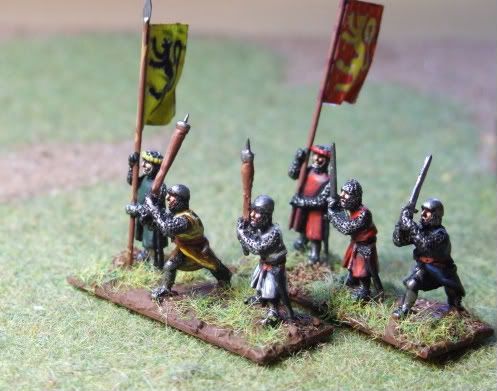
The general is marked with a flag and represent Jan de Renesse, a nobleman from Holland who led the forces at Kortrijk - possibly he was experienced. For the other knights I used a variety of arms from the Gelre armorial and Rietstaap as well as a book of seals of 13th century Low Countries knights. I wasn't too careful about whether they had fought for or against the French though - time was pressing and the details were sketchy; sometimes I had names but no details of arms. The arms of the burghers or patrician class were even harder to come by for the 14th century. A few are mentioned such as de Conninck's and, for a later period,  van Artevelde's but I couldn't be sure of many others. The regulations have survived which show the expectations of these 'nouveaux riches' as far as equipment goes - the two richest classes were to have armoured horses as well as the rest of the men-at-arms' panoply.
 Some of the Donnington knights come with a bird crest  - I adapted some of these by cutting or adding Green Stuff so a few have the crest shown in the Gelre Armorial. Wearing crests in battle was becoming rarer as the 14th century progressed but I kept a few as traditionalists or show-offs.
The figures come with smaller shields than this but I got some of the slightly larger ones - partly as it made painting easier.

I have already posted some pictures of Old Glory dismounted knights but I also have some more specifically Low Countires ones. They are figures from Mirliton and IMO some of their best. They are actually designed for a period earlier than the mounted men-at-arms which I used but they match the figures on the Kortrijk chest pretty nicely apart from the ailettes. To get the real Low Countries look, I have converted some to carry gepinde stafs (or whatever the plural is!) You can see the unconverted ones alongside the converts. The staves were made from a dressmakers pin with a covering of greeen stuff or Milliput. Once I knew what I was doing they could be made pretty quickly. Note that I also put a Milliput cerveilliere on one of the knights as shown on the Chest. Overall, I think the central figure gives a nice effect of the picture I have linked to before

Tuesday, 28 July 2009

Crossbowmen comparison

Here are some painted 15mm crossbowmen.


The stand on the left is Black Hat and Touller, the next stand is Essex and the stand on the right is Mirliton.


This is a close up of the Black Hat and Touller figures. They mix well, including the crossbows which are different styles in the other makes. The outer two are Black Hat, the centre two are Touller


One of the distinctive features of Italian warfare was the wide use of pavesarii, shield bearers protecting the crossbowmen behind.


These are Mirliton figures. The Mirliton figures with pavise, CO11, are the same as the 'Assorted infantrymen' CO10. I decided to replace these with the ones attacking with lanze longhe - CO12.

The pavises were marked in the colours of their state. http://www.heraldica.org/topics/national/tuscany.htm has some information from Villani. Much of the information is in Italian - unfortunately for me only some of Villani is easily available in an English translation.

Before the Battle of Campaldino, the shortsighted Bishop of Arezzo is said to have asked "Whose walls are those?" receiving the reply that they were the enemies' shields. Dino Compagni's account is here

If you can get access to a copy of Sercambi's illustrations they are chock full of examples of painted pavises. They are from the later 14th century but are still useful. My local university library has a copy.

Incidentally, David Nicolle says that the Genoese at Crecy had spear-carrying pavisarii with them and that it was their pavises which were left with the wagons. His essay is here
I haven't read much about Crecy, so I don't know how secure this idea is.

Tuesday, 14 July 2009

Figure Comparisons: 15mm Crossbowmen

A lot of threads on various sites ask about comparative sizes of various makes of figures and whether they would work together.
There are some good sites around but I thought I'd do a few comparisons of my own with my narrow focus.
First up are crossbowmen - unpainted to begin with.


Left to right on each row: Black Hat, Alain Touller, Mirliton, Donnington, Legio Heroica

The last two are a bit heftier than the others though part of the LH height is due to the helmet. I have mixed Black Hat and Touller figures on the same stands - and I'm pretty fussy about such things :)
The LH figures are from the Crusades range, representing late 12th century, as I ordered the wrong codes. They'll find a good home somewhere though.

I have some Essex crossbowmen too, though none unpainted. I really like the look of the Vexillia ones though they are designed for a later period so only a few have the right headgear for the period I'm looking for. I shall keep my eye on the Khurasan Swiss range which is in progress to see if crossbowmen are included as these should fit.

I'll try to get some pics of painted crossbowmen figures soon.