
This is my 15mm King of Aragon. The figures are Alain Touller with two Mirliton horses.
James I - the Conqueror, was king of Aragon through most of the 13th century. Much of his fighting was against various Muslim states, including the conquest of Mallorca and campaigning in Murcia. His life is covered by a chronicle which he authored (no doubt with the aid of a ghost writer). This is an excellent read. It is available on-line
here.
He was succeeded by Peter III - the Great. He fought against rebellions at home and then led an expedition to reinstate Aragonese suzerainty over Tunis. From there, he led his army to Sicily to fight against Charles of Anjou. Peter was given a large sum of money by the Byzantine Emperor to assist this endeavour - Charles had set his sights on taking Constantinople to re-establish the Latin Empire.
At one point the two kings agreed to end the war by a duel in Bordeaux, though only Peter turned up.
The Pope excommunicated Peter for his invasion of Sicily and, declaring him deposed, a Crusade was called. This involved a huge French invasion of Peter's territory. Initially successful, the Crusade collapsed into a rout due to disease and the defeat of the French fleet.
On Peter's death, he left his Spanish possessions to his son Alfonso III and Sicily to another son, James.
Peter and Charles of Anjou are both placed by Dante outside Purgatory, singing in harmony.
Alfonso conquered Mallorca from his uncle (another James) and then Minorca from its Muslim ruler. His six year reign ended with his death at the age of 27. Dante placed him at the foot of the mountain of Purgatory with the inefficient rulers.
James of Sicily inherited the Kingdom of Aragon. In order to achieve peace with the Angevin Charles II, James agreed to give Sicily to Charles. The Sicilians disagreed and made James' brother, Frederick, king. James briefly made war on his brother which largely took the form of naval actions - James was even appointed Captain-General of the Papacy. As a further inducement, James was given Corsica and Sardinia - even though these were not in the Pope's control.
Dante is not complimentary about the Aragonese kings of Sicily
That book will show the greed and cowardice
of him who oversees the Isle of Fire,
on which Anchises ended his long life;
and to make plain his paltriness, the letters
that register his deeds will be contracted,
to note much pettiness in little space.
And all shall see the filthiness of both
his uncle and his brother, who dishonored
a family so famous—and two crowns.
Paradiso, 19
Ferdinand IV is also criticised in the book of bad deeds, for his "life of treachery and ease."
Various chronicles cover the reigns of Peter and James. The most complete one available in English online was by Muntaner, available
here. It is also a valuable source for the Catalan Company which campaigned in Byzantine lands. Others include ones by Desclot and San Juan de la Pena, though I don't know of any complete English versions of these online.

This is my representation of Don Enrique of Castile. Figures are Alain Touller.
He was a younger son of Fernando III of Castile. He fought against his brother, Alfonso X, and although initially successful he was forced into exile in England. After three years he had to leave and went to Aragon. He conquered the small Moorish Kingdom of Niebla but was again induced to leave Spain. He worked as a mercenary for the King of Tunis and then went to Italy.
There seems some disagreement as to whether he joined Charles of Anjou in time for the battle of Benevento. He certainly received the post of Senator of Rome. He considered this insufficient repayment for his support of Charles and joined Conradin's invasion, providing Spanish and Roman forces. He was in the successful van at Tagliocozzo but fled when the apparently victorious army was defeated.
He spent the next 23 years in prison and may have written the poem 'Amadis'.
For wargaming he is a most useful figure, being suitable for Castillian, Aragonese, Hafsid Berber, Medieval German and possibly Charles of Anjou's French armies.
I found his arms using Wikipedia, so I hope they are accurate! I used the same style of arranging the quarters as on this picture of Alfonso X
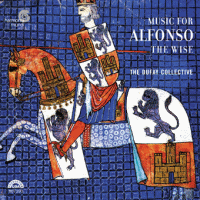
(Picture from
here)
Note the purplish hue to the lions and the cross on Enrique's flag. Even the modern Spanish arms should have a lion in
purpure but they are often shown in red. The actual original colour of purpure is debateable and even the above picture probably shows a change due to time. A pruplish red is probably the safest bet, though I've used a more (probably inaccurate) lilac colour on Enrique's flag
I have also painted a Castilian king but the photo is too blurred to use. Another time perhaps!
The following pictures show a variety of types of flags in use by Spanish forces. All are 13th century.

Fresco from
here

From a fresco depicting the conquest of Mallorca. The
senyera - the Catalan flag - is fairly unusual in that the bars are horizontal on the flag but vertical on shields. This shape is also unusual. A similarly shaped flag from the period still exists in
Valencia. The description says that the yellowing is due to age, which seems odd when so many flags are depicted with a yellow field. The conquest pennon has probaly lost a longer tail as on the above picture.
The most common, and traditional, portrayal of the flag is with 4 red pales but as can be seen this was not always adhered to.

A nice picture which not only shows flags and bards of Castilian knights but also some early
jinetes. I'm planning to get some suitable figures by Essex at the weekend.
(EDIT: Seems these are actually Muslims who are fighting alongside the Christians - the two were allied at the battle depicted. They may still be a guide to how early jinetes looked if raised from e.g. mozarabs).

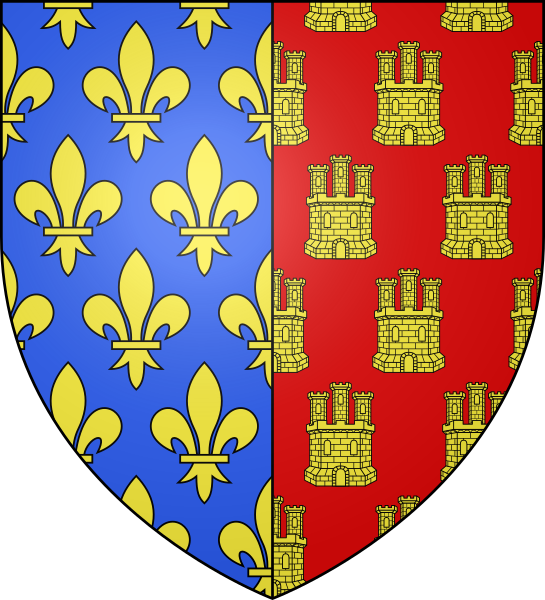

 Alphonse's seal shows how the arms were portrayed on the caparison - France at the front, Castile at the back.
 Alphonse was married to the heiress of the County of Toulouse and when his father in law died, Alphonse gained control of the county. This shows an interesting banner with the arms of Toulouse added to those of Alphonse, each portion of equal size.
.jpg)
