Showing posts with label Hungary. Show all posts

Wednesday, 9 August 2017

Hussite War Wagons


War wagons are one of those things I've often wanted but had shied away from for many years. I think I bought the first of these at a show where there wasn't much else I wanted, so I got them just because they were there.

It is possible that the use of this kind of converted wagon first started in Poland and then spread to Bohemia where they were used to great effect in the Hussite Wars. They were then adopted by Hungary and in Germany, with similar types being used in Russia.

Below are some of the wagons I have. The crew is a real mix. There are figures from Donnington, Khurasan, Minifigs, Irregular, QR, Vexillia and Mirliton. The Donnington peasants are particularly useful, with very Bohemian style clothing (15th century - not 1950s Greenwich Village).

Irregular
Some of the wagons have a crew which looks more professional which I use for the later 15th century such as the Hungarians.


These are the two styles of wagon from Irregular Miniatures. The wagon itself is the same in each case - the separately cast side planking is the difference. I think the style of planking is randomly provided.

They also do a wagon of the same style which comes with a small artillery piece.
Irregular

I have more Irregular wagons than any other, with enough to have some shooting to the left and some to the right.

Note the stone thrower - the wagons often had containers filled with stones for bombarding the enemy. Some other wagons have the stone throwing Swiss figures from Khurasan in them.


Alternative Armies

This wagon is from Alternative Armies (until recently sold as 15mm.co.uk and originally by Tabletop Games).

The wagons require more construction than the Irregular pieces. The sides of the actual wagon are separate but come with different options including the open ramp for one side. They come with horses but I decided to do them in a static pose.
It took a while to work out how to get everything together but once it was cleaned up of flash etc. they went together quite smoothly.


Alternative Armies (rear view)


This one has an artillery piece from Minifigs deployed alongside. The gunner is from QR, the shield bearer from Irregular.


 It also comes with a small section to go under the wagon - I haven't put these in as they are difficult to see but perhaps I will get round to it one day.

Minifigs


The Minifigs wagon has a one piece body with separate side hoarding. It is also provided with the under cart protection. It comes with two pairs of horse but I used Irregular horses for all the wagons.
The body of the examples I had from Minifigs needed a bit of tidying up including some filling but nothing too onerous


The comparison picture shows that the three companies go together pretty well. Each of them has its pluses and minuses. The Alternative Armies one, while tricky to put together, is probably the most accurate with its ramp and the suspension poles. It also doesn't have a driver's seat - the driver would probably have ridden one of the horses. However, the modern recreation at the Hussite Museum in Tabor does have a box for the driver to sit on.

I also have some by QR miniatures. These are much smaller though still pretty nice. Each pack has two wagons - one is dug in with its wheels partially buried.

Museum have fairly recently produced a range of war wagons. These look nice, and follow several modern reconstruction. However, I'm not convinced that the modern artists have interpreted the sources well - hinged side panels have become propped up roofs.

There are some very pretty war wagons on various websites, whereas I have gone for the plain wood look. This is based on contemporary pictures such as the Schlact im Walde* and the picture at the head of this blog.

What I will need to do is to add flags to some of the wagons. There are specific designs for different parts of the Hussite army. Since I have rather a lot of wagons, I may add some Hungarian heraldry to a few, as in Győző Somogyi's book on the army of Matthias Corvinus.

There are some clips online from a trilogy of Czech films made in the 1950s covering the Hussite Wars, There is certainly a political dimension to them, but the efforts to get a historical look are laudable. This is a clip of the Battle of Sudomer which has some good shots of war wagons. Note also the teams of unarmed pavise bearer and crossbowman. The music chosen by this editor may not be to everyone's taste :)


Wagner, Drobna and Durdik's book on Medieval Costume, Armour and Weapons has a particular emphasis on the Bohemians and shows several good pictures of wagons. Worth looking at, despite its age.

Much newer are the pair of books on die Heere den Hussiten. The plates aren't as interesting as the same company's book on the Teutonic Knights, so if you are not a German reader then I wouldn't recommend them.


*A wonderful source for the late 15th/early 16th century in Germany. One thing it shows is the wagons moving around the field, but how typical this was and how much is artistic licence is of course debatable. This and two subsequent posts give more details of the battle. A short account by von Berlichingen is here - this confirms that the wagons were attacked while still trying to form a wagenburg.


Sunday, 23 July 2017

Bohemians, Hungarians and Poles


I have been steadily replacing the pictures which were stored on Photobucket. I thought I ought to add a few new things.

Some time a year or so ago, I thought I would add a few things to my 13th century Hungarians so that I could use them as 15th century Hungarians.

The knights were obviously ought of date, so I painted some new ones. I needed some Serbians, so that was new lead. 
In fact, by the time I was finished, there was nothing from the 13th century army which was going to be used.

This post covers the infantry I used.


The best description of the 15th century Hungarian infantry is from Matthias Corvinus. Matt Haywood's useful site on Eastern European armies of this period has the information so I won't repeat it.

This sounds to me very like the Bohemians portrayed in action against Maximilian just after the end of Corvinus's reign. This has been debated on the DBMM and DBM yahoo groups in some depth so I won't go into the pros and cons.

Bohemians found their way into a number of armies after the end of the main Hussite Wars. There were various opportunities for these experienced soldiers in Germany, Hungary, Poland and with the Teutonic Knights as well as in their native land which was wrangled over by the neighbouring states and local rulers.

Even though I think these men probably fought in a similar fashion for these various employers, the DBMM lists portray them in different ways. 

The Hungarian lists separates out the various parts described by Corvinus. The 'shield bearers' are spear elements. For these, I used Vexillia's own Polish pavise bearers. There are only two poses but it is enough IMHO. They are very easy to paint, with quite a lot of armour. 
The pavises are from Minifigs. Not only do you get quite a lot for your money but they have no stand to get in the way. The shield designs are a mix of Bohemian and Hungarian origin, including some from Maximilian's victory parade. Some have St George, St Michael or David fighting Goliath, though on the battlefield the designs are very hard to see.


Various pictures of Maximilian's battle at Schoenberg 
exist ncluding this: 

As well as the various engravings of Schoenberg (aka Wenzenbach or the Bohmenschlacht), Maximilian's tomb has an interesting representation. Maximilian and his men are shown in fashionable armour of some timeafter the battle but the Bohemian opponents are wearing more typical armour of the 1480s. The scene is dramatised but gives some idea of the variety of arms being used.
See here for another couple of portrayals of the battle as well as a discussion of the Hussite soldier (in German).


In the sidebar is a link to Uwe Tresp's work on the Bohemian soldier which covers their tactics, weaponry etc. through the 15th century.


The 'MM list also has some Blade elements. I'm currently using some of the Polish figures from QR miniatures which are part of their 13 years war range. The figures are pretty good though rather chunky compared to the Vexillia figures. Some of the other figures have what looks like a goedendag but I suspect it is an ahlspiess as shown on Maximilian's tomb. The QR figures may get replaced - I have a variety of Minifigs figures which match the size of the Vexillia figures better, and despite being old they have some character.

 The Polish, Hussite and German lists all have double based BwX with Bw behind. They appeared in the German and Hussite lists for the first time with the current edition and it caused a problem - they had inferior bow as a rear rank which isn't according to the rules. As it isn't clear what would happen in various circumstances, the tournament organisers have generally decided that they will cost and act as BwX/BwO. (Update: the DBMM lists printed by Lulu have altered the classification in this way).
For those unfamiliar with DBx terminology, BwX usually represents a thin crust of shield bearers with some kind of melee weapon protecting larger numbers of shooters.

As I had already painted the late 15th style pavises for the Hungarians, I decided to go with more straightforward heraldry for these. I could have made some sabot bases to turn the spear into the front rank of the BwX but decided to go the whole hog.

The shield devices are city militia devices according to the very nice sheets of Polish and Teutonic heraldry like here.
They have been made for the Tannenerg/Grunwald period whereas these figures are mid to late 15th century. Some are for towns which rebelled against the Teutonic Knights, allying themselves with the Polish king. In contrast to the rather busy designs on the later pavises, I used red and white designs almost exclusively.

The painting of the Battle of Orsha shows Poles using a pavise and shooter combination in 1514. There are some debatable points about the accuracy of the painting but it is good to look at anyway.


 I know comparison photos are often useful.
These are handgunners - from the left:
QR - QR, Mirliton - Donnington NE, Donnington NE - Mirliton.

The final Mirliton figure is noticeably smaller than the other figures which it came with. I think it was made for the Condotta range which has slightly smaller figures than the Swiss-Burgundian range.
 Crossbow men -
from the left:
Vexillia-Mirliton, QR - QR

Wednesday, 29 August 2012

Hungarians of the 13th Century

A few months back, I decided to have another go at finding some of the heraldry for the Kingdom of Hungary in the 13th century. My lack of any knowledge of Hungarian was a bit of a problem and it seemed that there was precious little available online in English although I did find a few coats in wikipedia.

In Pal Engel's book there were a few references to heraldry which made it clear that it had begun to emerge in the kingdom soon after it appeared in Western Europe. Armed with a few names, I eventually found some information. It turns out that the Hungarian for coat of arms is cimer from the French cimier  meaning crest. The arms belonged to a number of gens (clans - nemzetseg) and I think that various members of the clans would bear the same arms or close variations. Here is a potted history of some of the clans. One reason for this different approach is that society developed very differently in Hungary compared to Western Europe although some aspects of feudalism did appear especially under the Angevins in the 14th century.

The most useful site I found was here. I concentrated on those labelled nemzetseg  as most of the entries are civic. Even without any knowledge of the language it was possible to use dates to narrow down the arms I wanted to use. There was quite a change in the style of arms into the 14th and 15th century, so I tried to make sure I used the arms from this earlier period. I saved these as a word document so that I could refer to it during painting. Even with this site, I have likely made some errors.
Support for some of the arms comes from the Gesta Hunnorum et Hungarorum of the late 13th century. The author included a discussion of where some of the non-Hungarian familes had originated, many of which were German. In many cases the arms are described.


By the 13th century, there were increasing numbers of people who held land within Croatia and Hungary proper so I have included a few Croatian arms. I did intend to keep them on the same base but messed up! Here is a site with some background to Croat heraldry.

The King. I don't think I found a specific example of both sets of arms being used together, so a bit of poetic licence.
(EDIT - I rememeber now - the Chronica Pictum does show this combination though it may well be anachronistic. See here

Centre figure is OG15s flanked by two Mirliton figures.


Hont-Pazman, Buzad-Hahot, Jak
Keglevic (Croat), Hermann ('Saxon'), Kaplony 


Ratold, Gutkeled (both probably 'Saxon')


Gundulic (Croat), Doroszma, Subic (Croat)


Kacsics, Vaja, Boksa


There are a few alterations to some of the figures. The Vaja figure is a OG15s. It comes with quite a tall helmet which I didn't much like, so this was cut down and changed to form an early form of face mask helm. The same figure was used for Doroszma but this time the entire head was removed and replaced with a Minifigs helmet. The rest of the Minifigs figure was a bit small to fit the style of the other figures but this magnificent crest needed to be put to use. I have a couple of others which are likely to end up being used elsewhere, probably as Poles or the King of Bohemia. The Hermann figure has also had a Minifigs head grafted onto an OG15s body. The shape of the helms makes them ideal candidates for transplants, with enough room to drill a hole and insert a small piece of brass rod to keep the head secure. 

For some background reading, there is a list of sources here . This mainly focuses on the 15th centry, so I would add the chronicle I mentioned earlier and also Hungary in the Thirteenth Century . I managed to look at both of these at my local University library. The latter book has a reasonable amount of military detail including some about the first Mongol invasion.


Friday, 20 January 2012

Magyars

As with various other projects, these started largely because I bought a couple of packs just because I liked the look. I was spurred on because I didn't have a suitable army for Warfare 2011, the theme for DBMM being the 'Horrible Huns'.
I decided to use the figures to form an Early Hungarian army which covers the period from the foundation of the kingdom until the Mongol conquest. The competition only allowed armies until 1150 so this directed me to the style of heavy cavalry to paint.

Unlike the slightly later period I have concentrated on, the amount of source material is pretty scanty for 11th century Hungary. There is the Chronicum Pictum - see the picture on the right - which shows events from the early kingdom, but this is actually 14th century. It does, however, show various figures in top coats and is some guide to reasonable colours.

For the mass of the Magyar horsemen I used these figures from Donnington's New Era range.
The shooting archers are 'break waist' allowing a nice range of poses. It means you can get a lot of movement on the bases.


Pechenegs formed a part of the army from before
the foundation of the kingdom. They may possibly have been settled by the kings in colonies to help to maintain royal control. A paper called 'Pechenegs, Cumans and Iasians' gives some interesting background if you like the academic detail - it is available on scribd but I'm never sure of the copyright status of such things so won't link to it!
These are the Donnington Pechenegs. The beards are supposed to have been a particular feature of these tribes. Again, some of the figures are break waisted.


I also have a few of the Donnington 'Bulgar' figures. Over time, the costume of the Hungarians became similar to this - in fact you can see elements of what would become the traditional hussar outfit. You can see this outfit in such as Mirliton's later period Hungarian cavalry.
This shows some Bulgarians facilitating the martyrdom of some Byzantines. Other pictures from the same period show other trouser colours incluidng red. The Donnington figures have these long trousers but I decided to keep the look similar to the Magyars and painted them as if tucked into longer boots.

This shows Donnington figures compared to Black Hat figures including one of their Hungarians. I used my Black Hat figures - mostly a mix of their Cumans and Hungarians - to stand for the Szekelers in the Hungarian army.
The figures are a pretty good match for size and style.


These are the Donnington cavalry. I use them for the traditionally armed heavier cavalry. I like the
figures though perhaps a couple of different armoured archers would help with variety. The bowcases are separate and I'm afraid I left them off most of the figures.
The horse tailed banner was used by the Magyars and other steppe origin armies. They seem to have continued to use them for a while after occupying what became Hungary.

The first king of Hungary, Stephen I, was helped in his struggle for leadership by Germans. Bavarians provided the bulk though over the next couple of centuries the origin of these troops became more varied; they were know as 'Saxons' though there origin was from various parts of Germany, especially the Rhinelands. There were also Flemish, French, Spanish and English immigrants.
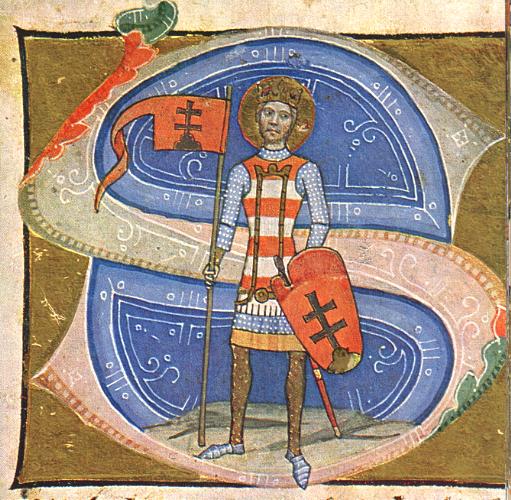
This later portrayal of Stephen shows the apostolic cross which was sent to him by the Pope. It is debateable whether he used this as his arms - this was before true heraldry. It does form part of the modern arms of Hungary and Slovakia. The stripes may date back to this period, being replaced as the main symbol by the cross but later returning to pre-eminence.

This is my first go at a Hungarian general, carrying the striped flag and shield. The three figures on the central base are part of the Donnington Norman range. The figure on the left wears a helmet which is shown in the Osprey book on the Normans though he is supposed to be 12th century. I think he looks better as a semi-westernised Hungarian. The bird is the earlier, re-Christian symbol of the Arpad dynasty.


The possibly 11th century Legenda Maior of St Stephen* says that  he carried the banners of St George and St Martin (...sub vexillo Deo dilecti pontificis Martini Sanctique martyris Georgii ducibus...) against his pagan uncle. I decided to paint one in a Byzantine style since there was some influence from there despite Stephen adopting catholicism. This can be seen in the decoration of the crown known as St Stephen's (which is fairly likely to post date him).
I already have a banner of St Martin on some of my Ghibelline cavalry, so I decided to do St George. There seem to be two traditions - one is the familar fight against the dragon but there is also a more portrait style which I decided to use.

The red cross on the shield may be from a slightly later period.

The figures are from QR Miniatures, a Polish compay which has lately added a couple of Early Medieval ranges. These are the Early Polish and Eastern Franks which can be bought as complete DBA packs. I only bought the cavalry. These are the East Franks and I thought they gave a nice mix of style representing the transition of gear. The previous picture shows that they mix pretty well with Donningon. The style of sculpture is slightly more basic than some other recent ranges but I like them and there are some great poses. The Poles are not quite so well posed but there are some very nice figures amongst them. The middle figures of each of these bases is from the Polish range - the pointing 'general' on the left is particularly nice.


*Incidentally, St Stephen is, amongst other things, patron saint of brick layers...