Showing posts with label Venexia. Show all posts

Monday, 31 July 2017

Stradiots, Hussars and Genitors


There was a parallel development of light cavalry at opposite ends of Europe which reached its height as the 16th century began.
The roots were, of course, far older. In the East, there was the steppe tradition which had come into Hungary and its neighbours many times. As Hungarian society changed, the number of locals who could provide skilled light cavalry began to decline. However certain regions and sections of society maintained their traditions for longer, in part due to the influence of the Tartars to the east and increasingly the Ottomans to the south.


These are QR Miniatures from their Polish late 16th century range. They look very similar to the illustrations of Hungarian horse archers from the late 15th/ early 16th century in the Army of King Matthias  so I have used them for these. A couple in the pack are armed with firearms so I have not used those. Others have cartridge boxes on their backs which I could have tried carving away but they are easily overlooked. 


These are QR Miniatures Serbians. Serbian cavalry entered Hungarian and then Polish service as their homeland was occupied by the Ottomans. Their style influenced the local cavalry, with the use of a lance being emphasised instead of a bow or crossbow. One of the theories for the origin of the word 'Hussar' is that it comes from Serbian. Over time, 'Serbian' may even have been a description of the style of cavalry rather than being a reliable indicator of the origin of all the men.
The figures seem to have been based very much on the Polish hussars in the Battle of Orsha painting*. Link has a number of close ups - I've shown a detailed view of the hussars at the head of this page. Also in the painting are similarly dressed figures who have bows as well as lances. They are likely Lithianians, though the green flag may originally have been blue.


The flag I have given them is Hungarian from here - it was a style carried at Mohacs in 1526.
These are some of my favourite figures.


These are some figures from the 'By Fire and Sword' range. Again, they are intended for a later period than I am modelling, so some have holsters on their horses. A bit of chopping and painting soon hides them though. These are from the 'Transylvanian' range. Most are actually sold as Szekelers so that is what I am using them as. They are quite similar to the Hungarians shown in the Babenberg family tree. I wonder if the blue trousers are significant - they seem to be increasingly a feature of Hungarian military wear until they became a standard part of the uniform in the 18th century.

These figures would probably work as Moldavians and Wallachians as well, and perhaps Lithuanians if they are not as dolled up as the ones in the Orsha painting.


A comparison shot of the QR Serbians with BFaS Szekelers. Since they are likely to be unfamiliar to many, I've put a comparative Essex element next to them.


Apart from the comparative Essex figures, these are Stradiots - those in the centre element are from Venexia, those on the right are Mirliton. All the Stradiots are mounted on Vexillia horses - some have had the Eastern style rump covers added.

Stradiots were recruited by the Venetians in their territories across the Adriatic. They were initially Albanians though their name is probably Greek. This has a selection of pictures of Stadiots and Hussars - there is often argument about which are represented in certain pictures.

For a while, the Venetians paid them according to the number of heads taken (see Commynes), so some of the horses have Xyston severed heads hanging from the saddle.

More stradiots and/or hussars can be found in Maximilian's Weiss Kunig including plates 75, 77, 82 and 83.

The role of stradiots and Albanians in war can be seen in various contemporary histories such as Chalkokondylas, Bembo and Commynes


Most of Western Europe used little or no light cavalry for most of the Medieval period. The main exception was in Iberia. The conditions, the Morish influence and the availability of suitable horses meant that the use of light cavalry continued through the reconquest and beyond.

These are mostly Donnington New Era figures from the new Islamic range and I really like them. There has been a lot of attention to detail, using mostly Ian Heath's pictures I think. These in turn are based largely on the 'Conquest of Majorca' and the 'Cantigas de Santa Maria' . There are many other examples here.
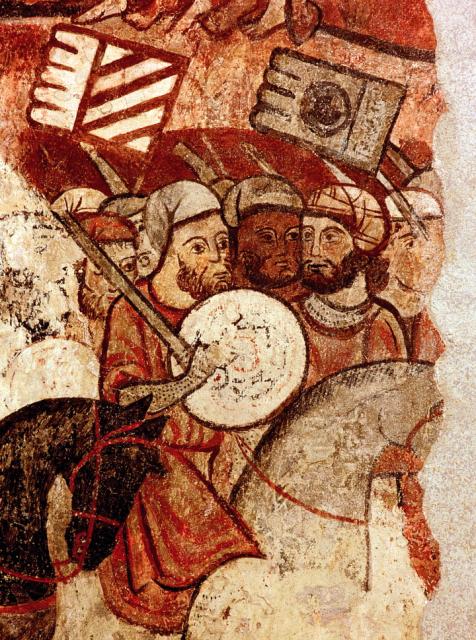


Berber horsemen continued to look very similar over the next centuries as can be seen in the Conquest of Oran.

The same picture shows how the Christian Spanish had changed by this time.


This shows the Essex Andalusian horse next to jinetes of the 14th century and some from the late 15th/early 16th. Even by the 14th century the equipment had become heavier. The middle figures are by Alain Touller, those on the left by Venexia (though on Vexillia horses). Both ranges are unfortunately OOP. [Update: Venexia are available from Lancashire Games. Vexillia are now OOP though].


*Watchers of BBC's Being Human may remember that Orsha was where Hal made his, umm, lifestyle choice.

Tuesday, 8 September 2015

Maximilian, the Landsknechte and the Swiss


As I said in a previous post, I have wanted to do some Italian Wars figures for a long time. 


One of the spurs was that Venexia were going out of production and the UK supplier was selling off the stock. Since these are some of my favourite looking figures, I decided to buy a good number of the various types of cavalry.

Hopefully, the range will see the light of day again but various issues have delayed their re-release by the new owners of the moulds.


The above photo is mostly of Venexia figures. Knights in sallets are from Mirliton. I gave some of these a green stuff skirt which was fashionable from around the start of the Italian Wars. 

The trumpeter is from Mirliton - he has a new hat and feathers added to give more of the 'Triumphzug' look. 
The 'candy cane' lance look is very popular with wargamers but may have been rather more restricted in reality. They do appear like this when used for banners such as in various of Diebold Schilling the Youngers illustrations.

My main sources for the troops of Maximilian are given in the last post. 


Landsknechte from Old Glory 15s. One feature that marks them as Hapsburg is that they have St Andrew's cross slashing on many of the figures.


Most of the standard bearers have the flags in a single hand as in most period pictures. Command packs are sold separately and are rather large. You may be able to negotiate buying smaller numbers with OG though if you are having a decent sized block then plenty of command adds to the look.
I mixed swordsmen and halberdiers into the front ranks for the visual appeal. They are also on some of the command stands so that the full blocks have mostly pikes to front and sides with halberds and swords around the banners and drums.


An attempt at peacock feathers.  


Talking of banners, the photography makes the shades of white stand out more than they do in real life. They also lose the texture. I've recently started using some water damaged tracing paper which has a nice crumpled texture. It also makes doing the opposite sides easier. They have sturdier than the strong tissue I used for my Byzantines. 


Old Glory crossbowmen. The red flag in the foreground was carried by the forlorn hope. The flag in the rear is carried by some of Maximilian's mercenaries in Schilling the Younger.

Luzern, Korporation Luzern, S 23 fol., p. 386 – Illustrated Chronicle by Diebold Schilling of Lucerne (Luzerner Schillling) (http://www.e-codices.unifr.ch/en/list/one/kol/S0023-2)


Old Glory arquebusiers. The flag is another carried by some of Maximilian's men in Schilling and here


Luzern, Korporation Luzern, S 23 fol., p. 521 – Illustrated Chronicle by Diebold Schilling of Lucerne (Luzerner Schillling) (http://www.e-codices.unifr.ch/en/list/one/kol/S0023-2)


Maximilian married Mary of Burgundy after the death of her father, Charles the Bold. Their daughter, Margaret, was regent of the Low Countries and was still using English archers in the early 16th century - 1500 were sent to help against Guelders for instance. (see Stow's Annals) where they joined an army of 10000. The DBMM list assumes that the Burgundian Ordonnance lance structure was still in place until the end of list in 1506, though with slightly fewer archers per knight. I think the 'MM list could be continued until the end of the covered period i.e. 1515 since Margaret continued as regent with a good deal of independence until then.

There are some archers in the 'Weiss kunig' though at least some are likely English.
The Camisado blog has a collection of Weiss Kunig plates showing archers. Some are carrying Burgundian saltires but may actually be English at Guinegatte in 1513.
In others, English seem to be shown in different costume, such as kettle hats. One plate shows the archers looking like Landsknechte.


I used Freikorp/QRF/TSS figures for these. I like them though they are slightly 'old school' compared to most of my figures. There is a mixture of Burgundian and early Tudor figures.

The yellow and red is said by Stow to be the livery of the Duke of Burgundy - perhaps Margaret's own. Poynings' men received new coats of this red and yellow along with Henry VIII's white and green. How this was arranged isn't clear, only that "these four colours were 'medled' together." They received these coats after campaigning in Guelders so did not wear them in action.


Old Glory artillery. The gun colours come from various sources including Maximilian's zeugbuch. 


When Margaret campaigned against Guelders, there were apparently 36 English serpentines as well as Poynings' archers. These are given individual names in Stow, such as the Antelope, the Cockatrice, the Mermaid, the Rose and the Normandy.


For much of the period, Maximilian and the Swiss were on opposing sides. Things particularly came to a head with the Swabian War which really ended any pretensions that the cantons were part of the Empire.

These are Khurasan figures. Some of the figures have Swiss crosses moulded onto their armour or as slashing.

Most of the standard bearers are converted pikemen. The way he holds his pike makes it easy to give him a one handed banner. Flags are hand painted.

The figures are rather smaller than the Old Glory landsknechte. This is exaggerated both by the slighter build and the very thin base of the Khurasan figures.

I only have enough Swiss to be able to provide an ally for the French. I have bought some of the Donnington Swiss for using in earlier periods. I shall paint these with far more use of cantonal colours as shown in some of the chronicles.