The title of this post is a shibboleth, a phrase which Flemish revolters against the King of France demanded that those they encountered said - if they couldn't pronounce the words correctly they would be taken to be French and killed.
This happened as part of the Flemish revolt against the rule of Philip IV 'the fair' of France.
The build up to the revolt is fairly complex but in a nutshell the King had placed Flanders under his personal rule due to a dispute with the Count. The royal appointee in charge of Bruges made himself unpopular through such matters as tax and eventually this led to the outbreak of open war. Not all of the cities of Flanders were initially involved and some, such as Ghent, had some history of loyalty to the French crown.
The first major battle was outside Kortrijk/Courtrai. It bacame known as the Battle of the Golden Spurs. This is covered in depth at the excellent
Liebaart site (Liebaart being a nickname for the anti-French party). The battle is also covered in various levels of detail by a number of books including
Verbruggen's and
Fegley's. See also the
account from the Annals of Ghent. The battle is a major part of Flemish culture, commemorated at a
museum in Kortrijk
The war continued with some more minor battles, the next major one being at Mons en Pevele. More cities sent their troops here, with Ghent's contribution being greater than at Kortrijk. The battle is an interesting contrast with Kortrijk as it shows the Flemish pikemen taking the offensive. The battle was a victory for the French but was a close run thing, with Philip being nearly killed or captured.
A peace treaty was signed soon which showed how close the French thought the battle - some cities remained under French rule but the majority of Flanders achieved de facto independence.
The Flemish revolt is often seen as being part of a major change in warfare in Western Europe with infantry achieving greater success on the battlefield. This also helped to alter the political balance between nobility and commoner. To see it as a peasants revolt is probably overstating the case - the equipment used by the Flemish infantry was expensive, representing many months wages of a skilled craftsmen. Most of the men were organised by guild, representing the various crafts and trades within the cities. They distinguished themselves by wearing uniform liveries and by carrying guild flags - more on this later. The weapons were less uniform though this may have been deliberate - one of the accounts describes how the men were placed so that a pikeman was alongside a goedendag wielder.

I won't enter into the debate about the nature of the goedendag - you can read more
here. The illustrations are taken from the Kortrijk Chest which can be seen on the same website. I think it is likely that, while the common term for the weapon was a '
gepinde staf' or '
plancon a picot', a chronicler picked up on a nickname for the same weapon and referred to it in his history.
Here is another illustration, taken from the French Grande Chroniques. The way in which the plancon can be wielded as a club is obvious, while the spike allows it to poked as a short spear.
There are times when a spontaneous purchase can lead you to spending a lot of time and money on something you hadn't intended! As I mentioned in some previous posts, I liked the look of Donnington's new era figures and bought a few. I originally thought I'd just use a few of the Low Countries figures in German or French armies, but with a bit of reading I decided to take the plunge and start another new army. I already have some knights painted as Flemish since these appear in various other armies- though going by the Kortrijk Chest I really ought to have knights wearing cone topped helms and ailettes.
I originally only bought a few plancon wielders as, in the DBM list, these are separated out as Blade(X). However, after reading the various acounts where the majority of these troops were side by side with the pikemen I decided to mix them in. I did a couple of bases as an experiment and liked the look. The Chest also shows some with falchion and buckler, so I mixed some of these in too.
The mixing had the benefit of increasing the variety on each base. I also found that the plancon wielders can easily be converted to using pikes. The figure carrying his weapon over the shoulder can be fitted with a pike at various angles. The other, with his plancon horizontal, can have his hand drilled out to give another pikeman at the ready. The left hand is a bit ill-defined to look as if it holding a pike, but I decided not to bother adding any milliput.
I used the figures with vertical spears as flag bearers and I'll also use some if I want a fourth rank of pikes, though the Flemish don't seem to have used their pikes in as great a depth as some. For the third rank, it is a mix of plancon wielders, some refitted with pikes, and swordsmen. I still wanted more variety. I had bought some of the figures using their spears overarm so I experimented with bending these to look as if they were holding a vertical pike. I liked the result, so added these into the mix. I also had some Alain Touller spearmen which were a bit big to mix with Black Hat figures and I found that they mixed nicely with the Donnington figures. I decided against putting any Mirliton spearmen into the mix - I wanted the pikemen to all have surcoats and most of the Mirliton ones don't have them.
The othe minor conversion I've made is to round off the helmets of figures wearing bascinets to give the appearance of an earlier helmet. The figures are designed for the mid 14th century and the bascinets match this period well. I'd have preferred to have seen more of the figures in these rather than kettle hats though, as the Chest and Leeguemeete paintings show a lot of uniformity in the headgear.
The majority of figures and reacreations I've seen of placon wielders have been based on the Ian Heath pictures in Armies of Medieval Europe v.1. He based his on the
Leugemeete paintings of Ghentish militia. When I looked at these, the shields all seem to be carried by men with spears, not plancons, so I left the shields off. I don't know how possible it was to use a shield with a spear like this, but I put a few on pikemen at the ready. They'd probably be more accurate if they were hanging on their backs, like some re-enactors I've seen.

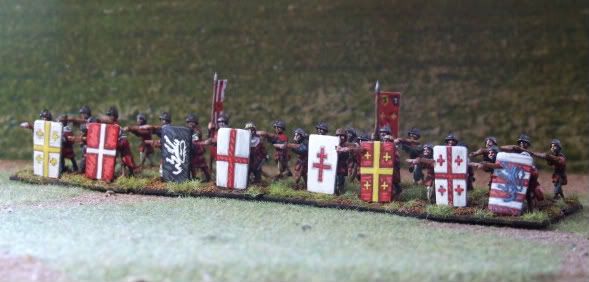
I painted my first few bases using a yellow and blue livery mentioned by Heath (from Froissart's mid 14th century description). Rune's description of the Flemish guild flags mentioned the use of
de Vigne's book. When I read a review of this, it mentioned that it had colour versions of the Leugemeete paintings, so I bought it. It does have some great plates - though none of the guildsmen are in yellow and blue. The liveries are either red, white, red and white or red and yellow. However, the text mentions that various other colours were worn by various guilds and cities and the availability of cloth seems to have been a factor. The shield of the
vieux wariers guild (basically second hand clothes dealers!) shows a tunic in yellow and blue, so I gave the figures I'd already painted a flag based on the shield.
Apart from the blue and yellow livery , the others are based on the paintings. De Vigne identifies one with a damaged flag as the butchers, based on the cleavers which some carry instead of spears or plancons.

I made the flags by drawing free hand a much larger version, scanning and colouring using Corel. I used a texture to give the effect of creases in the material, though I still need to play with the settings to get the highlights rights.
Rune has doem some very nice flags on the Krigsspil site but I wanted to include some guilds he hasn't covered and so for consistency I decided not to use any of his.
Note that at this earlier period the flags are still much taller than they are wide. Within a generation or so they became more or less square.
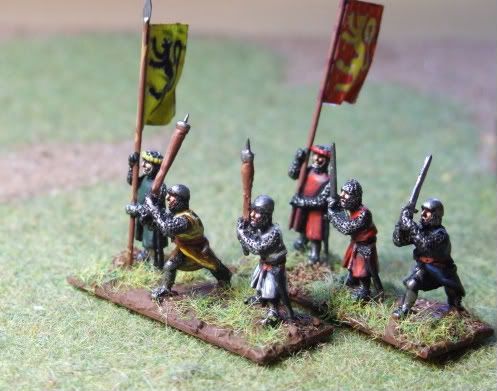
For the generals on foot, I am going to use some of Mirltons dismounted knights. These are wearing either coifs or a cervelliere which fits the look on the Chest nicely. I've added a milliput cervelliere over the coif of one which took very little time. So far, I've also convereted two of them to carry plancons. I cut away the swords, drilled out the hands and put a pin in place. The point of the pin forms the spike of the plancon and then I built up the body of the weapon with milliput and much cursing. I'm pleased with the result, giving a similar pose to the one in the illumination above. I'll post a photo when I've painted them. I may do some more when I start painting the bases which just have plancon wielding Bd(X).
One of the slightly disappointing things about this army is the heraldry of the commanders. I looked at who commanded the various sections of the army at Mons and then looked up their heraldry. They were very closely related and their heraldry shows it - most have the lion of Flanders with some kind of distinguishing label.

 I spent quite a while looking for figures suitable for the pavise bearers. I actually converted a couple of Khurasan's Swiss halberdiers and would have used these but when I ordered some Welsh spearmen (bearer on the right if this picture) from Donnington I thought the pose and clothing would fit quite nicely.
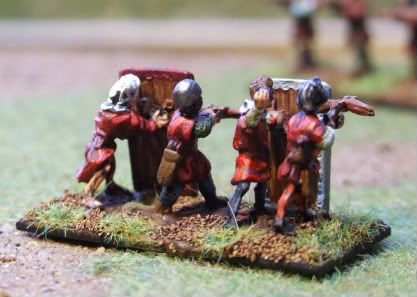 The figures wearing a hood actually come wielding a polearm in two hands in a sort of baseball pose. I cut off one arm and built another using green stuff in a pose as if the bearer is holding the pavise to his left.


.jpg)
