Showing posts with label Donnington. Show all posts

Wednesday, 9 August 2017

Hussite War Wagons


War wagons are one of those things I've often wanted but had shied away from for many years. I think I bought the first of these at a show where there wasn't much else I wanted, so I got them just because they were there.

It is possible that the use of this kind of converted wagon first started in Poland and then spread to Bohemia where they were used to great effect in the Hussite Wars. They were then adopted by Hungary and in Germany, with similar types being used in Russia.

Below are some of the wagons I have. The crew is a real mix. There are figures from Donnington, Khurasan, Minifigs, Irregular, QR, Vexillia and Mirliton. The Donnington peasants are particularly useful, with very Bohemian style clothing (15th century - not 1950s Greenwich Village).

Irregular
Some of the wagons have a crew which looks more professional which I use for the later 15th century such as the Hungarians.


These are the two styles of wagon from Irregular Miniatures. The wagon itself is the same in each case - the separately cast side planking is the difference. I think the style of planking is randomly provided.

They also do a wagon of the same style which comes with a small artillery piece.
Irregular

I have more Irregular wagons than any other, with enough to have some shooting to the left and some to the right.

Note the stone thrower - the wagons often had containers filled with stones for bombarding the enemy. Some other wagons have the stone throwing Swiss figures from Khurasan in them.


Alternative Armies

This wagon is from Alternative Armies (until recently sold as 15mm.co.uk and originally by Tabletop Games).

The wagons require more construction than the Irregular pieces. The sides of the actual wagon are separate but come with different options including the open ramp for one side. They come with horses but I decided to do them in a static pose.
It took a while to work out how to get everything together but once it was cleaned up of flash etc. they went together quite smoothly.


Alternative Armies (rear view)


This one has an artillery piece from Minifigs deployed alongside. The gunner is from QR, the shield bearer from Irregular.


 It also comes with a small section to go under the wagon - I haven't put these in as they are difficult to see but perhaps I will get round to it one day.

Minifigs


The Minifigs wagon has a one piece body with separate side hoarding. It is also provided with the under cart protection. It comes with two pairs of horse but I used Irregular horses for all the wagons.
The body of the examples I had from Minifigs needed a bit of tidying up including some filling but nothing too onerous


The comparison picture shows that the three companies go together pretty well. Each of them has its pluses and minuses. The Alternative Armies one, while tricky to put together, is probably the most accurate with its ramp and the suspension poles. It also doesn't have a driver's seat - the driver would probably have ridden one of the horses. However, the modern recreation at the Hussite Museum in Tabor does have a box for the driver to sit on.

I also have some by QR miniatures. These are much smaller though still pretty nice. Each pack has two wagons - one is dug in with its wheels partially buried.

Museum have fairly recently produced a range of war wagons. These look nice, and follow several modern reconstruction. However, I'm not convinced that the modern artists have interpreted the sources well - hinged side panels have become propped up roofs.

There are some very pretty war wagons on various websites, whereas I have gone for the plain wood look. This is based on contemporary pictures such as the Schlact im Walde* and the picture at the head of this blog.

What I will need to do is to add flags to some of the wagons. There are specific designs for different parts of the Hussite army. Since I have rather a lot of wagons, I may add some Hungarian heraldry to a few, as in GyÅ‘zÅ‘ Somogyi's book on the army of Matthias Corvinus.

There are some clips online from a trilogy of Czech films made in the 1950s covering the Hussite Wars, There is certainly a political dimension to them, but the efforts to get a historical look are laudable. This is a clip of the Battle of Sudomer which has some good shots of war wagons. Note also the teams of unarmed pavise bearer and crossbowman. The music chosen by this editor may not be to everyone's taste :)


Wagner, Drobna and Durdik's book on Medieval Costume, Armour and Weapons has a particular emphasis on the Bohemians and shows several good pictures of wagons. Worth looking at, despite its age.

Much newer are the pair of books on die Heere den Hussiten. The plates aren't as interesting as the same company's book on the Teutonic Knights, so if you are not a German reader then I wouldn't recommend them.


*A wonderful source for the late 15th/early 16th century in Germany. One thing it shows is the wagons moving around the field, but how typical this was and how much is artistic licence is of course debatable. This and two subsequent posts give more details of the battle. A short account by von Berlichingen is here - this confirms that the wagons were attacked while still trying to form a wagenburg.


Friday, 28 August 2015

Maximilian on the Road


A couple of years ago, I decided to branch out a little from the two areas which this blog has covered so far.

Decades back, I had some Italian Wars figures and I decided I'd have a go at the period again. I wanted to include landsknechte, but they had to be suitable for the end period of DBMM i.e. 1515. I looked at various options and the most sensible would have been to go for something from around 1500, before all the slashing took hold. I wasn't even sure if this style of clothing would be within the period.

I looked around at the sources and kept bumping into three particular period pieces made for the Emperor Maximilian. These were the paintings showing the 'Triumphzug'* (a triumphal procession), the 'Weisskunig' and 'Theuerdank'. All three were from the end of his reign with the majority of the illustrations completed by 1515. While some of the pictures are fanciful, landsknechte were shown in the slashed tunics pretty much as worn by the figures from Old Glory 15s. Some of the armoured figures have helmets which are probably a bit late but I liked them enough to include them. The trousers in the prints tend to be more fashionably ragged than the OG figures but at least the figures aren't in the much later pluderhosen.

 The figures duly sat in the lead mountain for a while but I decided to paint them to use at this year's Burton DBMM doubles competition. I'll try to take some shots of those in the next day or so.

When I used the army, I had some generic late medieval looking cars for the baggage but I didn't think they suited the army. What they needed was some of the baggage shown in the Triumphzug. When I decided to take the army to Britcon, I used the time I would normally need for last minute painting to have a go at some conversions.


 The first two wagons are more or less straight out of the bag Magister Militum examples. The only change is that I have moved the axles - medieval and early renaissance wagons seemed to put the rear axle nearer the back than seen on later types, even though much of the rest of the construction is the same.


The horses are from Irregular miniatures. I was going to use some Magister Militum figures on foot to lead the horses but the pictures show the drivers almost always riding. I cast around in the lead mountain and found some Welsh mounted longbowmen in a suitable pose. They were given a variety of greenstuff hats, puffed sleeves and capes plus a wire whip.

I thought some street furniture would look nice and used some items from this print of Nuremburg. The cross has the 'arma Christi' -  the spear and sponge from the crucifixion. It is made from strips of wood - a first attempt in plastic strip looked like it would snap as soon as was inconvenient. The stone shrine is made of greenstuff and square section polystyrene.


The last wagon uses some spare wheels which I think may be Magister Militum left over from my Flemish wagon laager.  It carries the barrel of a siege gun. The original painting shows another cart with what looks like the carriage, wheels etc. The barrel is made from greenstuff though I'd have done better to start with a plastic or wooden centre. The ropes are made from twisted wire.


So many renaissance pictures show a rather gruesome side of life that I thought I'd have a go at portraying. Breaking on the wheel was used as a punishment for various things; the offenders being tied to a wheel while they had their limbs
smashed with an iron bar then being hoisted up as a warning to others, dying a lingering death if they had not been able to bribe the torturer first for a quick end.


The wheel is a Langley offering, the victim and ravens are greenstuff. I couldn't make my mind up what to do about the wire for the flying bird - it stands out less against a wargames table. I should probably have attached the wire to the wheel instead.


Several  scenes of the Weisskunig show execution scenes. I already had a spare swordsman so I thought I'd have a go at making the victim using a wire armature. He came out a bit chubby but I was fairly pleased overall. The header picture shows the end result.


There was one thing on the Triumphzug that I really wanted to do and knew that I couldn't have got right so I needed to buy the basic figure for a conversion. One of the last scenes shows camp followers and one of them is leading a pack goat which seems to be carrying pots and pans.
I haven't yet seen anyone with one of these in their baggage so I thought it was a must. I had to wait until Britcon to get one from Donnington. He came with a goat herd who became the figure next to the goat on the painting. He has been converted to have a bit more of a stoop as well as gaining a large pack. There is some kind of creature on the pack - I'm still not sure if it is a cat, a dog or even a fox as different versions show it slightly differently. Mine does have the animal but it is so small that you wouldn't really know.

Also on the base is a pack donkey. This is an Essex mule but his pack has been made larger to fit the look of the painting. I've also extended the ears though the attempts to make the mane look like a donkey's didn't work.

I had a couple of spare pack horses and these were given the pay chests. They should be mules going by the painting but I decided to keep them as horses. The horses are by Donnington with the chests coming from one of the Donnington wagon packs and the blankets made from greenstuff. Their driver is also from Donnington with a suitable hat added.


The last couple of items are Baueda tents.
The first is painted as shown for Maximilian's meeting with Henry VIII in 1513 as in the Royal Collection.

Incidentally, according to Stow, Maximilian's tabard in the above link is black for the mourning of the Empress. Maximilian, writing in 1512, asks his daughter to ensure that mourning is worn by his family and various officials in the Netherlands. He does not seem to have cared greatly for Bianca but at least gave the appearance of mourning.


The second has the arms of Austria and Styria as shown in  Maximilian's Book of Armaments.


*The link to the Triumphzug shows the version in Spain. The German version can be found here but a search for Maximilian or similar needs to be entered. The sketches used for making the print blocks can also be seen here, with some features which didn't make it to the final version.

Tuesday, 22 April 2014

Normans


A long while back I said I'd put some comparisons of various Normans on here. Now that painting for Montaperti is out of the way, here are the Normans.

Two Dragons and Khurasan versions of Duke William

William Rufus from Two Dragons
 from the left: Two Dragons, Donnington and Khurasan.

They mix pretty well sizewise but the style is different enough that I would not mix them on a base. This has the advantage as well that I can tell which command each element is from. Two Dragons are the most idiosyncratic with a good variety of pose and lots of movement though there is a touch more caricature about them. The shields are rather thick but this doesn't stand out too much.
Donnington have a good range of poses though the sculpting isn't quite as sharp as the others.
Khurasan have a  bit more limited range of poses but these are designed to give the impression of a galloping mass. I'm slightly wary about the chance of some of the horses coming off their stands though. The figures are probably the easiest to pain of the three as the mail definition is very clear - this does of course mean it is exaggerated compared to real life but it helps the effect. It is also handy that the hands are ready to take the separate weapons - no drilling required.


This shows Two Dragons dismounted knights and Khurasan infantry. Again there is a difference in style but the size matches pretty well.


Lots of variety in the Two Dragons range


Two Dragons Scouts
Some more of my favourite figures from any range.


In DBMM, the Normans are allowed to dismount so it is handy to have the mounts ready.
More characterful figures from Two Dragons.

Friday, 20 January 2012

Magyars

As with various other projects, these started largely because I bought a couple of packs just because I liked the look. I was spurred on because I didn't have a suitable army for Warfare 2011, the theme for DBMM being the 'Horrible Huns'.
I decided to use the figures to form an Early Hungarian army which covers the period from the foundation of the kingdom until the Mongol conquest. The competition only allowed armies until 1150 so this directed me to the style of heavy cavalry to paint.

Unlike the slightly later period I have concentrated on, the amount of source material is pretty scanty for 11th century Hungary. There is the Chronicum Pictum - see the picture on the right - which shows events from the early kingdom, but this is actually 14th century. It does, however, show various figures in top coats and is some guide to reasonable colours.

For the mass of the Magyar horsemen I used these figures from Donnington's New Era range.
The shooting archers are 'break waist' allowing a nice range of poses. It means you can get a lot of movement on the bases.


Pechenegs formed a part of the army from before
the foundation of the kingdom. They may possibly have been settled by the kings in colonies to help to maintain royal control. A paper called 'Pechenegs, Cumans and Iasians' gives some interesting background if you like the academic detail - it is available on scribd but I'm never sure of the copyright status of such things so won't link to it!
These are the Donnington Pechenegs. The beards are supposed to have been a particular feature of these tribes. Again, some of the figures are break waisted.


I also have a few of the Donnington 'Bulgar' figures. Over time, the costume of the Hungarians became similar to this - in fact you can see elements of what would become the traditional hussar outfit. You can see this outfit in such as Mirliton's later period Hungarian cavalry.
This shows some Bulgarians facilitating the martyrdom of some Byzantines. Other pictures from the same period show other trouser colours incluidng red. The Donnington figures have these long trousers but I decided to keep the look similar to the Magyars and painted them as if tucked into longer boots.

This shows Donnington figures compared to Black Hat figures including one of their Hungarians. I used my Black Hat figures - mostly a mix of their Cumans and Hungarians - to stand for the Szekelers in the Hungarian army.
The figures are a pretty good match for size and style.


These are the Donnington cavalry. I use them for the traditionally armed heavier cavalry. I like the
figures though perhaps a couple of different armoured archers would help with variety. The bowcases are separate and I'm afraid I left them off most of the figures.
The horse tailed banner was used by the Magyars and other steppe origin armies. They seem to have continued to use them for a while after occupying what became Hungary.

The first king of Hungary, Stephen I, was helped in his struggle for leadership by Germans. Bavarians provided the bulk though over the next couple of centuries the origin of these troops became more varied; they were know as 'Saxons' though there origin was from various parts of Germany, especially the Rhinelands. There were also Flemish, French, Spanish and English immigrants.
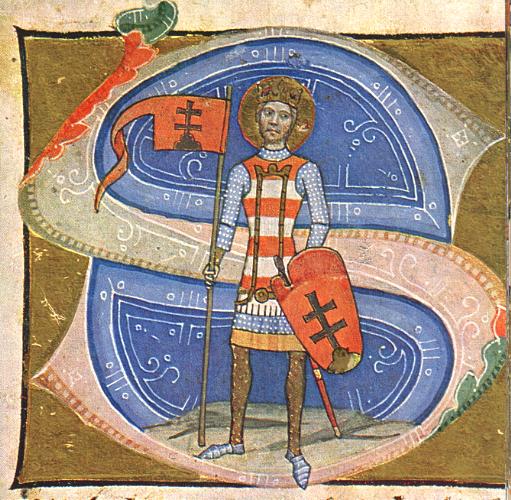
This later portrayal of Stephen shows the apostolic cross which was sent to him by the Pope. It is debateable whether he used this as his arms - this was before true heraldry. It does form part of the modern arms of Hungary and Slovakia. The stripes may date back to this period, being replaced as the main symbol by the cross but later returning to pre-eminence.

This is my first go at a Hungarian general, carrying the striped flag and shield. The three figures on the central base are part of the Donnington Norman range. The figure on the left wears a helmet which is shown in the Osprey book on the Normans though he is supposed to be 12th century. I think he looks better as a semi-westernised Hungarian. The bird is the earlier, re-Christian symbol of the Arpad dynasty.


The possibly 11th century Legenda Maior of St Stephen* says that  he carried the banners of St George and St Martin (...sub vexillo Deo dilecti pontificis Martini Sanctique martyris Georgii ducibus...) against his pagan uncle. I decided to paint one in a Byzantine style since there was some influence from there despite Stephen adopting catholicism. This can be seen in the decoration of the crown known as St Stephen's (which is fairly likely to post date him).
I already have a banner of St Martin on some of my Ghibelline cavalry, so I decided to do St George. There seem to be two traditions - one is the familar fight against the dragon but there is also a more portrait style which I decided to use.

The red cross on the shield may be from a slightly later period.

The figures are from QR Miniatures, a Polish compay which has lately added a couple of Early Medieval ranges. These are the Early Polish and Eastern Franks which can be bought as complete DBA packs. I only bought the cavalry. These are the East Franks and I thought they gave a nice mix of style representing the transition of gear. The previous picture shows that they mix pretty well with Donningon. The style of sculpture is slightly more basic than some other recent ranges but I like them and there are some great poses. The Poles are not quite so well posed but there are some very nice figures amongst them. The middle figures of each of these bases is from the Polish range - the pointing 'general' on the left is particularly nice.


*Incidentally, St Stephen is, amongst other things, patron saint of brick layers...

Thursday, 29 December 2011

More Baggage

It's been far too long since my last post so I thought I'd put up a few more photos of different types of baggage.

A while ago I made a version of de Montfort's carriage. At the time I wasn't entirely happy so I thought I'd have another go.
The draught horse is by Donnington. The rider and infantryman are Old Glory. The wheels are from Langley Models, a fantastic source for all sorts of size and type of wheel. Good service too!
For those who like such stuff, the rider bears the Lambton arms - possibly those of Sir John of Lambton Worm fame.


The lower body of the wagon is plastic card. I then bent some florists' wire to shape for tilt supports. I tried tissue but that was too porous. The original pictures also make the upper porion look quite rigid so I used thin card. I wasn't sure whether to have the ends rigid or open but I settled on making curtains out of Green Stuff. I then thought I could take advantage of the curtains and have a go at making a passenger out of Green Stuff too.


I was quite pleased with the result.

EDIT: See Schilling's Berne Chronicle for details of a similar but 15th century cart
http://www.e-codices.unifr.ch/en/list/one/bbb/Mss-hh-I0001 p.405


Some DBMM Medieval armies can have pack horses as baggage elements so I have these from Donnington. The various bits of cargo are separate so can be arranged as you wish.

The wagon behind is also Donnington and again the cargo which comes with it is separate, allowing a variety of loads.


Quite some time ago, I bought some Alain Touller Mongol Baggage. This is a nice little set with a rider, a family on foot and a few Bactrian camels.

The tent is from Baueda.


The pony and camels are pretty small compared to other companies' - not necessarily unrealistically sized but small enough to not mix well. The humans would mix pretty well with Essex and similar sized figures.


More recently, thanks to a post on TMP, I came across QR Miniatures. Most of the range is Renaissance although they also produce some Poles and Eastern Franks from the 11th century which aren't yet on the website.
I ordered some of their horses since a number of DBMM armies have pony herds for their baggage elements. There aren't many suitable horses lacking tack so I jumped at these. I was pleased with them though I'd still buy some shaggy steppe ponies if I could get them.

EDIT: Thanks to Geoff on TMP; another source of ponies are QRF's 'Yellow Ribbon' range. Some have a halter but no saddles or blankets.

Monday, 8 August 2011

The Marcher Lords and the Welsh

The English conquest of Wales was largely driven by the actions of the Marcher lords, those who held lands along the English-Welsh border. These were some of the most powerful subjects of the Kings of England at any time. They had far more independence than the majority of the barons with legal powers "like unto a king".  These powers are summaried in the Wikipedia article. One point I would disagree with is the opening staement that they were 'trusted'. That was the theory but in practice their power meant that they had to be carefully handled by the king.
 At the time of the 2nd Barons' War, the three Marcher Earls were those of Hereford, Pembroke and Gloucester. The Earldom of Shrewsbury had become extinct and the Earldom of Chester was held by Prince Edward. Another earldom, that of March, was created under Edward I and first held by Roger Mortimer.

I've already mentioned Hereford and Pembroke, so here is Gilbert de Clare, Earl of Gloucester and of
Hertford. 'Red' Gilbert (probably on account of his hair) had inherited the earldom at an early age - he wasn't actually knighted until de Montfort did so just before the Battle of Lewes. He threw in his lot with the Barons despite being married to the king's niece who was also daughter of the  Earl of Pembroke. His actions probably led to their estrangement so that they were legally separated after the war.

He led the central division of the Baronial army at Lewes. However, he fell out with de Montfort and began to aid the royalist party, joining Edward for Kenilworth and Evesham. He reaped the rewards, being given further lands in Wales. He had various disagreements with Llewellyn and led Edward's southern forces against the Welsh though without success.

He even engaged in a private war with de Bohun, Earl of Hereford. This was within the rights of a Marcher Lord but Edward stamped on it, prosecuting both parties and briefly imprisoning them to make the point.

 One feature of  Marcher warfare were the muntatores, the light cavalry known to have been used in Staffordshire and Shropshire from the late 11th century. They are described as having hauberk, iron helmet and lance. The lack of any mention of shields may not be significant - they are also not mentioned for the infantry the Assizes of arms and it is generally assumed that the infantry had them so the muntatores may also have done so. This article describes them and proposes a link between them and the hobelars which are often thought to have originated in Ireland. 

There may not have been any noticeable difference between the muntatores and the lesser equipped part of the Welsh cavalry. For my muntatores I have simply used some of the Legio Heroica sergeeants, mostly with no leg armour, on unbarded horses. However, for my Welsh cavalry I have used some Outpost cavalry and these may also be suitable for muntatores. Outpost's later sergeants are also suitable - they have kettle hats and cerveillieres. I don't have any comparison photos for Outpost yet but I would judge them pretty compatible with Mirliton and similar.

The English conquest of Wales relied to some extent on the fractious nature of Welsh politics. The Marcher lords and the King often involved themselves in a dispute between two Welsh parties and came away with gains from the loser. Some other gains were made through marriage and others through blatant annexation.
The Welsh also involved themselves in English politics - much of de Montfort's army at Evesham was composed of Welsh infantry and Llewellyn 'the last' was married to de Montfort's daughter.

By the mid-13th century, most of the south of Wales was under Marcher control and this seems to be the main area where archery was dominant.The north seems to have been fonder of spearmen and there were various occasions where they stood up to and defeated English knights, though often with the aid of favourable terrain.

The dress of these spearman is somewhat debateable.There is evidence that the standard form of dress found over most of Western Europe was becoming normal but there is other evidence that a more distinctive mode of dress remained in use. This has been dismissed as being English writers dismissing a more barbarous style of dress but the description seems no more outlandish or unsuitable than the broadly similar clothing worn in the Scottish highlands i.e. linen shirt and woolen cloak. Note - I don't think the overall appearance of these two forms of dress would have been similar, just the components. This article summarises the evidence. You can find Giraldus Cambrienensis' 12th century description here and some later depictions of Welsh soldiers here. This is one of the pictures from the National Archives of Wales.

There is a Flemish description which seems to confirm the appearance of the Welsh at the end of the 13th century. The Flemish version of van Velthem's Spiegel Historiael is here - the relevant section is around line 90. The link above has a translation into English.

One thing which I've pondered is the translation of 'roden rocke'. These are the red tunics which are mentioned in various books. I have absolutely no evidence for this, but I wonder if there is a Medieval Flemish equivalent of 'rude' (from the latin 'rudis') which this could represent. 'Rude garment' is a phrase which crops up in English to mean a simple or rough piece of clothing often used for something like St Francis's garb. The usual explanation however is that the king donated red cloth to them as an early form of livery. I have painted up some of my Welsh spearmen in red and the remainder in a motley collection using colours in the laws of Hywel Dda and here.

These are some of my Welsh spearmen.
From left to right they are from Lancashire, Donnington, Khurasan, Donnington, Khurasan and Lancashire.

Overall, my favourites are the Donnington figures. They have a proper hood and the proportions are IMHO the best. as can be seen, the three makes are very compatible in size. These are the first Lancashire figures I've used for a while and was largely as a result of them putting photos on their website. There is a third pose which I haven't used - it may well paint up well enough but I didn't like the figures as much. For the price it is affordable to discard the odd figure! Incidentally, their English foot such as these spearmen are very good figures - despite the number of feudal infantry I already have I shall have to find a home for them. I shall also probably use their Welsh archers as I seem to have accidentally found myself in possession of most of a Welsh army! I already have a few as samples but haven't painted them. They have a lot more action in the pose than Essex's Welsh.