
The meteoric rise of the Mongol Empire is covered by many websites. Their own account can be read in the Secret History. In short, a combination of absorption through alliance and conquest created a force which was strong enough to take on a succession of settled empires. The Xi Xia, of what is now Western China, were one of the first to feel the strength of Ghengis's force. They fought a series of wars against the Mongols. They eventually submitted but did not send forces to aid the Mongols when called upon. Further war resulted - Ghengis died during the final war of conquest. The Jin dynasty of northern China was also under attack during this early period and although losses in territory and life were huge, the resistance was sufficient for the Jin to retain some of their lands until after the death of the Khan.
Ogedei, Ghengis's successor, continued the process of conquest. There was something of a pattern - Mongol emissaries or traders in various places seem to have got themselves killed by the local authorities and an army was sent to wreak terrible vengeance. The Song dynasty, rulers of Southern China, managed to incur the wrath of Ogedei while allied with the Mongols against the Jin. The Song forces tried to retake land which had been lost a century or so earlier and killed a Mongol emissary who presumably voiced the Khan's displeasure.
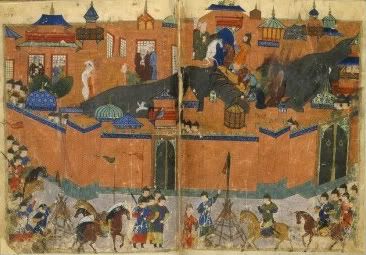
A relatively small force was sent to conquer the Kipchaks in what is now Russia - this expedition continued through the various Rus lands forcing them to become vassals of the Khan. Again, it continued to the west. It split into three, one part defeating a Polish/German army at Liegnitz - the involvement of Teutonic Knights at this battle was probably minimal and may have been non-existant despite many claims to the contrary. Even today the city of Krakow commemorates the attack of the 'Tartars' with a midday bugle call which cuts off short, as if the musician has been hit by an arrow.
The main part of the army confronted the Hungarians as a punishment for the King allowing the Cuman refugees to enter the country. Ironically tensions between Hungarians and Cumans led to the death of the Cuman king, most of the Cumans fleeing to the south.
The Hungarians met the Mongols at Mohi. The battle was hard fought but it resulted in the destruction of the Hungarian army and the death of much of the royal family and nobility. The Mongols pillaged the country though guerilla tactics by the populace meant that the kingdom remained unpacified.
The campaign against the Song dynasty proceeded in stages - again the death of a khan resulted in a hiatus. The nature of these wars was far more of a slog, characterised by long sieges, compared to the campaign in Russia and the rest of Europe. Even the succession of sieges in the Islamic areas were short by comparison. There is an essay about one of the longest here. It also gives some insight into the Song dynasty and its army. I'll post some more about the Song fairly soon.

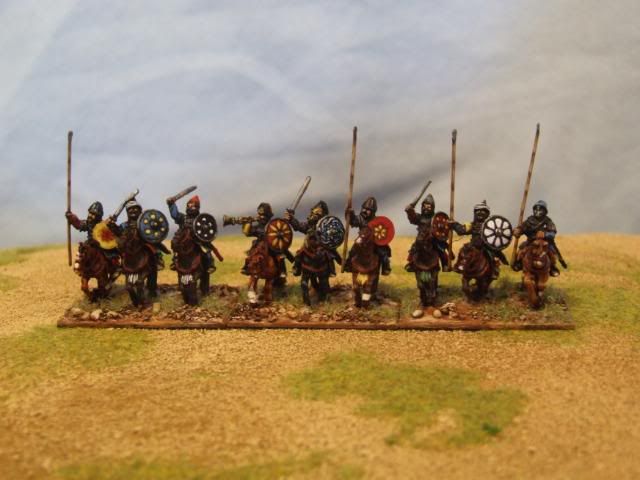
These are some of their Heavy Cavalry with Melee weapons. There are certainly references to Mongols with shields but there is debate as to whether they would use them on horseback. Portrayals of earlier troops in this area do lack shields, so I decided to cut away the ones moulded onto the figures. This was not quite as daunting as it seems and it was possible to create the arm fairly easily from the remains of the shield.

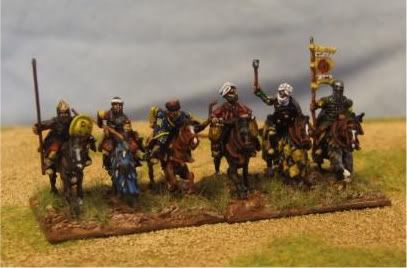
These are a mix of the heavy cavalry and medium cavalry archers. The main difference is really that the heavy cavalry are slightly bulkier figures, including the horses.

These are the Old Glory light cavalry with bows. I did these around the same time as the Turcoman cavalry and again I've overdone it when it comes to making them look as if they are firing sideways. It makes it confusing in the table-top!
The Mongol armies was made up of troops from a number of origins. Overtime, the appearance probably showed increasing degrees of homogeneity but I still have some which preserve the differences.

I use these as Jurchen cavalry. They are from the Outpost Manchu range. This is actually designed for a period about 400 years after the one I want, which shows mostly in the bowcases. At least some of the Jurchen had armoured horses - I may well use some of the Outpost Turkish horses which I have sitting around as the armour is pretty suitable. I could have just used the same figures as the Mongols but it lets me see which are which more easily and I liked the figures!
About half of the Outpost range are wearing the fabric covered 'brigandine' armour which became popular especially during the Manchu period. However, some seems to have been worn during the Mongol Yuan period. Even so, I asked Outpost to just send figures in lamellar armour after my initial order and I've even made some of the fabric covered armour into lamellar using milliput.

These are Black Hat light cavalry - a mix of Cumans, Hungarians and the occasional Lithuanian.
 They mix pretty well with the Old Glory figures though the horses are smaller
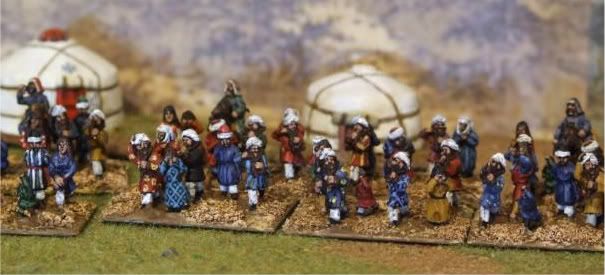 The 'human shield' figures are a mix of Donnington and Alain Touller figures. The AT packs come complete with a Mongol 'herder'. The Touller range looks pretty nice and I might well have gone with them if I hadn't already bought OG15s. The ponies do look very small compared to other companies' figures. This may well be accurate but the difference may be offputting. Since I bought mine, the horses have been redesigned so could be larger. I did buy the Korean infantry from Touller, which are based on the figures from the Invasion Scrolls. These may actually be Southern Chinese rather than Korean but either way they will find a place in my Yuan Dynasty army once they are painted. (edit: - they may even be Northern Chinese. The Yuan hadn't conquered the Song at the time of the first invasion of Japan. However, apparently some Southern Chinese troops had transferred to the Mongols even at this point, so it is hard to be sure who they are!)

.jpg)
