Showing posts with label Knights. Show all posts

Sunday, 1 July 2012

Alphonse of Poitiers


King Louis was accompanied on crusade by his brothers, Robert of Artois, Charles of Anjou and Alphonse of Poitiers.

Alphonse was the third oldest of the brothers (of those who survived childhood) and was given a sizeable amount of power and responsibility. He helped command against the English in the Saintonge War while still in his early twenties.

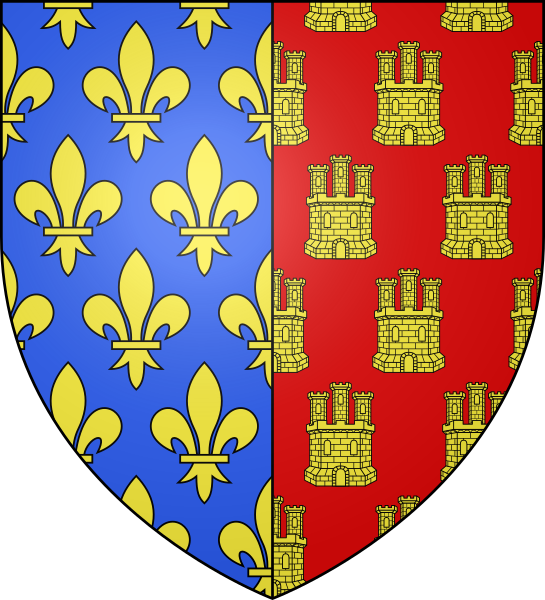
His mother was Blanche of Castile and this is represented in his arms.
Robert bore a label with the Castilian fortress on it and Charles initially had a bordure, also with the castle marked aroundit.
Blanche was seemingly a pretty formidable woman and made her mark through her sons. She was regent both in Louis's minority and again when he was abroad. He showed his respect to her in the decoration of the Sainte Chapelle in Paris- while the current decoration is a 19th century restoration it follows the likely original and for much of the surface the arms of France and Castile are scattered evenly across the walls. This chapel, incidentally, is well worth a visit. I went to watch a classical concert there and night which gives a chance to absorb the atmosphere and gaze at the decoration.

Alphonse's seal shows how the arms were portrayed on the caparison - France at the front, Castile at the back.


This layout, more than anything else, was the reason I wanted to paint the figure.


Alphonse was married to the heiress of the County of Toulouse and when his father in law died, Alphonse gained control of the county. This shows an interesting banner with the arms of Toulouse added to those of Alphonse, each portion of equal size. 

Alphonse seems to have been rather more level headed than his brother Robert. He fought well in the Seventh Crusade and returned to France to be co-regent when his mother died and Louis was still in the Holy Land. He took part in further campaigns to consolidate the gains from the English in France and then accompanied Louis on the Eighth Crusade to Tunis. This ended disastrously for the French but in a different way to the Seventh Crusade. This time, disease took many of the crusaders including Louis. Alphonse made it back to Europe where both he and his wife died.

One of his legacies was to leave the Holy See a grant of land which became the seat of the Avignon Papacy.  

Thursday, 2 September 2010

Flemish Crossbowmen and Knights


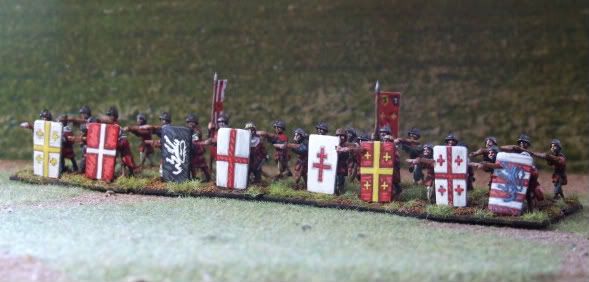
Common to a number of Low Countries cities were the guilds of crossbowmen - the Guild of Saint George. They were separate from the trade guilds and are shown in the Leugemeete fresco. There is still a Guild of St George in Ghent which has a nice bit of background.
 As mentioned in this link as well as various other places such as Verbruggen, de Vigne and de Liebaart, the crossbowmen were accompanied by 'boys' who carried the pavises at a ratio of two crossbowmen to one pavise. The current draft of the DBMM Book 4 list covering the Low Countries actually suggests basing them in this way after a couple of us mentioned it on the DBMMlist.  I suspect that this ratio may have been common in Europe at the time in the period following the adoption of the pavise. David Nicolle's essay on the Genoese at Crecy suggests that the pavises left behind would have been carried by pavise bearers rather than on the back of the crossbowmen as often portrayed following a late 14th century picture.  I don't know of any evidence that the Low Countries bearers had any form of spear - certainly at the various battles where the Fleemish crossbowmen are mentioned they withdraw rather than facing hand to hand combat, suggesting a lack of defensive weaponry.

 I did try out two crossbowmen and one pavise per base but the effect was a bit sparser than I liked. It would really look best, I think, with a deeper base and one firing and one loading crossbowman per pavise. An Impetus or similar sized base would be a good place to do this, or a double depth DBMM base. After a bit of experimentation I decided to have a rank of bases with pavises and another without, giving a ratio of three crossbows per pavise.

 I spent quite a while looking for figures suitable for the pavise bearers. I actually converted a couple of Khurasan's Swiss halberdiers and would have used these but when I ordered some Welsh spearmen (bearer on the right if this picture) from Donnington I thought the pose and clothing would fit quite nicely.

 I hoped to have finished them for Britcon but ran out of time. This was quite good though, since I bought some Donnington peasants and some of those also made good bearers. 
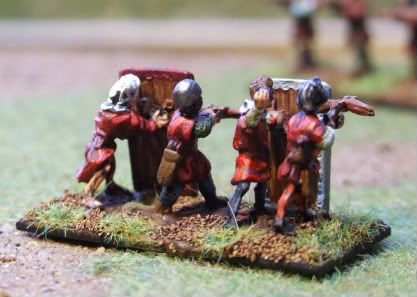
 The figures wearing a hood actually come wielding a polearm in two hands in a sort of baseball pose. I cut off one arm and built another using green stuff in a pose as if the bearer is holding the pavise to his left.


The crossbowmen are mostly Donnington with some Touller figures, including the flag bearers. another factor which influenced my choice of basing was that I had exactly the right number of crossbowmen unpainted to do it this way, as long as I used the standard bearers.


The pavises show a mixture of arms, including those of Bruges, Ypres and Ghent.  The others are those of Guilds of St.George from various cities as well as those of Guilds of St. Sebastian. This was thoeretically a guild of archers although the fresco showed them with the same mix of weapons as other guildsmen. However I used a bit of licence and included some of their shields as I had the details and liked them.

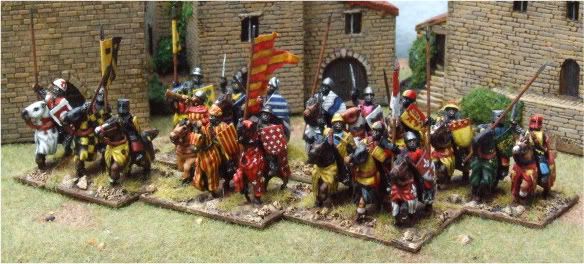
To finish off my pictures of Low Countries figures, here are some knights. First of all mounted:


The general is marked with a flag and represent Jan de Renesse, a nobleman from Holland who led the forces at Kortrijk - possibly he was experienced. For the other knights I used a variety of arms from the Gelre armorial and Rietstaap as well as a book of seals of 13th century Low Countries knights. I wasn't too careful about whether they had fought for or against the French though - time was pressing and the details were sketchy; sometimes I had names but no details of arms. The arms of the burghers or patrician class were even harder to come by for the 14th century. A few are mentioned such as de Conninck's and, for a later period,  van Artevelde's but I couldn't be sure of many others. The regulations have survived which show the expectations of these 'nouveaux riches' as far as equipment goes - the two richest classes were to have armoured horses as well as the rest of the men-at-arms' panoply.
 Some of the Donnington knights come with a bird crest  - I adapted some of these by cutting or adding Green Stuff so a few have the crest shown in the Gelre Armorial. Wearing crests in battle was becoming rarer as the 14th century progressed but I kept a few as traditionalists or show-offs.
The figures come with smaller shields than this but I got some of the slightly larger ones - partly as it made painting easier.

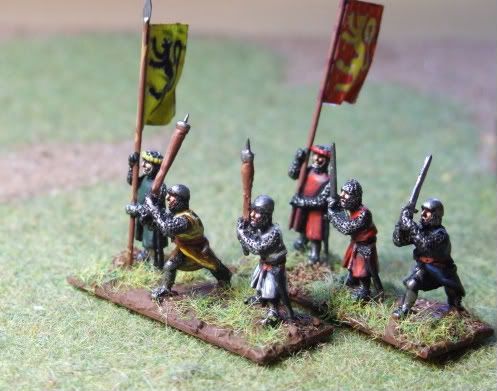
I have already posted some pictures of Old Glory dismounted knights but I also have some more specifically Low Countires ones. They are figures from Mirliton and IMO some of their best. They are actually designed for a period earlier than the mounted men-at-arms which I used but they match the figures on the Kortrijk chest pretty nicely apart from the ailettes. To get the real Low Countries look, I have converted some to carry gepinde stafs (or whatever the plural is!) You can see the unconverted ones alongside the converts. The staves were made from a dressmakers pin with a covering of greeen stuff or Milliput. Once I knew what I was doing they could be made pretty quickly. Note that I also put a Milliput cerveilliere on one of the knights as shown on the Chest. Overall, I think the central figure gives a nice effect of the picture I have linked to before

Monday, 4 January 2010

Comparisons of Knights

Here's a comparison between the knights from various companies.


First, the horses. From the left
Legio Heroica, Essex, Mirliton, Black Hat, Alain Touller.

The Touller horses have been redesigned since I bought mine and I haven't seen them.


Again, from the left
Legio Heroica, Essex, Mirliton, Black Hat, Touller
The Black Hat knights aren't quite as versatile as their infantry, being noticeably smaller than other ranges. The Legio figures are a bit taller but it is their bulk which makes them stand out next to other figures. Their shields are just about identical in size to the ones from Mirliton though a little thicker. The Mirliton figure is one of the later ones in this range. Some of the earlier ones are a little smaller though not so much that it couldn't be natural variation. The Essex figure is one of their Spanish range wearing obsolete gear for the mid- to late-13th century.
From some pictures I've seen elsewhere, the Old Glory 'Crusader' range is a pretty good match for size and build of the Mirliton figures. Most of this range carry heater shields more typical of the mid 13th century than the 3rd Crusade. The ones in the 'Holy Order' range have larger shields which are of an earlier form though still more early 13th than late 12th century. The range seems to have a mix of early 13th century 'face mask' helms and mid century full helms. Both of these were found earlier, but full helms in particular seem to have been extremely uncommon pre-1200 and not predominant for another generation or more. The Old Glory figures also have most of the knights on barded horses which were probably uncommon before 1200.

I've used Mirliton figures for my Italians as well as French and German forces which are in progress. I used Touller figures for the Spanish. My current project is a Feudal English army of roughly the time of Simon de Montfort. I've had the urge for a while to paint a few figures bearing the arms of the nobility who held lands close to where I live. I've found even more information than I hoped and so now I shall do a whole army. About a dozen figures done so far so watch this space.

EDIT: Since writing this, Touller are out of production and unlikely to return, Black Hat/Gladiator/Metal Magic have just gone out of production and Legio Heroica are hard to get if at all.

On the positive side, Donnington have a range of 12th and 13th century figures. Mirliton have a range of  14th century figures, most of which will be suitable for the early part of the century. There are a few companies producing STLs for 3d printing though most are designed for 28mm rather than 15mm. They can be scaled but this can result in very fine detail which is harder to pick out. My favourite range is the March to Hell figures though the 13th century Feudal Europe mounted figures are very short in the leg. 

Tuesday, 11 August 2009

Spain


The Iberian peninsula was divided between various kingdoms and other states, some Christian and some Muslim. Through this period there was conflict between most of the states at some time or other.

My initial interest in the Spanish armies was because of the involvement of the King of Aragon in Sicily, a conflict known as the War of the Sicilian Vespers. In brief, once Charles of Anjou defeated Manfred he gained control of the Kingdom of Sicily which included the island and the southern part of Italy as far as the Papal states. He had his eyes set on building a Mediterranean empire - I'll post something about this another time.

Peter III of Aragon had invaded the lands of Tunis to re-establish the suzerainty over Tunis that his father had imposed. While he was there, he was visited by emissaires from Sicily, inviting him to take over the kingdom from Charles. Peter had a claim on the Kingdom of Sicily through his wife and in his own right, and accepted the invitation. There is speculation that the journey to Tunis was actually a smokescreen and that it was only ever intended as a stepping stone to Sicily. The best book I've read on the background is Runciman's "The Sicilian Vespers" though I've included a link to an even older free download book in the sidebar.


The actual number of land battles in this war suitable for a wargame is small - most of the major actions were naval. The final land battle of the war, Falconaria, is perhaps the best for playing.


These are Alain Touller figures (with two Mirliton horses). As far as I know only Touller and Essex do specific Spanish figures. (Edit: Spanish are now also available from Donnington in the New Era range). The features which are particular to Iberian knights are - many of them wear a bowl shaped helmet, often with a face veil of mail; the surcoats have a sort of short sleeve; horse barding often leaves the head and neck bare and the shield has a far more rounded base than the more widely used heater shield. Touller has since redesigned the horses, which I haven't seen. The ones I have are pretty good although there aren't many poses. The great helms of the figures sold as Leonese knight look a bit rounded in places such as the vision slits. This initially put me off them but a very quick bit of work with a knife made them look how I wanted them.
Touller also does some Military Order knights wearing a hooded surcoat - I'll get some pictures of these eventually.


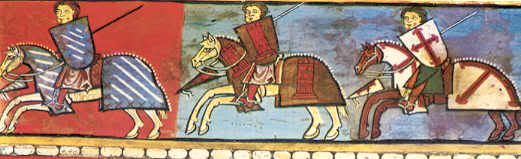
The Spanish nobility seem to have liked showing off their heraldry. Unlike the illustration in the Manesse Codex where most caparisons have a sprinkling of small heraldic devices, Spanish illustrations tend to show the barding with a single large form of the arms in each quarter of the housing. Sometimes the arms are split across front and back, as on the seal of the Kings of Castile and Leon.
These are not figures to paint if you don't want to do the heraldry. Some of these have the arms repeated on - the shield, four quarters of the caparison, each of the sleeves and often on the helmet.


Usually the heraldry aren't on the main body of the surcoat but there are exceptions.

Interestingly, in many of the early pictures showing surcoats from across Europe they don't show the coats of arms, so that probably isn't the original reason for surcoats being adopted.


More Spanish another time, including some of the personalities.