
A notable feature of the Aragonese and, to some extent, the other Iberian armies was their use of the almughavars (or almogavars). These were infantry who, despite a lack of armour, soon gained a reputation for their fighting ability. They formed part of the armies used in the conquest of Valencia and were a major component of the Aragonese forces in Sicily. After the treaty of Caltabellota, a large number left Sicily and became the Catalan Company, working for various employers in and around Greece. Eventually they carved out their own state. Not all almughavars joined the Company though - some, for example, seem to have been part of della Ratta's mercenaries in Florence. These were paid for by their old enemy, the Angevin king in Naples. Dego della Ratta turns up as a character in the Decameron, an interesting read though decidedly more worldly than Dante's Divine Comedy.
The 13th century chronicles have a great deal of detail about the Almughavars, especially Muntaner's Chronicle.
A pretty modern good summary of their career is here, with many sources listed. There is also a more general review of Spanish tactics which includes the almughavars here.
In wargaming terms they are difficult to portray since their lack of armour would make them very vunerable in many sets of rules. Sometimes they are categorised as if they were more protected to give them a chance of standing up to knights as they did on occasion such as the Battle of Falconaria. The circumstances in which they fought may also have helped, so it makes for much discussion.
As I write this, the DBMM lists which covers the Sicilians and the Catalan Company are being looked at before the publication later this year.. In the armies with Almughavars which have been published they have been categorised as superior auxilia. There has been discussion about them being fast blades in the new list, which may mean a change to the Book 3 almughavars.
In 15mm, the companies which make almughavars that I know of are Essex, Eureka, Irregular and Touller. I only have the first two - there are various pics of the Touller ones around such as here.
EDIT: Touller are no longer available. However, Lurkio figures (now available from Gripping Beast) also provide a large number of variations in the Almughavar pack. Donnington do Bidet javelinmen in the Feudal Europe range. March to Hell do 3d prints and the Medieval unarmoured militia with javelins look like they would work well.
This is a comparison shot of my Essex (on the left) and Eureka figures. There are, I think, 3 variations in the Essex range and an impressive 18 or so in the Eureka range. The Essex ones are perfectly decent but are a bit two-dimensional. Some of my figures have had arms bent so that the upright spears in particular are at more varied angles.

Some of the Eureka figures are a bit taller than the others but nothing which can't be explained by normal height differences.
Both ranges have the cap as the dominant headgear, as in the Heath books. This is mentioned in a description by Desclot as being leather, possibly red despite my painting. Other descriptions mention a sort of net for the hair which may have been metal. Some of the Eureka figures have this.
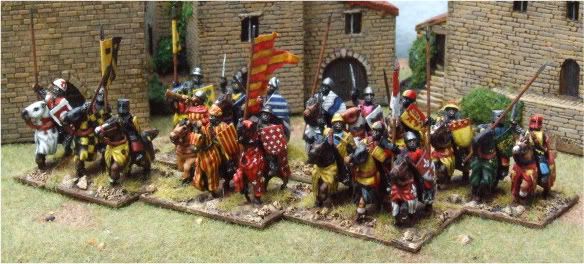
The flags carried by the Catalan Company are described in Muntaner (p.409 in the edition linked to above). He mentions that the foot carried 'pennons' of the King of Aragon and King Fadrique - i.e. the King of Sicily. I haven't looked to see what the original Catalan word translated as pennons was, but it is likely pendon which had a pretty broad meaning rather than just the small triangular flags.

The flags carried by the Catalan Company are described in Muntaner (p.409 in the edition linked to above). He mentions that the foot carried 'pennons' of the King of Aragon and King Fadrique - i.e. the King of Sicily. I haven't looked to see what the original Catalan word translated as pennons was, but it is likely pendon which had a pretty broad meaning rather than just the small triangular flags.






.jpg)
