Showing posts with label Essex. Show all posts

Monday, 31 July 2017

Stradiots, Hussars and Genitors


There was a parallel development of light cavalry at opposite ends of Europe which reached its height as the 16th century began.
The roots were, of course, far older. In the East, there was the steppe tradition which had come into Hungary and its neighbours many times. As Hungarian society changed, the number of locals who could provide skilled light cavalry began to decline. However certain regions and sections of society maintained their traditions for longer, in part due to the influence of the Tartars to the east and increasingly the Ottomans to the south.


These are QR Miniatures from their Polish late 16th century range. They look very similar to the illustrations of Hungarian horse archers from the late 15th/ early 16th century in the Army of King Matthias  so I have used them for these. A couple in the pack are armed with firearms so I have not used those. Others have cartridge boxes on their backs which I could have tried carving away but they are easily overlooked. 


These are QR Miniatures Serbians. Serbian cavalry entered Hungarian and then Polish service as their homeland was occupied by the Ottomans. Their style influenced the local cavalry, with the use of a lance being emphasised instead of a bow or crossbow. One of the theories for the origin of the word 'Hussar' is that it comes from Serbian. Over time, 'Serbian' may even have been a description of the style of cavalry rather than being a reliable indicator of the origin of all the men.
The figures seem to have been based very much on the Polish hussars in the Battle of Orsha painting*. Link has a number of close ups - I've shown a detailed view of the hussars at the head of this page. Also in the painting are similarly dressed figures who have bows as well as lances. They are likely Lithianians, though the green flag may originally have been blue.


The flag I have given them is Hungarian from here - it was a style carried at Mohacs in 1526.
These are some of my favourite figures.


These are some figures from the 'By Fire and Sword' range. Again, they are intended for a later period than I am modelling, so some have holsters on their horses. A bit of chopping and painting soon hides them though. These are from the 'Transylvanian' range. Most are actually sold as Szekelers so that is what I am using them as. They are quite similar to the Hungarians shown in the Babenberg family tree. I wonder if the blue trousers are significant - they seem to be increasingly a feature of Hungarian military wear until they became a standard part of the uniform in the 18th century.

These figures would probably work as Moldavians and Wallachians as well, and perhaps Lithuanians if they are not as dolled up as the ones in the Orsha painting.


A comparison shot of the QR Serbians with BFaS Szekelers. Since they are likely to be unfamiliar to many, I've put a comparative Essex element next to them.


Apart from the comparative Essex figures, these are Stradiots - those in the centre element are from Venexia, those on the right are Mirliton. All the Stradiots are mounted on Vexillia horses - some have had the Eastern style rump covers added.

Stradiots were recruited by the Venetians in their territories across the Adriatic. They were initially Albanians though their name is probably Greek. This has a selection of pictures of Stadiots and Hussars - there is often argument about which are represented in certain pictures.

For a while, the Venetians paid them according to the number of heads taken (see Commynes), so some of the horses have Xyston severed heads hanging from the saddle.

More stradiots and/or hussars can be found in Maximilian's Weiss Kunig including plates 75, 77, 82 and 83.

The role of stradiots and Albanians in war can be seen in various contemporary histories such as Chalkokondylas, Bembo and Commynes


Most of Western Europe used little or no light cavalry for most of the Medieval period. The main exception was in Iberia. The conditions, the Morish influence and the availability of suitable horses meant that the use of light cavalry continued through the reconquest and beyond.

These are mostly Donnington New Era figures from the new Islamic range and I really like them. There has been a lot of attention to detail, using mostly Ian Heath's pictures I think. These in turn are based largely on the 'Conquest of Majorca' and the 'Cantigas de Santa Maria' . There are many other examples here.
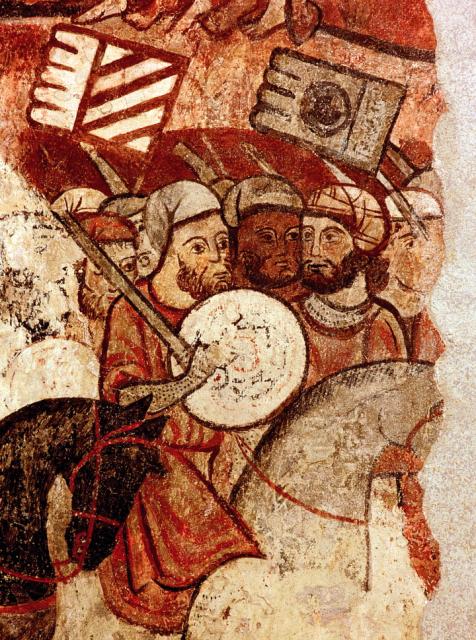


Berber horsemen continued to look very similar over the next centuries as can be seen in the Conquest of Oran.

The same picture shows how the Christian Spanish had changed by this time.


This shows the Essex Andalusian horse next to jinetes of the 14th century and some from the late 15th/early 16th. Even by the 14th century the equipment had become heavier. The middle figures are by Alain Touller, those on the left by Venexia (though on Vexillia horses). Both ranges are unfortunately OOP. [Update: Venexia are available from Lancashire Games. Vexillia are now OOP though].


*Watchers of BBC's Being Human may remember that Orsha was where Hal made his, umm, lifestyle choice.

Saturday, 4 January 2014

The Way of the Horse and Bow

...or the Early Samurai in DBMM.


It has been rather too long since my last blog post, though much of that time was spent with this project.

One of the first armies I ever painted was a Samurai period Japanese army but that was for a friend to use with WRG 6th edition a long time ago. Since then, I haven't been particularly interested in them. When I started researching the Mongols, I used the Invasion Scroll for some ideas and that put the germ of an idea for doing a Samurai army into my head.

I was put off by the thought of doing the lacing for the Mongol invasion period and eventually started to do an early 16th century army, the lacing being less prominent. A few of the Old Glory figures had a look which lent themselves to be painted wearing the older style armour and after doing them I thought it might be manageable after all.

Sometimes, an idle thought like this can lead to a lot of work...

Anyway, I'd already researched the available 15mm ranges and there aren't many which are intended for the 12th and 13th centuries, the time of the Gempei war, the Mongol invasion and the beginning of the shogunate.


This shows the two ranges I chose. Those on the left are Eureka, available in the UK from Fighting 15s.
Those to the right are Essex. I liked each range for different reasons and so had one command's cavalry from Eureka with the remainder by Essex.

During the writing of the DBMM lists for the Samurai, the evidence was interpreted as there being very close co-operation between the mounted and foot. This has been reproduced by having a compulsory double base of cavalry and auxillia (representing the followers). This gives a number of disadvantages - slower movement, less able to exploit gaps, less easy to interpenetrate as many other troop types - but gives some advantages - a bonus in combat being the most important.

When it came down to it, the main reason I decided to do them was that the big base allowed more of a diorama look than a normal size.

These are more of the Eureka figures. Some of the cavalry are supported by monks, just for variety.
The banner is made from wire and paper.


Below are some of the Eureka foot. There is a nice degree of variety with the dismounted Samurai but only two rather similar poses for the followers. The banners - hata-jirushi - are moulded on the figures.


They are a bit pricier than most ranges but the mounted archers in particular are fine figures, with a 'breakwaist' allowing multiple positions. A couple of other poses would have been nice, such as the distinctive position as the bow is about to be drawn. There are also some cavalry carrying swords and naginata though these poses are less impressive.


Eureka also do this command scene. They provide screens though I actually used some from Peter Pig. They are painted with the Hojo kamon.


More Eureka figures.
I started doing the binding on a the bows in red but switched to a light buff as it was more noticeable.


These are Essex figures. I don't often use Essex but these have a much broader ranger of poses and are pretty accurate. The banners are more paper and wire creations. Neither Eureka nor Essex do a mounted banner bearer even though they are shown in the original scrolls - in fact one of the bearers on foot is only unmounted because his horse was killed.


These are some of the hata-jirushi shown on the invasion scroll. Going by the numbers from some contingents, there were a lot of these banners carried in an army. To make things a little easier, the generals have two banners per base, one carried by a foot soldier.

You can also see the quivers. Some of them have a separate quiver which needs to be glued on, as does the sword scabbard. The quivers which are moulded on are probably a bit high but they don't spoil the figure.

The DBMM list allows one command of cavalry to be single based, which gives a bit of flexibility. The figure brandishing a sword has this to replace the naginata he came with. It is, though, extremely unusual to see a cavalryman in scrolls from this period with anything other than a bow in his hand. In the histories, the sword tends to get used once the arrows are expended - I wasn't about the carve them off this figure though. The sword is simply a spare tachi  as supplied by Essex for gluing on in its scabbard. They are thin enough for this and I rather wish I'd replaced them on the Eureka figures as well.

A mix of infantry from Essex. It is possible to have archers (psiloi in DBMM)
supporting some of the naginata armed foot (auxillia in 'MM) which mostly helps against mounted attacks. However, these are unusually a compulsory double base. This makes them a bit cheaper but gives less flexibility. The pavises to the rear are simply plastic card with a brass wire support.

There is a good range of variation in the Essex foot.

Here are some more, with the odd head from Peter Pig.


And more, with the peasants carrying sharpened bamboo in the background.


For inspiration and info:
Online - 
The Heiji Scroll
The Invasion Scroll
Going by the scrolls, most samurai had single colour lacing (other than the top couple of rows which were often pale), Some, especially in the Heiji scroll, appear to have leather covering each row. However, for the showier forms of lacing see Lacing patterns. Also see this for the range of colours used.

Books -
 In Little Need of Divine Intervention, Takezaki Suenaga's Scrolls of the Mongol Invasion of Japan (Conlan) (includes line drawings, a translation of the text and a discussion of the invasions).
Warriors of Japan as portrayed in the War Tales (Varley) - mostly about behaviour rather than appearance
Samurai, Warfare and State in Early Medieval Japan (Friday)
There is a handy thread on TMP with more suggested reading matter for the Samurai era, including this early period, here.
Various Turnbull books are handy but most of his stuff covers the Sengoku.


Sunday, 5 June 2011

Beasts of Burden


I have a bit of a weakness for getting baggage animals for my armies, especially when I see ones I haven't seen before. Here is a bit of background for some of the beasts used in ancient armies.
Donkeys
(Rather irrelevantly, the word 'donkey' wasn't used in English until a couple of hundred years ago and is one of those which seems to have appeared from nowhere to become the common name.  (Another is 'dog' which appears in late medieval times...) The older name, which is still used for a range of related animals is the 'Ass').
Several different species of ass are found in Asia and Africa (and a species in Europe may have survived into historical times). Studies show that the likely ancestors of modern domesticated asses lived in North Africa - probably the ancestor of the Nubian and Somali asses. The Asiatic asses seem to have been hard to domesticate though they may have been used to pull Sumerian chariots. These were known by the Romans as onagers, hence the name they gave to some catapults because of their kick. The Greek name - which in English is hemione - literally means 'half-ass'...
 There are various references to asses in Ancient texts and it isn't always clear which species is meant. Biblical references include dometicated asses. Pliny refers to Cappadocian mules which can bear young  - these are likely Asiatic (probably Syrian) Wild Asses.
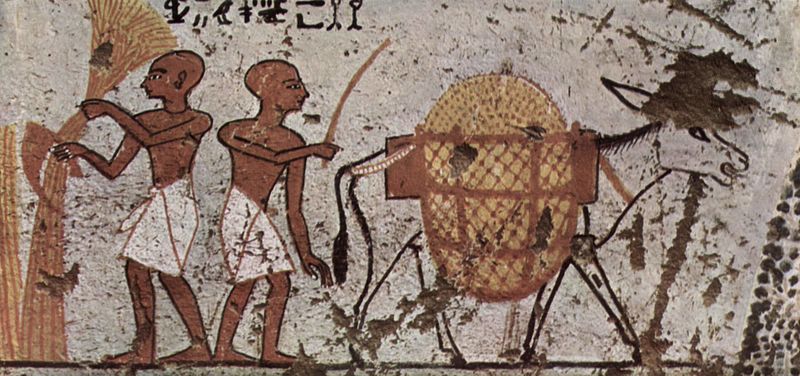
Donkeys were commonly used as beasts of burden, especially where horses were in short supply for the breeding of mules. Other than the Egyptian painting at the start of this ramble, there are some Greek images of baggage donkeys such as here .

Despite their common use in Ancient times the number of 15mm donkeys available is very limited. I used some from Tin Soldier.  There is a single pose and no variation in load, though the heads and legs are fairly easy to bend as can be seen from my photo. If I hadn't been in a hurry to get these painted I might have put some green stuff baggage on some for variety. Tin Soldier figures can have a slight cartoony feel to them and these remind me a little of those in Disney's Pinocchio. I rather like them though :)  The drivers are from Xyston. Other bases use women and children from the Thracian range.

Mules 

Mules are of course a cross between a horse and a donkey - to be specific a female horse and male donkey. They are almost always infertile - so much so that the rare instances of a female mule bearing a foal was considered portentous. Mule use requires a decent number of breeding mares and some societies have not had the horses to spare. Egypt, for instance, seems to have used mules fairly rarely. (See here page 60) . The chariot pulling animals of Sumeria mentioned above may have been a similar hybrid though of domesticated donkeys and wild (Asiatic) asses.
  Mules have various advantages over donkeys and horses. They tend to be larger than donkeys though often not by much. The shape combines features of horse and donkey - in terms of figures the tail is like a horse's and the mane may not stick up as much.
Since I had no suitable figures at the time, I painted some of Essex's mules to look more like donkeys. These are much smaller than the Tin Soldier donkeys, and to me would be far too small against Xyston figures. [EDIT - Since posting this, Forged in Battle have released some Roman mules. I hope that Corvus Belli's mules are re-released as they looked good. I may end up getting some of AB's mules which are really nice but I fear they and the accompanying figures may be rather large].

Camels

Apadana Tribute - the BM
The Bactrian camel and the dromedary are both found being used as baggage animals in ancient times. Hybrids also found their place (see here). The most famous uses of baggage camels are when Cyrus the Great is supposed to have used his to scare Lydian horses and when the Surena carried plenty of spare arrows for shooting down Crassus's Romans. Plutarch says that Mithradates used them - he berates Sallust for saying that it was Lucullus's soldiers who first saw them and that they had previously been seen during the Pontic invasion of Greece (as well as a century earlier being used by Antiochus). These could have been either type of camel since,as in modern English, ancient usage can often refer to either form. Persian carvings show both types being brought in tribute.
Note, camels seems to have been known about in Egypt long before the Romans, since various terracotta and other images have been found there. However, these are likely to represent animals used by traders from the East rather than indicating wide use of the animal with Egypt proper. Camel drivers are mentioned in Ptolemaic documents and these do seem to have operated in the country itself rather than in Syria.

There is a nice image of a dromedary being used by Assyrians here. For my Persians, I have Bactrian camels. These are figures by Essex and have a lot of character. I think there are three variants in pose. The drivers are Xyston - various levy troops I had spare.
My pictures don't really do them justice  - there is a clearer one on Madaxeman - you'll also find some nicely done Essex dromedaries too


Alain Touller does some nice Bactrian camels with Mongol 'civilians'. They are quite a lot smaller
than other companies' offerings though I shall eventually paint them. If and when I do, I'll add them here. (EDIT - Here they are. Now OOP, unfortunately).


For my Islamic armies, I have a choice. I originally use Peter Pig's camels and drivers. Like most of their figures the drivers are small compared to other ranges. The camels are similar in size to other companies, including ones by Irregular and Tin Soldier which I haven't shown.


Though the Peter Pig beasts are decent enough figures, I got carried away and bought some of the
fairly new camels from Donnington. These have the baggage separate from the camels allowing a great deal of variety. They are the biggest of the camels I have though they don't dwarf other ranges.


Finally, here is a comparison shot of the three manufacturers:

Monday, 4 January 2010

Comparisons of Knights

Here's a comparison between the knights from various companies.


First, the horses. From the left
Legio Heroica, Essex, Mirliton, Black Hat, Alain Touller.

The Touller horses have been redesigned since I bought mine and I haven't seen them.


Again, from the left
Legio Heroica, Essex, Mirliton, Black Hat, Touller
The Black Hat knights aren't quite as versatile as their infantry, being noticeably smaller than other ranges. The Legio figures are a bit taller but it is their bulk which makes them stand out next to other figures. Their shields are just about identical in size to the ones from Mirliton though a little thicker. The Mirliton figure is one of the later ones in this range. Some of the earlier ones are a little smaller though not so much that it couldn't be natural variation. The Essex figure is one of their Spanish range wearing obsolete gear for the mid- to late-13th century.
From some pictures I've seen elsewhere, the Old Glory 'Crusader' range is a pretty good match for size and build of the Mirliton figures. Most of this range carry heater shields more typical of the mid 13th century than the 3rd Crusade. The ones in the 'Holy Order' range have larger shields which are of an earlier form though still more early 13th than late 12th century. The range seems to have a mix of early 13th century 'face mask' helms and mid century full helms. Both of these were found earlier, but full helms in particular seem to have been extremely uncommon pre-1200 and not predominant for another generation or more. The Old Glory figures also have most of the knights on barded horses which were probably uncommon before 1200.

I've used Mirliton figures for my Italians as well as French and German forces which are in progress. I used Touller figures for the Spanish. My current project is a Feudal English army of roughly the time of Simon de Montfort. I've had the urge for a while to paint a few figures bearing the arms of the nobility who held lands close to where I live. I've found even more information than I hoped and so now I shall do a whole army. About a dozen figures done so far so watch this space.

EDIT: Since writing this, Touller are out of production and unlikely to return, Black Hat/Gladiator/Metal Magic have just gone out of production and Legio Heroica are hard to get if at all.

On the positive side, Donnington have a range of 12th and 13th century figures. Mirliton have a range of  14th century figures, most of which will be suitable for the early part of the century. There are a few companies producing STLs for 3d printing though most are designed for 28mm rather than 15mm. They can be scaled but this can result in very fine detail which is harder to pick out. My favourite range is the March to Hell figures though the 13th century Feudal Europe mounted figures are very short in the leg. 

Sunday, 30 August 2009

Awake the Iron! - the Almughavars


 A notable feature of the Aragonese and, to some extent, the other Iberian armies was their use of the almughavars (or almogavars). These were infantry who, despite a lack of armour, soon gained a reputation for their fighting ability. They formed part of the armies used in the conquest of Valencia and were a major component of the Aragonese forces in Sicily. After the treaty of Caltabellota, a large number left Sicily and became the Catalan Company, working for various employers in and around Greece. Eventually they carved out their own state. Not all almughavars joined the Company though - some, for example, seem to have been part of della Ratta's mercenaries in Florence. These were paid for by their old enemy, the Angevin king in Naples. Dego della Ratta turns up as a character in the Decameron, an interesting read though decidedly more worldly than Dante's Divine Comedy.


 The 13th century chronicles have a great deal of detail about the Almughavars, especially Muntaner's Chronicle.
A pretty modern good summary of their career is here, with many sources listed. There is also a more general review of Spanish tactics which includes the almughavars here.

In wargaming terms they are difficult to portray since their lack of armour would make them very vunerable in many sets of rules. Sometimes they are categorised as if they were more protected to give them a chance of standing up to knights as they did on occasion such as the Battle of Falconaria. The circumstances in which they fought may also have helped, so it makes for much discussion.
As I write this, the DBMM lists which covers the Sicilians and the Catalan Company are being looked at before the publication later this year.. In the armies with Almughavars which have been published they have been categorised as superior auxilia. There has been discussion about them being fast blades in the new list, which may mean a change to the Book 3 almughavars.
In 15mm, the companies which make almughavars that I know of are Essex, Eureka, Irregular and Touller. I only have the first two - there are various pics of the Touller ones around such as here.

EDIT: Touller are no longer available. However, Lurkio figures (now available from Gripping Beast) also provide a large number of variations in the Almughavar pack. Donnington do Bidet javelinmen in the Feudal Europe range. March to Hell do 3d prints and the Medieval unarmoured militia with javelins look like they would work well.

This is a comparison shot of my Essex (on the left) and Eureka figures. There are, I think, 3 variations in the Essex range and an impressive 18 or so in the Eureka range. The Essex ones are perfectly decent but are a bit two-dimensional. Some of my figures have had arms bent so that the upright spears in particular are at more varied angles.
Some of the Eureka figures are a bit taller than the others but nothing which can't be explained by normal height differences.
Both ranges have the cap as the dominant headgear, as in the Heath books. This is mentioned in a description by Desclot as being leather, possibly red despite my painting. Other descriptions mention a sort of net for the hair which may have been metal. Some of the Eureka figures have this.

 The flags carried by the Catalan Company are described in Muntaner (p.409 in the edition linked to above). He mentions that the foot carried 'pennons' of the King of Aragon and King Fadrique - i.e. the King of Sicily. I haven't looked to see what the original Catalan word translated as pennons was, but it is likely pendon which had a pretty broad meaning rather than just the small triangular flags.

Tuesday, 28 July 2009

Crossbowmen comparison

Here are some painted 15mm crossbowmen.


The stand on the left is Black Hat and Touller, the next stand is Essex and the stand on the right is Mirliton.


This is a close up of the Black Hat and Touller figures. They mix well, including the crossbows which are different styles in the other makes. The outer two are Black Hat, the centre two are Touller


One of the distinctive features of Italian warfare was the wide use of pavesarii, shield bearers protecting the crossbowmen behind.


These are Mirliton figures. The Mirliton figures with pavise, CO11, are the same as the 'Assorted infantrymen' CO10. I decided to replace these with the ones attacking with lanze longhe - CO12.

The pavises were marked in the colours of their state. http://www.heraldica.org/topics/national/tuscany.htm has some information from Villani. Much of the information is in Italian - unfortunately for me only some of Villani is easily available in an English translation.

Before the Battle of Campaldino, the shortsighted Bishop of Arezzo is said to have asked "Whose walls are those?" receiving the reply that they were the enemies' shields. Dino Compagni's account is here

If you can get access to a copy of Sercambi's illustrations they are chock full of examples of painted pavises. They are from the later 14th century but are still useful. My local university library has a copy.

Incidentally, David Nicolle says that the Genoese at Crecy had spear-carrying pavisarii with them and that it was their pavises which were left with the wagons. His essay is here
I haven't read much about Crecy, so I don't know how secure this idea is.