Showing posts with label Mirliton. Show all posts

Monday, 31 July 2017

Stradiots, Hussars and Genitors


There was a parallel development of light cavalry at opposite ends of Europe which reached its height as the 16th century began.
The roots were, of course, far older. In the East, there was the steppe tradition which had come into Hungary and its neighbours many times. As Hungarian society changed, the number of locals who could provide skilled light cavalry began to decline. However certain regions and sections of society maintained their traditions for longer, in part due to the influence of the Tartars to the east and increasingly the Ottomans to the south.


These are QR Miniatures from their Polish late 16th century range. They look very similar to the illustrations of Hungarian horse archers from the late 15th/ early 16th century in the Army of King Matthias  so I have used them for these. A couple in the pack are armed with firearms so I have not used those. Others have cartridge boxes on their backs which I could have tried carving away but they are easily overlooked. 


These are QR Miniatures Serbians. Serbian cavalry entered Hungarian and then Polish service as their homeland was occupied by the Ottomans. Their style influenced the local cavalry, with the use of a lance being emphasised instead of a bow or crossbow. One of the theories for the origin of the word 'Hussar' is that it comes from Serbian. Over time, 'Serbian' may even have been a description of the style of cavalry rather than being a reliable indicator of the origin of all the men.
The figures seem to have been based very much on the Polish hussars in the Battle of Orsha painting*. Link has a number of close ups - I've shown a detailed view of the hussars at the head of this page. Also in the painting are similarly dressed figures who have bows as well as lances. They are likely Lithianians, though the green flag may originally have been blue.


The flag I have given them is Hungarian from here - it was a style carried at Mohacs in 1526.
These are some of my favourite figures.


These are some figures from the 'By Fire and Sword' range. Again, they are intended for a later period than I am modelling, so some have holsters on their horses. A bit of chopping and painting soon hides them though. These are from the 'Transylvanian' range. Most are actually sold as Szekelers so that is what I am using them as. They are quite similar to the Hungarians shown in the Babenberg family tree. I wonder if the blue trousers are significant - they seem to be increasingly a feature of Hungarian military wear until they became a standard part of the uniform in the 18th century.

These figures would probably work as Moldavians and Wallachians as well, and perhaps Lithuanians if they are not as dolled up as the ones in the Orsha painting.


A comparison shot of the QR Serbians with BFaS Szekelers. Since they are likely to be unfamiliar to many, I've put a comparative Essex element next to them.


Apart from the comparative Essex figures, these are Stradiots - those in the centre element are from Venexia, those on the right are Mirliton. All the Stradiots are mounted on Vexillia horses - some have had the Eastern style rump covers added.

Stradiots were recruited by the Venetians in their territories across the Adriatic. They were initially Albanians though their name is probably Greek. This has a selection of pictures of Stadiots and Hussars - there is often argument about which are represented in certain pictures.

For a while, the Venetians paid them according to the number of heads taken (see Commynes), so some of the horses have Xyston severed heads hanging from the saddle.

More stradiots and/or hussars can be found in Maximilian's Weiss Kunig including plates 75, 77, 82 and 83.

The role of stradiots and Albanians in war can be seen in various contemporary histories such as Chalkokondylas, Bembo and Commynes


Most of Western Europe used little or no light cavalry for most of the Medieval period. The main exception was in Iberia. The conditions, the Morish influence and the availability of suitable horses meant that the use of light cavalry continued through the reconquest and beyond.

These are mostly Donnington New Era figures from the new Islamic range and I really like them. There has been a lot of attention to detail, using mostly Ian Heath's pictures I think. These in turn are based largely on the 'Conquest of Majorca' and the 'Cantigas de Santa Maria' . There are many other examples here.
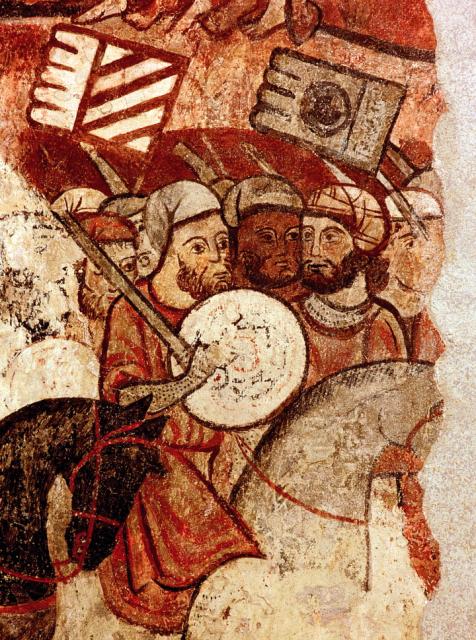


Berber horsemen continued to look very similar over the next centuries as can be seen in the Conquest of Oran.

The same picture shows how the Christian Spanish had changed by this time.


This shows the Essex Andalusian horse next to jinetes of the 14th century and some from the late 15th/early 16th. Even by the 14th century the equipment had become heavier. The middle figures are by Alain Touller, those on the left by Venexia (though on Vexillia horses). Both ranges are unfortunately OOP. [Update: Venexia are available from Lancashire Games. Vexillia are now OOP though].


*Watchers of BBC's Being Human may remember that Orsha was where Hal made his, umm, lifestyle choice.

Sunday, 23 July 2017

Bohemians, Hungarians and Poles


I have been steadily replacing the pictures which were stored on Photobucket. I thought I ought to add a few new things.

Some time a year or so ago, I thought I would add a few things to my 13th century Hungarians so that I could use them as 15th century Hungarians.

The knights were obviously ought of date, so I painted some new ones. I needed some Serbians, so that was new lead. 
In fact, by the time I was finished, there was nothing from the 13th century army which was going to be used.

This post covers the infantry I used.


The best description of the 15th century Hungarian infantry is from Matthias Corvinus. Matt Haywood's useful site on Eastern European armies of this period has the information so I won't repeat it.

This sounds to me very like the Bohemians portrayed in action against Maximilian just after the end of Corvinus's reign. This has been debated on the DBMM and DBM yahoo groups in some depth so I won't go into the pros and cons.

Bohemians found their way into a number of armies after the end of the main Hussite Wars. There were various opportunities for these experienced soldiers in Germany, Hungary, Poland and with the Teutonic Knights as well as in their native land which was wrangled over by the neighbouring states and local rulers.

Even though I think these men probably fought in a similar fashion for these various employers, the DBMM lists portray them in different ways. 

The Hungarian lists separates out the various parts described by Corvinus. The 'shield bearers' are spear elements. For these, I used Vexillia's own Polish pavise bearers. There are only two poses but it is enough IMHO. They are very easy to paint, with quite a lot of armour. 
The pavises are from Minifigs. Not only do you get quite a lot for your money but they have no stand to get in the way. The shield designs are a mix of Bohemian and Hungarian origin, including some from Maximilian's victory parade. Some have St George, St Michael or David fighting Goliath, though on the battlefield the designs are very hard to see.


Various pictures of Maximilian's battle at Schoenberg 
exist ncluding this: 

As well as the various engravings of Schoenberg (aka Wenzenbach or the Bohmenschlacht), Maximilian's tomb has an interesting representation. Maximilian and his men are shown in fashionable armour of some timeafter the battle but the Bohemian opponents are wearing more typical armour of the 1480s. The scene is dramatised but gives some idea of the variety of arms being used.
See here for another couple of portrayals of the battle as well as a discussion of the Hussite soldier (in German).


In the sidebar is a link to Uwe Tresp's work on the Bohemian soldier which covers their tactics, weaponry etc. through the 15th century.


The 'MM list also has some Blade elements. I'm currently using some of the Polish figures from QR miniatures which are part of their 13 years war range. The figures are pretty good though rather chunky compared to the Vexillia figures. Some of the other figures have what looks like a goedendag but I suspect it is an ahlspiess as shown on Maximilian's tomb. The QR figures may get replaced - I have a variety of Minifigs figures which match the size of the Vexillia figures better, and despite being old they have some character.

 The Polish, Hussite and German lists all have double based BwX with Bw behind. They appeared in the German and Hussite lists for the first time with the current edition and it caused a problem - they had inferior bow as a rear rank which isn't according to the rules. As it isn't clear what would happen in various circumstances, the tournament organisers have generally decided that they will cost and act as BwX/BwO. (Update: the DBMM lists printed by Lulu have altered the classification in this way).
For those unfamiliar with DBx terminology, BwX usually represents a thin crust of shield bearers with some kind of melee weapon protecting larger numbers of shooters.

As I had already painted the late 15th style pavises for the Hungarians, I decided to go with more straightforward heraldry for these. I could have made some sabot bases to turn the spear into the front rank of the BwX but decided to go the whole hog.

The shield devices are city militia devices according to the very nice sheets of Polish and Teutonic heraldry like here.
They have been made for the Tannenerg/Grunwald period whereas these figures are mid to late 15th century. Some are for towns which rebelled against the Teutonic Knights, allying themselves with the Polish king. In contrast to the rather busy designs on the later pavises, I used red and white designs almost exclusively.

The painting of the Battle of Orsha shows Poles using a pavise and shooter combination in 1514. There are some debatable points about the accuracy of the painting but it is good to look at anyway.


 I know comparison photos are often useful.
These are handgunners - from the left:
QR - QR, Mirliton - Donnington NE, Donnington NE - Mirliton.

The final Mirliton figure is noticeably smaller than the other figures which it came with. I think it was made for the Condotta range which has slightly smaller figures than the Swiss-Burgundian range.
 Crossbow men -
from the left:
Vexillia-Mirliton, QR - QR

Tuesday, 8 September 2015

Maximilian, the Landsknechte and the Swiss


As I said in a previous post, I have wanted to do some Italian Wars figures for a long time. 


One of the spurs was that Venexia were going out of production and the UK supplier was selling off the stock. Since these are some of my favourite looking figures, I decided to buy a good number of the various types of cavalry.

Hopefully, the range will see the light of day again but various issues have delayed their re-release by the new owners of the moulds.


The above photo is mostly of Venexia figures. Knights in sallets are from Mirliton. I gave some of these a green stuff skirt which was fashionable from around the start of the Italian Wars. 

The trumpeter is from Mirliton - he has a new hat and feathers added to give more of the 'Triumphzug' look. 
The 'candy cane' lance look is very popular with wargamers but may have been rather more restricted in reality. They do appear like this when used for banners such as in various of Diebold Schilling the Youngers illustrations.

My main sources for the troops of Maximilian are given in the last post. 


Landsknechte from Old Glory 15s. One feature that marks them as Hapsburg is that they have St Andrew's cross slashing on many of the figures.


Most of the standard bearers have the flags in a single hand as in most period pictures. Command packs are sold separately and are rather large. You may be able to negotiate buying smaller numbers with OG though if you are having a decent sized block then plenty of command adds to the look.
I mixed swordsmen and halberdiers into the front ranks for the visual appeal. They are also on some of the command stands so that the full blocks have mostly pikes to front and sides with halberds and swords around the banners and drums.


An attempt at peacock feathers.  


Talking of banners, the photography makes the shades of white stand out more than they do in real life. They also lose the texture. I've recently started using some water damaged tracing paper which has a nice crumpled texture. It also makes doing the opposite sides easier. They have sturdier than the strong tissue I used for my Byzantines. 


Old Glory crossbowmen. The red flag in the foreground was carried by the forlorn hope. The flag in the rear is carried by some of Maximilian's mercenaries in Schilling the Younger.

Luzern, Korporation Luzern, S 23 fol., p. 386 – Illustrated Chronicle by Diebold Schilling of Lucerne (Luzerner Schillling) (http://www.e-codices.unifr.ch/en/list/one/kol/S0023-2)


Old Glory arquebusiers. The flag is another carried by some of Maximilian's men in Schilling and here


Luzern, Korporation Luzern, S 23 fol., p. 521 – Illustrated Chronicle by Diebold Schilling of Lucerne (Luzerner Schillling) (http://www.e-codices.unifr.ch/en/list/one/kol/S0023-2)


Maximilian married Mary of Burgundy after the death of her father, Charles the Bold. Their daughter, Margaret, was regent of the Low Countries and was still using English archers in the early 16th century - 1500 were sent to help against Guelders for instance. (see Stow's Annals) where they joined an army of 10000. The DBMM list assumes that the Burgundian Ordonnance lance structure was still in place until the end of list in 1506, though with slightly fewer archers per knight. I think the 'MM list could be continued until the end of the covered period i.e. 1515 since Margaret continued as regent with a good deal of independence until then.

There are some archers in the 'Weiss kunig' though at least some are likely English.
The Camisado blog has a collection of Weiss Kunig plates showing archers. Some are carrying Burgundian saltires but may actually be English at Guinegatte in 1513.
In others, English seem to be shown in different costume, such as kettle hats. One plate shows the archers looking like Landsknechte.


I used Freikorp/QRF/TSS figures for these. I like them though they are slightly 'old school' compared to most of my figures. There is a mixture of Burgundian and early Tudor figures.

The yellow and red is said by Stow to be the livery of the Duke of Burgundy - perhaps Margaret's own. Poynings' men received new coats of this red and yellow along with Henry VIII's white and green. How this was arranged isn't clear, only that "these four colours were 'medled' together." They received these coats after campaigning in Guelders so did not wear them in action.


Old Glory artillery. The gun colours come from various sources including Maximilian's zeugbuch. 


When Margaret campaigned against Guelders, there were apparently 36 English serpentines as well as Poynings' archers. These are given individual names in Stow, such as the Antelope, the Cockatrice, the Mermaid, the Rose and the Normandy.


For much of the period, Maximilian and the Swiss were on opposing sides. Things particularly came to a head with the Swabian War which really ended any pretensions that the cantons were part of the Empire.

These are Khurasan figures. Some of the figures have Swiss crosses moulded onto their armour or as slashing.

Most of the standard bearers are converted pikemen. The way he holds his pike makes it easy to give him a one handed banner. Flags are hand painted.

The figures are rather smaller than the Old Glory landsknechte. This is exaggerated both by the slighter build and the very thin base of the Khurasan figures.

I only have enough Swiss to be able to provide an ally for the French. I have bought some of the Donnington Swiss for using in earlier periods. I shall paint these with far more use of cantonal colours as shown in some of the chronicles.


Saturday, 29 November 2014

The Carroccio

Each year, the Society of Ancients organises a day where the same battle is played using a number of different rulesets. Speakers place the battle in its historical context, and there are usually discussions about the available sources and how to portray the battle in miniature.
For 2014, the chosen battle was Montaperti, which fits my existing collection of figures rather nicely.

I put on a DBMM version of this battle which you can read about in Slingshot 296 - the magazine of the Society of Ancients.


One notable feature of the battle is the presence on each side of a carroccio - a wagon carrying a banner.
Even today, many Italian cities feature these in their festivals. 
The Mirliton 15mm Carroccio
(with Black Hat Feudal figures on the same base as escorts)


The carrocci and similar great standards carried on wagons were a feature of many battles, especially in the 11th to 13th centuries.


Medieval Italy: An Encyclopedia summarises the origin and some details of these wagons but I thought I would bring together some of the evidence about them.

Frederick II taking the captured Lomabard League carroccio into Cremona.
For the parade, it was drawn by his elephant.

The description of Richard I's standard at Arsuf (1191) sums up much of  the appearance, and both the value and the disadvantages of the wagon standard.

"The Normans defended the standard, which we do not consider it irrelevant here to describe. It was formed of a long beam, like the mast of a ship; made of most solid ceiled work, on four wheels; put together with joints, bound with iron, and to all appearance no sword or axe could cut, or fire injure it. A chosen body of soldiers were generally appointed to guard it, especially in a combat on the plains, lest, by any hostile attack, it should be broken or thrown down; for if it fell by any accident, the army would be dispersed and put into confusion. For they are dismayed when it does not appear, and think that their general must be overcome by faint-heartedness when they do not see his standard flying; for no people have strength to resist the enemy if their chief is in alarm from the fall of his standard; but whilst it remains erect they have a certain refuge. Near it the weak are strengthened; the wounded soldiers, even those of rank and celebrity, who fall in the battle, are carried to it, and it is called “Standard,” from its standing a most compact signal to the army. It is very properly drawn on wheels, for it is advanced when the enemy yields, and drawn back if they press on, according to the state of the battle. It was surrounded by the Normans and English.

Battle of the Standard - 19th century copy from 'ancient manuscripts' 
Also known as the battle of Northallerton, where an Anglo-Norman army defeated the Scots of David I. It is possible that the standard was used in deliberate imitation of the Italians.
"Some of them soon erected in the centre of a frame which they brought, the mast of a ship to which they gave the name of the Standard.
On the top of this pole they hung a silver pyx containing the Host and the banners of St Peter the apostle, and John of Beverley and Wilfrid of Ripon, confessors and bishops. In so doing their hope was that our Lord Jesus Christ, through the efficacy of his Body, might be their leader in the struggle. They also provided for their men a sure and conspicuous rallying point, by which they might rejoin their comrades in the event of their being cut off."


The Emperor Otto's standard at Bouvines (1214)
This seems to be a 'draco' style standard.  Harold II, Henry III and David I are also described as using dragon standards though not carried on carts. See my post for an interpretation.
"Soon after, Otto, already flying his banners as if he wanted to celebrate before the fact the triumph he was so sure of, raises his standard high, surrounds himself with the supreme honors of the empire, so as to make his rays shine in the middle of such a great show and to proclaim himself the sovereign of the whole world. On a chariot, he has a pole raised around which a dragon is curled which can be seen far away from all sides, its tail and wings bloated by the winds, showing its terrifying teeth and opening its enormous mouth. Above the dragon hovers Jupiter's bird with golden wings while the whole of the surface of the chariot, resplendent with gold, rivals the sun and even boasts of shining with a brighter light."

 
Minifigs 15mm Carroccio.


"And to the end the Fiesolans which were come to dwell in Florence might be more faithful and loving with the Florentines, they caused the arms of the said two commonwealths to be borne in common, and made the arms to be dimidiated red and white, as still to our times they are borne upon the Carroccio and in the host of the Florentines. " (G. Villani IV.7)

"In the year of Christ 1228, when M. Andrea of 

Perugia was Podestà of Florence, the Florentines led an army against Pistoia with the Carroccio
(G. Villani VI.5)

1241
"And the heads of the Ghibellines in Florence being banished, the people and the Guelfs who remained in the lordship of Florence, changed the arms of the commonwealth of Florence, and whereas of old they bore the field red and the lily white, they now made on the contrary the field white and the lily red; and the Ghibellines retained the former standard, but the ancient standard of the commonwealth dimidiated white and red, to wit, the standard that went with the host upon the carroccio, never was changed." 
(G. Villani VI.43)

Montaperti (1260)

The most extensive sources on the carroccio which I have found have been regarding the battle of Montaperti.

"And note, that the carroccio, which was led by the commonwealth and people of Florence, was a chariot on four wheels, all painted red, and two tall red masts stood up together thereupon, whereon was fastened and waved the great standard of the arms of the commune, which was dimidiated white and red, and still may be seen to-day in S. Giovanni. And it was drawn by a great pair of oxen covered with red cloth, which were set apart solely for this, and belonged to the Hospitallers of Pinti, and he who drove them was a freeman of the commonwealth. This carroccio was used by our forefathers in triumphs and solemnities, and when they went out with the host, the neighbouring
The Florentine martinella and carroccio at Montaperti
Villani's Chronicle (Wikimedia)
counts and knights brought it from the armoury of S. Giovanni and conducted it to the piazza of the Mercato Nuovo, and having halted by a landmark, which is still there, in the form of a stone carved like a chariot, they committed it to the keeping of the people, and it was led by popolani in the expeditions of war, and to guard it were chosen the best and strongest and most virtuous among the foot soldiers of the popolani, and round it gathered all the force of the people. And when the host was to be assembled, a month before the time when they were to set forth, a bell was hung upon the arch of Porte Sante Marie, which was at the head of the Mercato Nuovo, and there was rung by day and by night without ceasing. And this they did in their pride, to give opportunity to the enemy, against whom the host should go forth, to prepare themselves. And some called it Martinella, and some the Asses’ Bell. And when the Florentine host went forth, they took down the bell from the arch and put it into a wooden tower upon a car, and 
the sound thereof guided the host. By these two pomps of the carroccio and of the bell was maintained the lordly pride of the people of old and of our forefathers in their expeditions."

(G. Villani VI.76)

"Ora, preso il partito per li Fiorentini di uscire a campo, partironsi di Firenze il grande campo; e per pompa e per grandigia e per mettere spavento ai nemici, menarono il carroccio, sopra del quale era una grande an tenna in sulla quale si spiegava 1' arme del comune di Firenze, che allora era bianca e vermiglia" 


"tirato da due grossi palafreni" (drawn by two great steeds)

"Con quest' ultimo Terzo veniva il carroccio , con suvvi il gonfalone reale , eh' era tutto bianco , e  ben dava conforto che pareva il manto della Vergine Maria. " 

The white banner of Camiolla is shown on the Sienese carroccio in Ventura's paintings. Note how rustic the wagon is, with solid wheels and possibly wicker sides.


According to the headphone guide provided by the cathedral, the two wooden poles here are the masts (antennae) of the Florentine and Sienese carrocci used at Montaperti. A nineteenth century study says that they are actually votive offerings of Sienese antennae.


This rather unprepossessing
doorway is seemingly
the home of modern Siena's
carroccio. It is right next to the
Piazza del Campo


Other battles where a standard wagon is noted include

Sirmium (1167) - used by the Hungarians
Legnano (1176) - where it formed the heart of the victorious Milanese defence
Bodesine (1213) - details seem confused but a Milanese carroccio said to have been captured here still exists - in part - in Cremona
Cortenuova (1237) - the Milanese carroccio was captured and sent via Cremona to Frederick's allies in Rome.
Kitzingen (1266). A banner of St Killian was carried on a Fahnenwagen by Wurzburg. It is described as 13' 6" by 7' 3" here
Wörringen (1288) - used by the Archbishop of Cologne. His opponents seem to have had their own but captured the Archbishop's and continued to use it in later years.
A 1621 picture of the standard wagon at Wörringen is here. Another, clearer, picture can be found in this modelling guide to making this wagon. The Rymkronyk can be found here. More info on the battle including a model of the wagon here.
Gollheim (1298) - used by the Archbishop of Mainz while fighting on the side of Albrecht von Hapsburg. There is a rather fanciful 18th century depiction here.


Lewes (1264) - De Montfort left his banner with his wagon but this does not seem have been a proper standard in the manner of the others. The wagon had been used to carry him around after he was injured and during the battle seems to have incarcerated some London notables.


Please let me know if you have details of other battles where carrocci are known to have taken part.


Model Carrocci:

Mirliton 15mm or 15mm,  28mm
Minifigs 15mm
Black Hat 15mm
Essex 15mm, 28mm
Hall of Ancient Warriors 15mm (I don't know anything of this one!)
Perry 28mm - also available with just the wagon
First Corps 28mm

Let me know if you are aware of others.

Downloadable banners from Krigsspil

Wednesday, 29 August 2012

Hungarians of the 13th Century

A few months back, I decided to have another go at finding some of the heraldry for the Kingdom of Hungary in the 13th century. My lack of any knowledge of Hungarian was a bit of a problem and it seemed that there was precious little available online in English although I did find a few coats in wikipedia.

In Pal Engel's book there were a few references to heraldry which made it clear that it had begun to emerge in the kingdom soon after it appeared in Western Europe. Armed with a few names, I eventually found some information. It turns out that the Hungarian for coat of arms is cimer from the French cimier  meaning crest. The arms belonged to a number of gens (clans - nemzetseg) and I think that various members of the clans would bear the same arms or close variations. Here is a potted history of some of the clans. One reason for this different approach is that society developed very differently in Hungary compared to Western Europe although some aspects of feudalism did appear especially under the Angevins in the 14th century.

The most useful site I found was here. I concentrated on those labelled nemzetseg  as most of the entries are civic. Even without any knowledge of the language it was possible to use dates to narrow down the arms I wanted to use. There was quite a change in the style of arms into the 14th and 15th century, so I tried to make sure I used the arms from this earlier period. I saved these as a word document so that I could refer to it during painting. Even with this site, I have likely made some errors.
Support for some of the arms comes from the Gesta Hunnorum et Hungarorum of the late 13th century. The author included a discussion of where some of the non-Hungarian familes had originated, many of which were German. In many cases the arms are described.


By the 13th century, there were increasing numbers of people who held land within Croatia and Hungary proper so I have included a few Croatian arms. I did intend to keep them on the same base but messed up! Here is a site with some background to Croat heraldry.

The King. I don't think I found a specific example of both sets of arms being used together, so a bit of poetic licence.
(EDIT - I rememeber now - the Chronica Pictum does show this combination though it may well be anachronistic. See here

Centre figure is OG15s flanked by two Mirliton figures.


Hont-Pazman, Buzad-Hahot, Jak
Keglevic (Croat), Hermann ('Saxon'), Kaplony 


Ratold, Gutkeled (both probably 'Saxon')


Gundulic (Croat), Doroszma, Subic (Croat)


Kacsics, Vaja, Boksa


There are a few alterations to some of the figures. The Vaja figure is a OG15s. It comes with quite a tall helmet which I didn't much like, so this was cut down and changed to form an early form of face mask helm. The same figure was used for Doroszma but this time the entire head was removed and replaced with a Minifigs helmet. The rest of the Minifigs figure was a bit small to fit the style of the other figures but this magnificent crest needed to be put to use. I have a couple of others which are likely to end up being used elsewhere, probably as Poles or the King of Bohemia. The Hermann figure has also had a Minifigs head grafted onto an OG15s body. The shape of the helms makes them ideal candidates for transplants, with enough room to drill a hole and insert a small piece of brass rod to keep the head secure. 

For some background reading, there is a list of sources here . This mainly focuses on the 15th centry, so I would add the chronicle I mentioned earlier and also Hungary in the Thirteenth Century . I managed to look at both of these at my local University library. The latter book has a reasonable amount of military detail including some about the first Mongol invasion.