Thursday, 24 February 2011

Medieval Village

A while back, I posted about a model church I built. I used the same method to construct some vilage houses and have finally got them finished (more or less!).
I based the church with a small graveyard.
There are some crosses to mark the graves though they are so difficult to see that they are actaully more trouble than they are worth. The fence is from Hovels as part of their Dark Age range.
There are records of a bishop ordering the enclosure of the area around the churches in his diocese dating from this period. This was seemingly a twofold reason. It kept animals from wandering around the graves. It also helped to stake a claim to the land - there was often dispute between church and village over the rights to wood grown next to the church. When I took the photo I forgot to include a tree which I bought for the purpose. It is a Skale Scenics oak though it does a fair job of being a large yew.


These are two of the three houses I built. They are cruck houses as in this diagram
They were often quite standardised in size. This was due to various factors; many villages were planned by the local landowner so plots were of equal size. The building width was influenced by the size of the animals kept inside since they shared the dwelling with the humans. This continued in many areas of Europe until really quite recently. There is a diagram of a 19th century house - French I think - where the animals tails are tied strategically to avoid slurry being sprayed around the kitchen.
This article gives a table of house widths - they are pretty close to being 16' (around 5m) across. The length of houses is given by the number of bays - again, each bay is around 16' wide - with two or three bays being typical.
The pig sty is from Hovels. It comes with lengths of fencing. I used Donnington pigs though the ones from Hovels are fine. For England the pigs should probably be similar to Tamworths with upright ears and ginger hair. Those on the Luttrell Psalter are really quite lithe by modern standards.

I've based the buildings individually for convenience and to allow the village to be varied in size. The hight of the bases is actually an advantage since each house was built on a toft - a raised area. These would have been larger in proportion to the houses than I have shown. The raised area helped with drainage and would often have continued to rise with time compared to the roads due to erosion of the road and deposition on the toft. Much of the toft would be given over to vegetables and would often have been fenced to protect against wandering animals - for much of farming history fences etc. were for keeping animals out of an area rather than keeping them in.

While I'm discussing farming, there is a great site which is useful for the whole history of British farming. It shows a typical landscape at various points in history and discusses factors such as tree cover. One of the things which surprised me was that there was less tree cover in England at the beginning of the 14th century than there is now. More land had to be cleared for farming, partly because so much was left fallow, and many marginal areas were planted which were abandoned due to the various scourges of the 14th century. By the time the population had recovered, farming was more efficient so much of the marginal land was never recleared, despite the subsequent massive rise in population.

This is a place I must get round to visiting: Cosmeston Medieval Village.

Thursday, 10 February 2011

More Spear comparisons

A while ago someone asked whether I had some comparison shots Donnington and Khurasan.
These are, from left to right - Khurasan, Donnington New Era, Old Glory (from Crusader range) and Black Hat (feudal range).

Sunday, 30 January 2011

Plutarch's Wars: Successor Generals


There were a number of interesting characters in the Successor Wars. Some had held high office under Alexander whereas others made a meteoric rise in the confusion of shifting alliances or only attained maturity as the wars raged.

The careers of these men is covered in many places, so I won't go into detail. If you are interested, then reading the appropriate Lives by Plutarch is a good place to start although by his own admission he is interested in the moral aspects rather than straightforward history.

For my Successor armies, I painted a variety of generals. I wanted at least 6 so I can field two armies at once, plus some on foot. With so many theoretical elements, I decided to add a few details to give a bit of differentiation.

 This is one of the foot generals. Figures are by Xyston. For the phalangites shields I made some transfers. The general's aspis was inspired the the decoration in the Tomb of the Erotes


The picture at the beginning of this post shows some of the mounted generals I use. All figures are by Xyston.


The central figure wears a helmet as shown on some depictions of Alexander. He gets used as Alex and as various others of the Successors.


I use this as Eumenes of Kardia. He raised a large number of Kappadokian cavalry and some of these may have formed his personal agema. I have kept them on armoured horses as may have been used by Kappadokians at Gaugamela a decade earlier.
The Xyston Kappadokian figures are a little bigger than their Macedonians which makes Eumenes look quite young!


This rear view is the figure I use for Peukestes. He was an enthusiastic supporter of Alexander's move towards mixing the Persians and Macedonians and is noted for wearing Persian dress. For these figures I used the Xyston xystophoroi figures. These are larger than most others - the cloak and feathers add to this impression. As can be seen, I removed the feathers from all except the general. I also added some sleeves and a collar to turn his cloak into the distinctive Persian coat. This is shown in Achaemenid art, is worn by Easterners in Roman art and continues to show up in the area even today - Hamid Karzai frequently wears a coat in this fashion.


I know a lot of visitors to my blog are interested in the comparison shots. Here are some Xyston cavalry alongside Old Glory 15s Seleucids.


Here are, from left, Black Hat (ex-Gladiator) Kappadokians, Essex Companions and Xyston Companions.

Plutarch's Wars: A Successor Battle

The Wars of Alexander's Successors have interested me for a long time and make for good wargames. A number histories have quite a lot of detail about the battles and the troops who fought them. The various generals have armies which are similar enough for generalship to play an even larger part than normal while each having their own quirks to make them distinctive.
We recently fought a Successor battle with DBMM at our club. The armies were equal points - 500 apiece - one being based on Antigonus One-eyed's forces (Asiatic Early Successor) and the other being Seleucid. It was similar to the clash at Ipsos which resulted in Antigonus's death. It is possible to recreate the coalition force at Ipsos using the Lysimachid list but I was slightly short of some of the necessary troops, especially the eight elephants needed for one side.
I feel Successor battles work best at 500 points (or more) as it gives you enough points to have a sizeable phalanx while still having the troops to fight a good battle on the wings.
Here are a couple of pictures - the club lighting isn't up to much and using the flash didn't improve the pics much :(

Here is the Antigonid phalanx, flanked by a vineyard. The Seleucid elephants are advancing. They should be towerless at this point but I haven't finished the basing of the ones I have - it was a last minute decision to use these armies!


The whole field near the beginning of the game. Seleucids on the right.


The clash of pike. The Seleucid argyraspides initially killed a number of enemies but overall there was enough toing-and froing that the Antigonid's were beginning to threaten the Seleucid flank. Out of shot, the rest of the Seleucid pike were beginning to beat the rest of the Antigonid phalanx.


The situation on the Seleucid left. This was the major clash of cavalry as the right was partially covered by a marsh. The Seleucids moved their right flank general and his agema to this wing. This didn't create a superiority in numbers but did improve the command situation. We had a clash of elephants as well as a swirling cavalry battle. The Seleucids broke the Antigonids but it is unlikely that many of them could have avoided pursuing the enemy from the board.
We called time here. The Seleucids didn't need to inflict many more casualties to break the Antigonid phalanx but their own left was beginning to falter and this could have had a devastating impact on their own phalanx.

Next - some photos of some Successor generals.


Sunday, 5 December 2010

Plutarch's Wars: Skythians and lots of Green Stuff

...or Scythians if you prefer!

I've never really fancied a Skythian army, but I seem to have always had a few figures for using in a variety of armies as far back as when I was using Peter Laing figures. I have a mixture of various sources although they are mostly stored away now that I have some Xyston figures.

For sources, I didn't go much further than the Osprey on these chaps. However, be careful! Virtually all of the figures in the plates are armoured and only one shows the typical Skythian cap which is worn by many of  the figures in Skythian art as well as depictions made by other nations. The Falcon figures range, which has some nice figures, follows the Osprey and as a result few of the range wear the caps.
One source which is worth a look is the Persian depiction of a fight between them and some Skythians. You can find it here - do a search for 'Scythian'.

For my Persians, I wanted to have some Massagetae armoured cavalry. There is a lot of discussion about how and whether they were linked to the western Skythians and what differences there would be in armour. Roman  Army Talk has a discussion with loads of links - many are in Russian but if you don't read the lingo then you can still look at the pictures! I did a lot of searching for suitable figures. There are various ones available for 'Scythian Heavy Cavalry'. Here are some I looked at.
Falcon: a good variety, based on the Osprey book. The figures are quite nice but perhaps a bit lacking in animation compared to more modern figures. Also quite small and reportedly difficult to get hold of.
Alain Touller: I was quite tempted. I've been told that the figures are small compared to other Touller figures.
Essex: Only seems to be one pose and lacked the full armour I wanted. Their Later Saka figures have potential, though perhaps more for the period after the one I'm doing. The horse armour lacks a certain something too.
Khurasan: I think they have some Massagetae on the way.
Old Glory: Quite nice figures but again the armour wasn't what I wanted.
Donnington: One of the older ranges. Paint up quite nicely I believe.
I got very interested by the Tin Soldier figures on Madaxeman's very useful site - but they are actually 28mm!
Xyston: Used to list a Massagetae heavy in their range as being for future release, but no sign after many years. However, I had some spare figures so thought I would turn my hand to some conversions, aided by Green Stuff and snippers.

I had some Xyston 'Satrapal Guard' figures and a few 'Northern Thracian Cavalry' which I thought would fit the bill. Ideally, I would like all of them to have armoured horses but may end up mixing them. The main textual source for their appearance is Herodotus:
[1.215] In their dress and mode of living the Massagetae resemble the Scythians. They fight both on horseback and on foot, neither method is strange to them: they use bows and lances, but their favourite weapon is the battle-axe. Their arms are all either of gold or brass. For their spear-points, and arrow-heads, and for their battle-axes, they make use of brass; for head-gear, belts, and girdles, of gold. So too with the caparison of their horses, they give them breastplates of brass, but employ gold about the reins, the bit, and the cheek-plates. They use neither iron nor silver, having none in their country; but they have brass and gold in abundance.

I would like all of them to have armoured horses but may end up mixing them. I referred to the sources available in the Roman Army Talk discussion, the Osprey, Armies of the Macedonian and Punic Wars, the Montvert Persian book and Gorelik's book on the Eurasian nomads.
With much chopping and Green Stuffing, this is what I got.
I had many goes with the caps unti I had something which I think I'm happy with.
The first ones I did were trying to look the same as those shown in Persian carvings, but they looked a bit too much like garden gnomes.
The next I was happier with, and weren't too different to the Xyston caps. However, I decided to go with something between the two, trying to look like those worn by some of the figures on Skythian gold artefacts.
 
 
They also needed to have bow cases added. These were pretty straightforward. I cut them more or less to shape before adding to the figure. Before it cured, I added it to the figure which allowed it to adapt to the shape of the figure. The bow was made as part of this and carved to shape when the case had hardened. If I did them again I would probably shape the bow with at least a core of brass wire (probably flattened) first. Hopefully they will be robust enough.
 
The bit which took the most time was making the shields. I did think of using Xyston peltas but the shapes weren't quite what I wanted. I had read a while ago about using Green Stuff to make push moulds and thought this would be an opportunity to try it out.
Firstly, I made some blanks out of plastic card. I mixed up some Green Stuff (apparently, a higher proportion of blue helps to retain detail). This needs to be coated with a release agent. Various things would work - I used something as high tech as olive oil from the kitchen. 
 
I left it overnight to cure.
The blanks can be removed fairly easily as the Green Stuff is still slightly flexible. I could have put some detail on the shields to begin with, but thought it might be easier to carve it into the Green Stuff. It worked reasonably well, but for the second attempt I put a think layer of the material in the bottom of each mould and worked the detail onto that. It also made the moulds shallower as the first shields came out a little thick.
To use the moulds, oil first then take a small blob of Green Stuff. This is squished and pushed into the mould, trying to make sure it gets right into all the detail. Leave overnight. These are the final results.
 
 
The excess trims off easily enough. The shields are slightly flexible but should be fine - I hope.
A couple of figures have had a wrap around shield added onto their backs as shown in some reconstructions.
Now I need to paint them which may well be a Christmas holiday job as I'm rounded off various other bits and pieces first. I also have to decide what length spear to give them - it'll probably be a longish spear but nowhere near as long as a Macedonian xyston as longer lance use on the steppes seems to have been later than the 4th century BC.

Friday, 12 November 2010

A real marsh - of sorts

I thought that I really ought to visit my local marsh since I have only been once and it was covered in snow and frozen solid at the time! I only live about two minutes drive away so it is a bit pathetic that I haven't been before.

It is one of the only remaining sizeable bits of marsh in the Midlands which isn't simply part of a floodplain. It is formed as run off from the nearby hills with the local geology preventing it from draining. There is reckoned to be about 5 foot depth of peat which has accumalated. Man has left his mark on the environment especially through the collection of wood. This has been going on for hundreds and perhaps thousands of years - pre-Roman settlement is known in the area. Without human intervention, wetland in this area tends to be wooded with trees such as alder surrounding numerous bodies of open water. As well as being used for things like clogs, in post-medieval times alder was one source of charcoal for gunpowder making. 
This map is from one of the information boards at the entrance to the marsh. The roughly horizontal line of trees seems, going by a nineteenth century OS map, to be the remains of a hedge line. The area has become more wooded in the last century with the decline of wood gathering though this is one method of keeping the meadows relatively clear...

Mowing machine
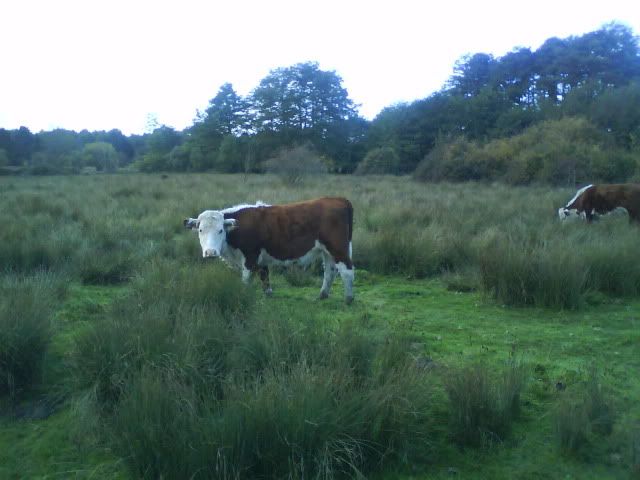
A small herd is maintained on the meadows; they keep down the grass and much of the scrub although the photo shows how much of  even the drier area is covered with low reeds. The herd roams into part of the marsh area as well. I could follow some of their tracks as far as the pond. Parts of the marsh may be too deep for them - the path crosses the main body of the marsh on a duckboard causeway and it looks decidedly wet underfoot. If you ever go - beware. I was wearing army boots and almost ended up pitching into the mire; the duckboards are decidedly slippy!

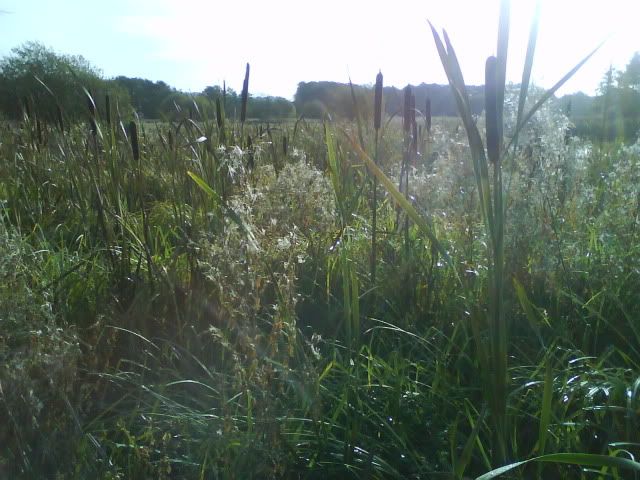
There are a couple of sizeable areas of open water surrounded by pretty dense reeds and bulrushes. Much of this is pretty tall.
Swampster in the bulrushes.


As for wargaming....
In DBMM terms I think I calculated that the marsh area would qualify as a 1 ME piece. Whether it is wet enough to be 'marsh' in rule terms is debateable though it is certainly far enough away from a river not to count as the marsh allowable adjacent to a water feature. It is certainly at least boggy ground. It did strike me that the rushes would be tall and dense enough to hide light infantry though their presence would likely to be revealed quite quickly if there was any movement.
The wet meadow is much drier (or was when I visited in October, though the autumn had been relatively dry) and might count as either open ground or some kind of rough going.

On a closing note... one of the reasons for the survival of this area of marsh (now an SSSI) was through the work of my father and his colleagues during the expansion of my town. Draining of the area had certainly been considered. He also helped to ensure that the route of the ancient and Roman road was preserved as the area was built up. Thanks, Dad.

Thursday, 11 November 2010

Plutarch's Wars: Romans of the Late Republic

The army of the Late Republic was led by a succession of generals who have made their mark on history. Julius Caesar is of course the most famous. But this is also the period of Marius and Sulla, Lucullus and Sertorius, Antony and Crassus. It is the time when the Republic's most deadly enemies were probably its own generals but it is also the time of Spartacus and Mithridates, Tigranes and Vercingetorix, Cleopatra and Surena.
 I wasn't particularly interested in this period when I was buidling armies 25 years ago, but I liked the look of the new (at the time) Freikorps Romans and I ended up buying a few. The metal was pretty brittle then, but most of them survived in my possession unpainted for the next couple of decades.
 
Once I had built a Pontic army I decided to start painting some Romans as an enemy for them. Since I had these Freikorps figures I decided to continue using them, especially as I wasn't keen on most of the others then available.
In the past year or so, the range has been redesigned so these figures are no longer available. Their replacements look pretty good though.

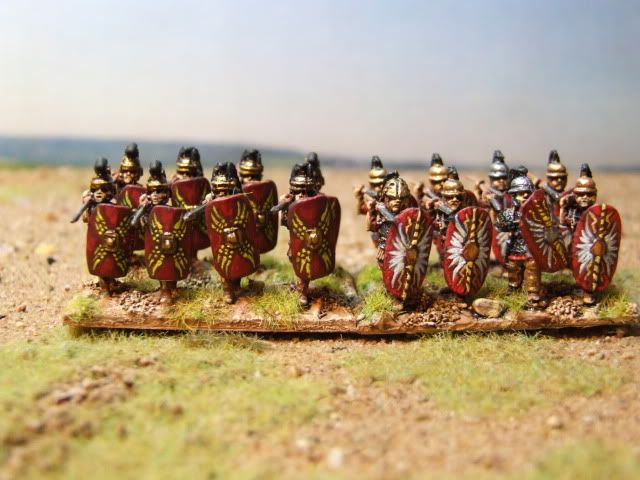
The figures were designed for the period covering the late Republic and into Augustus's reign. It isn't really clear how early the squared off oval shields began to be common, so I have included some with the others.
I painted the shield designs based on some from Armies and Enemies of Imperial Rome. Designs like this seem to have appeared on the monument to Actium so were probably used in the Civil Wars. Other shields may have been plainer and at least some seem to have had the name of their commander painted on. Actual colours are debateable though Amato's book shows a fresco with a red shield. I have some others painted with a blue background and some with black. (Incidentally, if you are interested in ancient paints, Pliny, book 35, goes into some details. Some paints would obviously be more common than others).

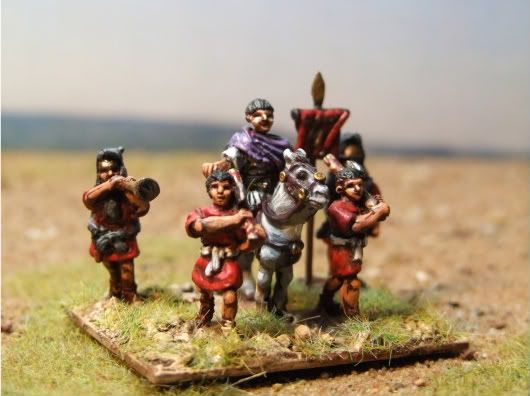
The Freikorps range includes some interesting looking generals for the Romans but unfortunately the horses are substantially smaller than most other ranges now avaible, so I have never painted mine. Instead, I have a variety of generals.

These are from the Warmodelling range. When I bought them, the company only produced Mid-Republican figures but these are equally suitable for the later period. The main feature of Warmodelling figures which lets them down a bit is that the horses tend to have stumpy legs, but from a normal wargamers viewpoint this is not as apparent. 
The legionaries from Warmodelling look pretty good although I think the shields are a bit too broad. I'm tempted by their 'auxilliaries' in the same range  for use in a Slave Revolt army which I am very slowly building.


These are from the Alain Touller range. They mix well with the other companies' figures. Their legionaries have pretty accurate looking shields although I'd prefer a wider variety in appearance.


I have a few of the Corvus Belli legionaries which will get painted some day. I'm not sure whether they will become the most experienced troops of a Slave army or a second Roman army for Civil War use. Either way, they are probably the most dynamic range of legionaries available for this period.