Showing posts with label Old Glory. Show all posts

Tuesday, 8 September 2015

Maximilian, the Landsknechte and the Swiss


As I said in a previous post, I have wanted to do some Italian Wars figures for a long time. 


One of the spurs was that Venexia were going out of production and the UK supplier was selling off the stock. Since these are some of my favourite looking figures, I decided to buy a good number of the various types of cavalry.

Hopefully, the range will see the light of day again but various issues have delayed their re-release by the new owners of the moulds.


The above photo is mostly of Venexia figures. Knights in sallets are from Mirliton. I gave some of these a green stuff skirt which was fashionable from around the start of the Italian Wars. 

The trumpeter is from Mirliton - he has a new hat and feathers added to give more of the 'Triumphzug' look. 
The 'candy cane' lance look is very popular with wargamers but may have been rather more restricted in reality. They do appear like this when used for banners such as in various of Diebold Schilling the Youngers illustrations.

My main sources for the troops of Maximilian are given in the last post. 


Landsknechte from Old Glory 15s. One feature that marks them as Hapsburg is that they have St Andrew's cross slashing on many of the figures.


Most of the standard bearers have the flags in a single hand as in most period pictures. Command packs are sold separately and are rather large. You may be able to negotiate buying smaller numbers with OG though if you are having a decent sized block then plenty of command adds to the look.
I mixed swordsmen and halberdiers into the front ranks for the visual appeal. They are also on some of the command stands so that the full blocks have mostly pikes to front and sides with halberds and swords around the banners and drums.


An attempt at peacock feathers.  


Talking of banners, the photography makes the shades of white stand out more than they do in real life. They also lose the texture. I've recently started using some water damaged tracing paper which has a nice crumpled texture. It also makes doing the opposite sides easier. They have sturdier than the strong tissue I used for my Byzantines. 


Old Glory crossbowmen. The red flag in the foreground was carried by the forlorn hope. The flag in the rear is carried by some of Maximilian's mercenaries in Schilling the Younger.

Luzern, Korporation Luzern, S 23 fol., p. 386 – Illustrated Chronicle by Diebold Schilling of Lucerne (Luzerner Schillling) (http://www.e-codices.unifr.ch/en/list/one/kol/S0023-2)


Old Glory arquebusiers. The flag is another carried by some of Maximilian's men in Schilling and here


Luzern, Korporation Luzern, S 23 fol., p. 521 – Illustrated Chronicle by Diebold Schilling of Lucerne (Luzerner Schillling) (http://www.e-codices.unifr.ch/en/list/one/kol/S0023-2)


Maximilian married Mary of Burgundy after the death of her father, Charles the Bold. Their daughter, Margaret, was regent of the Low Countries and was still using English archers in the early 16th century - 1500 were sent to help against Guelders for instance. (see Stow's Annals) where they joined an army of 10000. The DBMM list assumes that the Burgundian Ordonnance lance structure was still in place until the end of list in 1506, though with slightly fewer archers per knight. I think the 'MM list could be continued until the end of the covered period i.e. 1515 since Margaret continued as regent with a good deal of independence until then.

There are some archers in the 'Weiss kunig' though at least some are likely English.
The Camisado blog has a collection of Weiss Kunig plates showing archers. Some are carrying Burgundian saltires but may actually be English at Guinegatte in 1513.
In others, English seem to be shown in different costume, such as kettle hats. One plate shows the archers looking like Landsknechte.


I used Freikorp/QRF/TSS figures for these. I like them though they are slightly 'old school' compared to most of my figures. There is a mixture of Burgundian and early Tudor figures.

The yellow and red is said by Stow to be the livery of the Duke of Burgundy - perhaps Margaret's own. Poynings' men received new coats of this red and yellow along with Henry VIII's white and green. How this was arranged isn't clear, only that "these four colours were 'medled' together." They received these coats after campaigning in Guelders so did not wear them in action.


Old Glory artillery. The gun colours come from various sources including Maximilian's zeugbuch. 


When Margaret campaigned against Guelders, there were apparently 36 English serpentines as well as Poynings' archers. These are given individual names in Stow, such as the Antelope, the Cockatrice, the Mermaid, the Rose and the Normandy.


For much of the period, Maximilian and the Swiss were on opposing sides. Things particularly came to a head with the Swabian War which really ended any pretensions that the cantons were part of the Empire.

These are Khurasan figures. Some of the figures have Swiss crosses moulded onto their armour or as slashing.

Most of the standard bearers are converted pikemen. The way he holds his pike makes it easy to give him a one handed banner. Flags are hand painted.

The figures are rather smaller than the Old Glory landsknechte. This is exaggerated both by the slighter build and the very thin base of the Khurasan figures.

I only have enough Swiss to be able to provide an ally for the French. I have bought some of the Donnington Swiss for using in earlier periods. I shall paint these with far more use of cantonal colours as shown in some of the chronicles.


Wednesday, 2 January 2013

Plutarch's Wars:north of the Danube

I've covered some of the later forces of the various trans-Danubian people so here are some from an earlier period.
The people who occupied modern Rumania are known in various sources as the Getae and the Dacians with others such as the Basternae mentioned. The whole business is complex and since the ancient sources dont agree about who was who it is difficult for modern historians to be sure. The Dacians and Getae may have been one and the same or neighbours or some other combination. The Bastarnae are described both as Celts and as Germans.
A variety of ancient sources the interaction between Rome and this group of peoples. The first major conflict began just before the Third Mithridatic War and merged into it, the Bastarnae providing troops for Mithridates.
For the various wars leading up to Trajan's conquest in the early 2nd century AD there are a number of sources including Strabo, Livy, Tacitus, Suetonius, Cassius Dio.
One source for the appearance of the Getae (and the 'barbarised' Greeks of the Black Sea coast) is Ovid, a poet who was exiled to Tomis by Augustus - possibly for getting over-friendly with the emperor's grand-daughter. He describes the Getae having untrimmed hair and beards and that they kept off the cold with pelts and loose trousers (Among the Getae). This fits pretty well with the images we have of the Dacians and possibly their allies. Considering how few pictures we have of some peoples, we are rather spoilt to have both Trajan's Column and the Adamklissi monument. One always has to be careful about taking everything at face value, but they are still rather useful.
I have a few of Old Glory 15s Dacians. The normal packs include a mix of shielded figures with javelins and those carrying a falx. They are also either bare chested or wearing a tunic.
These are some I painted:


So far, I have only finished the bare chested variants. I shall be using these as Bastarnae to make identification easier.


One possibly helpful painting source is St Jerome who describes the Getae as being yellow haired. He may have been describing the Goths so it isn't that certain. Translations disagree about the whole description - some say the Getae are ruddy (presumably complexion) and yellow haired whereas others take it as being red and yellow haired.

A note of caution about red hair. Obviously there are people today who we describe as red-haired and there   jkl; will have been people with the same colouration in ancient times. However, I have seen a theory that in many cases the word translated as 'red' - purros in Greek - could mean a lightish brown or reddish blond in many cases. I find the development of colour words interesting - brown is commonly a late word to enter a language.


I've also done a few Old Glory 15s Sarmatians. These are pretty much as on the Tryphon tombstone though with some armoured horses. Armour may have been rawhide as in this amazing survival now at the NY Met - Strabo describes the Roxolani using this material. Pausanias describes a suit of armour made from horse hoof. If not lacquered, this may not have been too different in colour to rawhide although perhaps more shiny and it can have a slight greenish hue.

Wednesday, 29 August 2012

Hungarians of the 13th Century

A few months back, I decided to have another go at finding some of the heraldry for the Kingdom of Hungary in the 13th century. My lack of any knowledge of Hungarian was a bit of a problem and it seemed that there was precious little available online in English although I did find a few coats in wikipedia.

In Pal Engel's book there were a few references to heraldry which made it clear that it had begun to emerge in the kingdom soon after it appeared in Western Europe. Armed with a few names, I eventually found some information. It turns out that the Hungarian for coat of arms is cimer from the French cimier  meaning crest. The arms belonged to a number of gens (clans - nemzetseg) and I think that various members of the clans would bear the same arms or close variations. Here is a potted history of some of the clans. One reason for this different approach is that society developed very differently in Hungary compared to Western Europe although some aspects of feudalism did appear especially under the Angevins in the 14th century.

The most useful site I found was here. I concentrated on those labelled nemzetseg  as most of the entries are civic. Even without any knowledge of the language it was possible to use dates to narrow down the arms I wanted to use. There was quite a change in the style of arms into the 14th and 15th century, so I tried to make sure I used the arms from this earlier period. I saved these as a word document so that I could refer to it during painting. Even with this site, I have likely made some errors.
Support for some of the arms comes from the Gesta Hunnorum et Hungarorum of the late 13th century. The author included a discussion of where some of the non-Hungarian familes had originated, many of which were German. In many cases the arms are described.


By the 13th century, there were increasing numbers of people who held land within Croatia and Hungary proper so I have included a few Croatian arms. I did intend to keep them on the same base but messed up! Here is a site with some background to Croat heraldry.

The King. I don't think I found a specific example of both sets of arms being used together, so a bit of poetic licence.
(EDIT - I rememeber now - the Chronica Pictum does show this combination though it may well be anachronistic. See here

Centre figure is OG15s flanked by two Mirliton figures.


Hont-Pazman, Buzad-Hahot, Jak
Keglevic (Croat), Hermann ('Saxon'), Kaplony 


Ratold, Gutkeled (both probably 'Saxon')


Gundulic (Croat), Doroszma, Subic (Croat)


Kacsics, Vaja, Boksa


There are a few alterations to some of the figures. The Vaja figure is a OG15s. It comes with quite a tall helmet which I didn't much like, so this was cut down and changed to form an early form of face mask helm. The same figure was used for Doroszma but this time the entire head was removed and replaced with a Minifigs helmet. The rest of the Minifigs figure was a bit small to fit the style of the other figures but this magnificent crest needed to be put to use. I have a couple of others which are likely to end up being used elsewhere, probably as Poles or the King of Bohemia. The Hermann figure has also had a Minifigs head grafted onto an OG15s body. The shape of the helms makes them ideal candidates for transplants, with enough room to drill a hole and insert a small piece of brass rod to keep the head secure. 

For some background reading, there is a list of sources here . This mainly focuses on the 15th centry, so I would add the chronicle I mentioned earlier and also Hungary in the Thirteenth Century . I managed to look at both of these at my local University library. The latter book has a reasonable amount of military detail including some about the first Mongol invasion.


Friday, 17 August 2012

7th Crusade II

One point about the naming of this crusade. You will find some source material (such as the Salles des Croisades) numbering it as the Sixth Crusade. This is due to debate in the past as to whether Frederick II's crusade counted; he was excommunicate at the time and he achieved his aims by the rather unknightly method of negotiation rather than by slaughtering the heathen.

Anyway, more on the participants. This crusade was predominantly French, though the Wikipedia article are a bit off the mark with the reason. Henry III of England was not involved in conflict with de Montfort at this point - relations had been strained but Henry actually stopped de Montfort going on crusade as he wanted him to govern in Gascony. Allowing him to return to Syria could have been a convenient method of getting him out of the way if necessary.

Some English did take part however. The most famous was William II Longespée, son of the 3rd Earl of Salisbury. He is often styled Earl of Salisbury, and claimed the title himself, but his father only had the title by marriage and the younger William's mother still lived. He was not an exile and, according to a letter he sent to the Pope, accepted that the denial of the title to him was in accordance with the law. (See the Wikipedia article). In fact, he was even given an annuity by the king and Henry may have been instrumental in William gaining additional land. See the History of Poole from around page 16 for more detail of this character. The figure on the left of the picture is painted as Longespée.
His standard is borne by a member of the de Vere family. I have used one of the variants of the standard arms with a black engrailed border. The figure on the mail barded horse bears the arms of the de Bohun's. I'm now doubtful that a prominent member of the family carried out his crusading vows but I kept them anyway.
The figures are all Old Glory 15s.


These are also Old Glory 15s - lances have been replaced as those moulded on are rather flimsy.

They are painted as some of the knights from Frankish Romania. In the centre is de la Roche, Duke of Athens (though he was in the 8th, not 7th, crusade). On the right of the picture are the rather plain arms of the decidedly unplain sounding Katzenellenbogen.

More OG15s. The centre arms are those of Ibelin, borne by the Count of Jaffa. There is an interesting passage in Joinville:
"The Count of Jaffa came ashore upon our left, who was cousin-german to the Count of Montbeliart, and of the lineage of Joinville. He it was who made the most noble show at landing; for his galley came up all painted above and below water with his escutcheons, the arms of which are "or with a cross gules patee." He had about three hundred oarsmen in his galley, and each oarsman bore a target with his arms, and to each target was attached a streamer with his arms embossed in gold."
This is one of the few instances I have seen where it shows the rank and file also bearing the arms of their lord.


Finally, some more French knights.
The main reason I have included this is because it shows a mix of Old Glory (right) and Mirliton (left). The two ranges mix very well. The OG shields are slightly smaller. I do have some gripes with the range. They are sold as 3rd crusade whereas they are far more suitable for the mid-13th century though some have an older style helm. They also lack a saddle cloth on either the figure or the horse and there is a ridge underneath which stops them sitting well on the horse.However it was easy enough to make a green stuff saddle cloth and this helped the figures to sit well. I like the full mail bard on some of the horses and there is a wider range of horse pose than Mirliton.

Thursday, 29 December 2011

More Baggage

It's been far too long since my last post so I thought I'd put up a few more photos of different types of baggage.

A while ago I made a version of de Montfort's carriage. At the time I wasn't entirely happy so I thought I'd have another go.
The draught horse is by Donnington. The rider and infantryman are Old Glory. The wheels are from Langley Models, a fantastic source for all sorts of size and type of wheel. Good service too!
For those who like such stuff, the rider bears the Lambton arms - possibly those of Sir John of Lambton Worm fame.


The lower body of the wagon is plastic card. I then bent some florists' wire to shape for tilt supports. I tried tissue but that was too porous. The original pictures also make the upper porion look quite rigid so I used thin card. I wasn't sure whether to have the ends rigid or open but I settled on making curtains out of Green Stuff. I then thought I could take advantage of the curtains and have a go at making a passenger out of Green Stuff too.


I was quite pleased with the result.

EDIT: See Schilling's Berne Chronicle for details of a similar but 15th century cart
http://www.e-codices.unifr.ch/en/list/one/bbb/Mss-hh-I0001 p.405


Some DBMM Medieval armies can have pack horses as baggage elements so I have these from Donnington. The various bits of cargo are separate so can be arranged as you wish.

The wagon behind is also Donnington and again the cargo which comes with it is separate, allowing a variety of loads.


Quite some time ago, I bought some Alain Touller Mongol Baggage. This is a nice little set with a rider, a family on foot and a few Bactrian camels.

The tent is from Baueda.


The pony and camels are pretty small compared to other companies' - not necessarily unrealistically sized but small enough to not mix well. The humans would mix pretty well with Essex and similar sized figures.


More recently, thanks to a post on TMP, I came across QR Miniatures. Most of the range is Renaissance although they also produce some Poles and Eastern Franks from the 11th century which aren't yet on the website.
I ordered some of their horses since a number of DBMM armies have pony herds for their baggage elements. There aren't many suitable horses lacking tack so I jumped at these. I was pleased with them though I'd still buy some shaggy steppe ponies if I could get them.

EDIT: Thanks to Geoff on TMP; another source of ponies are QRF's 'Yellow Ribbon' range. Some have a halter but no saddles or blankets.

Thursday, 10 February 2011

More Spear comparisons

A while ago someone asked whether I had some comparison shots Donnington and Khurasan.
These are, from left to right - Khurasan, Donnington New Era, Old Glory (from Crusader range) and Black Hat (feudal range).

Tuesday, 29 December 2009

The Horde from the East


 Incursions into Europe by the people of the great Eurasian steppes had been happening since before the end of the Roman Empire. The Kingdom of Hungary traced its roots to the Magyars who settled in the Carpathian basin in the 10th century. Cumans, the western part of the Kipchak group, arrived in Hungary and the Balkans in the early part of the 13th century. They were refugees, fleeing a threat from the East.

 The meteoric rise of the Mongol Empire is covered by many websites. Their own account can be read in the Secret History. In short, a combination of absorption through alliance and conquest created a force which was strong enough to take on a succession of settled empires. The Xi Xia, of what is now Western China, were one of the first to feel the strength of Ghengis's force. They fought a series of wars against the Mongols. They eventually submitted but did not send forces to aid the Mongols when called upon. Further war resulted - Ghengis died during the final war of conquest.  The Jin dynasty of northern China was also under attack during this early period and although losses in territory and life were huge, the resistance was sufficient for the Jin to retain some of their lands until after the death of the Khan. 

Ogedei, Ghengis's successor, continued the process of conquest. There was something of a pattern - Mongol emissaries or traders in various places seem to have got themselves killed by the local authorities and an army was sent to wreak terrible vengeance. The Song dynasty, rulers of Southern China, managed to incur the wrath of Ogedei while allied with the Mongols against the Jin. The Song forces tried to retake land which had been lost a century or so earlier and killed a Mongol emissary who presumably voiced the Khan's displeasure.


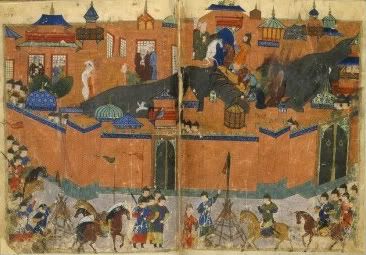
To the west, a series of campaigns conquered the Islamic lands - eventually conquering as far as Mesopotamia with incursions into Syria. The impact on Central Asia was immense and may well have caused a permanent decline in the economy of the area through the destruction of cities and even the grazing of huge numbers of horses. In this campaign, and others, locals were driven in advance of the Mongols as a human shield - especially during sieges. Catapults of various sorts were used extensively. During the campaigns in the Islamic region, the Mongols seems to have acquired the means to build counterweight catapults - the hui hui pao.


A relatively small force was sent to conquer the Kipchaks in what is now Russia - this expedition continued through the various Rus lands forcing them to become vassals of the Khan. Again, it continued to the west. It split into three, one part defeating a Polish/German army at Liegnitz - the involvement of Teutonic Knights at this battle was probably minimal and may have been non-existant despite many claims to the contrary. Even today the city of Krakow commemorates the attack of the 'Tartars' with a midday bugle call which cuts off short, as if the musician has been hit by an arrow.

The main part of the army confronted the Hungarians as a punishment for the King allowing the Cuman refugees to enter the country. Ironically tensions between Hungarians and Cumans led to the death of the Cuman king, most of the Cumans fleeing to the south.
The Hungarians met the Mongols at Mohi. The battle was hard fought but it resulted in the destruction of the Hungarian army and the death of much of the royal family and nobility. The Mongols pillaged the country though guerilla tactics by the populace meant that the kingdom remained unpacified.

These forces left Europe on hearing of the death of Ogedei. Tradition meant that the new khan should be chosen by the whole army. Further attacks on Hungary occurred but, importantly, they tended to lack the same ability to conquer cities.

The campaign against the Song dynasty proceeded in stages - again the death of a khan resulted in a hiatus. The nature of these wars was far more of a slog, characterised by long sieges, compared to the campaign in Russia and the rest of Europe. Even the succession of sieges in the Islamic areas were short by comparison. There is an essay about one of the longest here. It also gives some insight into the Song dynasty and its army. I'll post some more about the Song fairly soon.

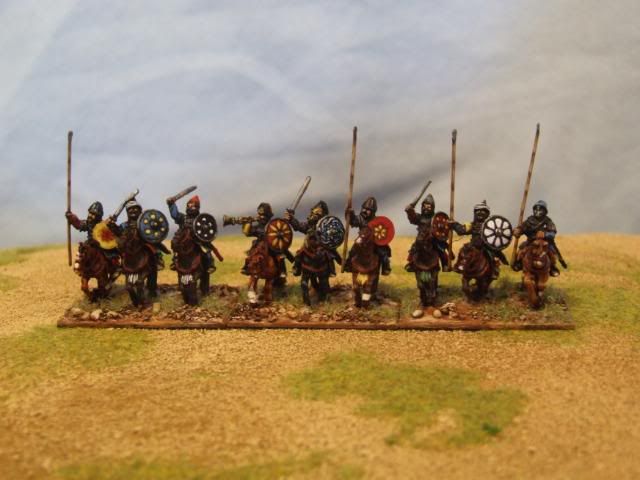
I used Old Glory figures for my Mongols.


These are some of their Heavy Cavalry with Melee weapons. There are certainly references to Mongols with shields but there is debate as to whether they would use them on horseback. Portrayals of earlier troops in this area do lack shields, so I decided to cut away the ones moulded onto the figures. This was not quite as daunting as it seems and it was possible to create the arm  fairly easily from the remains of the shield.


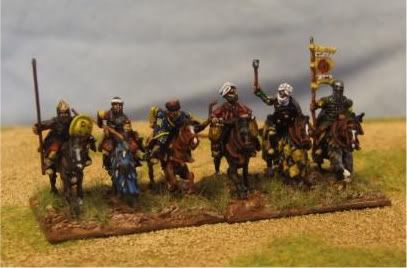
These are a mix of the heavy cavalry and medium cavalry archers. The main difference is really that the heavy cavalry are slightly bulkier figures, including the horses.


These are the Old Glory light cavalry with bows. I did these around the same time as the Turcoman cavalry and again I've overdone it when it comes to making them look as if they are firing sideways. It makes it confusing in the table-top!


The Mongol armies was made up of troops from a number of origins. Overtime, the appearance probably showed increasing degrees of homogeneity but I still have some which preserve the differences.


I use these as Jurchen cavalry. They are from the Outpost Manchu range. This is actually designed for a period about 400 years after the one I want, which shows mostly in the bowcases. At least some of the Jurchen had armoured horses - I may well use some of the Outpost Turkish horses which I have sitting around as the armour is pretty suitable. I could have just used the same figures as the Mongols but it lets me see which are which more easily and I liked the figures!
About half of the Outpost range are wearing the fabric covered 'brigandine' armour which became popular especially during the Manchu period. However, some seems to have been worn during the Mongol Yuan period. Even so, I asked Outpost to just send figures in lamellar armour after my initial order and I've even made some of the fabric covered armour into lamellar using milliput.


These are Black Hat light cavalry - a mix of Cumans, Hungarians and the occasional Lithuanian.


They mix pretty well with the Old Glory figures though the horses are smaller


The 'human shield' figures  are a mix of Donnington and Alain Touller figures. The AT packs come complete with a Mongol 'herder'. The Touller range looks pretty nice and I might well have gone with them if I hadn't already bought OG15s. The ponies do look very small compared to other companies' figures. This may well be accurate but the difference may be offputting. Since I bought mine, the horses have been redesigned so could be larger. I did buy the Korean infantry from Touller, which are based on the figures from the Invasion Scrolls. These may actually be Southern Chinese rather than Korean but either way they will find a place in my Yuan Dynasty army once they are painted. (edit: - they may even be Northern Chinese. The Yuan hadn't conquered the Song at the time of the first invasion of Japan. However, apparently some Southern Chinese troops had transferred to the Mongols even at this point, so it is hard to be sure who they are!)

Sunday, 11 October 2009

Syria and the Turks

The period I'm covering saw the last gasp of the Crusades in Egypt and Syria, with later efforts being concentrated elsewhere such as Spain and Prussia.

Part of the reason why the remanants of the Crusader states lasted for as long as they did was that their Muslim opponents could be as fractious as their European counterparts. After Saladin's death his territories were divided amongst his sons and other family members. At various times, one of these coud claim to be the overall leader but conflict between the cities was frequent. One result of this internecine warfare was the hiring of Khwarizmians, refugees from the Mongol Conquest. These were employed by first one side and then another in the wars between the Ayyubid Sultan in Egypt and his uncle and others. While crossing Palestine, the Khwarizmians took Jerusalem from the Christians, resulting in Muslim rule of the city for the next 7 centuries.

As might be expected for a 14th century Christian, Dante consigned Muhammed and Ali to one of the lower regions of the Inferno. Saladin is also in the Inferno, but on the first level, the region for those who
"did not sin; and yet, though they have merits,
that's not enough, because they lacked baptism,
the portal of the faith that you embrace.
And if they lived before Christianity,
they did not worship God in fitting ways;"
Saladin is notable as the others are almost all Classical figures, ranging from heroes of the Trojan Wars , through the philosphers and writers of Greece to renowned figures of Ancient Rome. Indeed, Saladin is noted as standing slightly apart from the others.


These are some 15mm Old Glory figures which I use as Ayyubid Syrians. They are a mix including not only their Syrian figures but also some OG Seljuks. Spears have been replaced by wire - the last few ranges from OG have seen them switch to very thin lances instead of the open hands on other ranges.
 This OG range has some nice figures but others are nowhere near as good. The size of riders and horses varies greatly and details such as bowcases and quivers are often far too small. I think the Syrians and Bedouins are probably the best of this range. The Seljuk range is generally much more consistent and better detailed.


These are Outpost Ghilman (with and Old Glory drummer - the Outpost one is very big).
The horse of the man with the mace has had a bard made of a J-cloth added.
When I first got the Outpost figures they seemed much smaller than most ranges but placed side by side the difference is due to the more natural proportions. Some of the horses are very nice, others aren't quite so good.


Turcoman cavalry - Outpost on the left, Old Glory on the right.
I tried for a dynamic basing with the OG figures, with most of them looking as if they are charging across the opponents front, firing as they go. Trouble is, it gets confusing as to which way they are actually facing, despite the base width and depth being different. I may well rebase these.