Showing posts with label Comparison. Show all posts

Monday, 31 July 2017

Stradiots, Hussars and Genitors


There was a parallel development of light cavalry at opposite ends of Europe which reached its height as the 16th century began.
The roots were, of course, far older. In the East, there was the steppe tradition which had come into Hungary and its neighbours many times. As Hungarian society changed, the number of locals who could provide skilled light cavalry began to decline. However certain regions and sections of society maintained their traditions for longer, in part due to the influence of the Tartars to the east and increasingly the Ottomans to the south.


These are QR Miniatures from their Polish late 16th century range. They look very similar to the illustrations of Hungarian horse archers from the late 15th/ early 16th century in the Army of King Matthias  so I have used them for these. A couple in the pack are armed with firearms so I have not used those. Others have cartridge boxes on their backs which I could have tried carving away but they are easily overlooked. 


These are QR Miniatures Serbians. Serbian cavalry entered Hungarian and then Polish service as their homeland was occupied by the Ottomans. Their style influenced the local cavalry, with the use of a lance being emphasised instead of a bow or crossbow. One of the theories for the origin of the word 'Hussar' is that it comes from Serbian. Over time, 'Serbian' may even have been a description of the style of cavalry rather than being a reliable indicator of the origin of all the men.
The figures seem to have been based very much on the Polish hussars in the Battle of Orsha painting*. Link has a number of close ups - I've shown a detailed view of the hussars at the head of this page. Also in the painting are similarly dressed figures who have bows as well as lances. They are likely Lithianians, though the green flag may originally have been blue.


The flag I have given them is Hungarian from here - it was a style carried at Mohacs in 1526.
These are some of my favourite figures.


These are some figures from the 'By Fire and Sword' range. Again, they are intended for a later period than I am modelling, so some have holsters on their horses. A bit of chopping and painting soon hides them though. These are from the 'Transylvanian' range. Most are actually sold as Szekelers so that is what I am using them as. They are quite similar to the Hungarians shown in the Babenberg family tree. I wonder if the blue trousers are significant - they seem to be increasingly a feature of Hungarian military wear until they became a standard part of the uniform in the 18th century.

These figures would probably work as Moldavians and Wallachians as well, and perhaps Lithuanians if they are not as dolled up as the ones in the Orsha painting.


A comparison shot of the QR Serbians with BFaS Szekelers. Since they are likely to be unfamiliar to many, I've put a comparative Essex element next to them.


Apart from the comparative Essex figures, these are Stradiots - those in the centre element are from Venexia, those on the right are Mirliton. All the Stradiots are mounted on Vexillia horses - some have had the Eastern style rump covers added.

Stradiots were recruited by the Venetians in their territories across the Adriatic. They were initially Albanians though their name is probably Greek. This has a selection of pictures of Stadiots and Hussars - there is often argument about which are represented in certain pictures.

For a while, the Venetians paid them according to the number of heads taken (see Commynes), so some of the horses have Xyston severed heads hanging from the saddle.

More stradiots and/or hussars can be found in Maximilian's Weiss Kunig including plates 75, 77, 82 and 83.

The role of stradiots and Albanians in war can be seen in various contemporary histories such as Chalkokondylas, Bembo and Commynes


Most of Western Europe used little or no light cavalry for most of the Medieval period. The main exception was in Iberia. The conditions, the Morish influence and the availability of suitable horses meant that the use of light cavalry continued through the reconquest and beyond.

These are mostly Donnington New Era figures from the new Islamic range and I really like them. There has been a lot of attention to detail, using mostly Ian Heath's pictures I think. These in turn are based largely on the 'Conquest of Majorca' and the 'Cantigas de Santa Maria' . There are many other examples here.
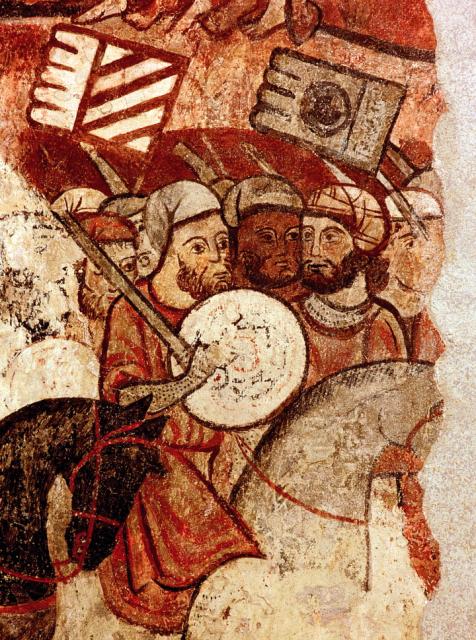


Berber horsemen continued to look very similar over the next centuries as can be seen in the Conquest of Oran.

The same picture shows how the Christian Spanish had changed by this time.


This shows the Essex Andalusian horse next to jinetes of the 14th century and some from the late 15th/early 16th. Even by the 14th century the equipment had become heavier. The middle figures are by Alain Touller, those on the left by Venexia (though on Vexillia horses). Both ranges are unfortunately OOP. [Update: Venexia are available from Lancashire Games. Vexillia are now OOP though].


*Watchers of BBC's Being Human may remember that Orsha was where Hal made his, umm, lifestyle choice.

Sunday, 23 July 2017

Bohemians, Hungarians and Poles


I have been steadily replacing the pictures which were stored on Photobucket. I thought I ought to add a few new things.

Some time a year or so ago, I thought I would add a few things to my 13th century Hungarians so that I could use them as 15th century Hungarians.

The knights were obviously ought of date, so I painted some new ones. I needed some Serbians, so that was new lead. 
In fact, by the time I was finished, there was nothing from the 13th century army which was going to be used.

This post covers the infantry I used.


The best description of the 15th century Hungarian infantry is from Matthias Corvinus. Matt Haywood's useful site on Eastern European armies of this period has the information so I won't repeat it.

This sounds to me very like the Bohemians portrayed in action against Maximilian just after the end of Corvinus's reign. This has been debated on the DBMM and DBM yahoo groups in some depth so I won't go into the pros and cons.

Bohemians found their way into a number of armies after the end of the main Hussite Wars. There were various opportunities for these experienced soldiers in Germany, Hungary, Poland and with the Teutonic Knights as well as in their native land which was wrangled over by the neighbouring states and local rulers.

Even though I think these men probably fought in a similar fashion for these various employers, the DBMM lists portray them in different ways. 

The Hungarian lists separates out the various parts described by Corvinus. The 'shield bearers' are spear elements. For these, I used Vexillia's own Polish pavise bearers. There are only two poses but it is enough IMHO. They are very easy to paint, with quite a lot of armour. 
The pavises are from Minifigs. Not only do you get quite a lot for your money but they have no stand to get in the way. The shield designs are a mix of Bohemian and Hungarian origin, including some from Maximilian's victory parade. Some have St George, St Michael or David fighting Goliath, though on the battlefield the designs are very hard to see.


Various pictures of Maximilian's battle at Schoenberg 
exist ncluding this: 

As well as the various engravings of Schoenberg (aka Wenzenbach or the Bohmenschlacht), Maximilian's tomb has an interesting representation. Maximilian and his men are shown in fashionable armour of some timeafter the battle but the Bohemian opponents are wearing more typical armour of the 1480s. The scene is dramatised but gives some idea of the variety of arms being used.
See here for another couple of portrayals of the battle as well as a discussion of the Hussite soldier (in German).


In the sidebar is a link to Uwe Tresp's work on the Bohemian soldier which covers their tactics, weaponry etc. through the 15th century.


The 'MM list also has some Blade elements. I'm currently using some of the Polish figures from QR miniatures which are part of their 13 years war range. The figures are pretty good though rather chunky compared to the Vexillia figures. Some of the other figures have what looks like a goedendag but I suspect it is an ahlspiess as shown on Maximilian's tomb. The QR figures may get replaced - I have a variety of Minifigs figures which match the size of the Vexillia figures better, and despite being old they have some character.

 The Polish, Hussite and German lists all have double based BwX with Bw behind. They appeared in the German and Hussite lists for the first time with the current edition and it caused a problem - they had inferior bow as a rear rank which isn't according to the rules. As it isn't clear what would happen in various circumstances, the tournament organisers have generally decided that they will cost and act as BwX/BwO. (Update: the DBMM lists printed by Lulu have altered the classification in this way).
For those unfamiliar with DBx terminology, BwX usually represents a thin crust of shield bearers with some kind of melee weapon protecting larger numbers of shooters.

As I had already painted the late 15th style pavises for the Hungarians, I decided to go with more straightforward heraldry for these. I could have made some sabot bases to turn the spear into the front rank of the BwX but decided to go the whole hog.

The shield devices are city militia devices according to the very nice sheets of Polish and Teutonic heraldry like here.
They have been made for the Tannenerg/Grunwald period whereas these figures are mid to late 15th century. Some are for towns which rebelled against the Teutonic Knights, allying themselves with the Polish king. In contrast to the rather busy designs on the later pavises, I used red and white designs almost exclusively.

The painting of the Battle of Orsha shows Poles using a pavise and shooter combination in 1514. There are some debatable points about the accuracy of the painting but it is good to look at anyway.


 I know comparison photos are often useful.
These are handgunners - from the left:
QR - QR, Mirliton - Donnington NE, Donnington NE - Mirliton.

The final Mirliton figure is noticeably smaller than the other figures which it came with. I think it was made for the Condotta range which has slightly smaller figures than the Swiss-Burgundian range.
 Crossbow men -
from the left:
Vexillia-Mirliton, QR - QR

Tuesday, 22 April 2014

Normans


A long while back I said I'd put some comparisons of various Normans on here. Now that painting for Montaperti is out of the way, here are the Normans.

Two Dragons and Khurasan versions of Duke William

William Rufus from Two Dragons
 from the left: Two Dragons, Donnington and Khurasan.

They mix pretty well sizewise but the style is different enough that I would not mix them on a base. This has the advantage as well that I can tell which command each element is from. Two Dragons are the most idiosyncratic with a good variety of pose and lots of movement though there is a touch more caricature about them. The shields are rather thick but this doesn't stand out too much.
Donnington have a good range of poses though the sculpting isn't quite as sharp as the others.
Khurasan have a  bit more limited range of poses but these are designed to give the impression of a galloping mass. I'm slightly wary about the chance of some of the horses coming off their stands though. The figures are probably the easiest to pain of the three as the mail definition is very clear - this does of course mean it is exaggerated compared to real life but it helps the effect. It is also handy that the hands are ready to take the separate weapons - no drilling required.


This shows Two Dragons dismounted knights and Khurasan infantry. Again there is a difference in style but the size matches pretty well.


Lots of variety in the Two Dragons range


Two Dragons Scouts
Some more of my favourite figures from any range.


In DBMM, the Normans are allowed to dismount so it is handy to have the mounts ready.
More characterful figures from Two Dragons.

Wednesday, 29 August 2012

Hungarians of the 13th Century

A few months back, I decided to have another go at finding some of the heraldry for the Kingdom of Hungary in the 13th century. My lack of any knowledge of Hungarian was a bit of a problem and it seemed that there was precious little available online in English although I did find a few coats in wikipedia.

In Pal Engel's book there were a few references to heraldry which made it clear that it had begun to emerge in the kingdom soon after it appeared in Western Europe. Armed with a few names, I eventually found some information. It turns out that the Hungarian for coat of arms is cimer from the French cimier  meaning crest. The arms belonged to a number of gens (clans - nemzetseg) and I think that various members of the clans would bear the same arms or close variations. Here is a potted history of some of the clans. One reason for this different approach is that society developed very differently in Hungary compared to Western Europe although some aspects of feudalism did appear especially under the Angevins in the 14th century.

The most useful site I found was here. I concentrated on those labelled nemzetseg  as most of the entries are civic. Even without any knowledge of the language it was possible to use dates to narrow down the arms I wanted to use. There was quite a change in the style of arms into the 14th and 15th century, so I tried to make sure I used the arms from this earlier period. I saved these as a word document so that I could refer to it during painting. Even with this site, I have likely made some errors.
Support for some of the arms comes from the Gesta Hunnorum et Hungarorum of the late 13th century. The author included a discussion of where some of the non-Hungarian familes had originated, many of which were German. In many cases the arms are described.


By the 13th century, there were increasing numbers of people who held land within Croatia and Hungary proper so I have included a few Croatian arms. I did intend to keep them on the same base but messed up! Here is a site with some background to Croat heraldry.

The King. I don't think I found a specific example of both sets of arms being used together, so a bit of poetic licence.
(EDIT - I rememeber now - the Chronica Pictum does show this combination though it may well be anachronistic. See here

Centre figure is OG15s flanked by two Mirliton figures.


Hont-Pazman, Buzad-Hahot, Jak
Keglevic (Croat), Hermann ('Saxon'), Kaplony 


Ratold, Gutkeled (both probably 'Saxon')


Gundulic (Croat), Doroszma, Subic (Croat)


Kacsics, Vaja, Boksa


There are a few alterations to some of the figures. The Vaja figure is a OG15s. It comes with quite a tall helmet which I didn't much like, so this was cut down and changed to form an early form of face mask helm. The same figure was used for Doroszma but this time the entire head was removed and replaced with a Minifigs helmet. The rest of the Minifigs figure was a bit small to fit the style of the other figures but this magnificent crest needed to be put to use. I have a couple of others which are likely to end up being used elsewhere, probably as Poles or the King of Bohemia. The Hermann figure has also had a Minifigs head grafted onto an OG15s body. The shape of the helms makes them ideal candidates for transplants, with enough room to drill a hole and insert a small piece of brass rod to keep the head secure. 

For some background reading, there is a list of sources here . This mainly focuses on the 15th centry, so I would add the chronicle I mentioned earlier and also Hungary in the Thirteenth Century . I managed to look at both of these at my local University library. The latter book has a reasonable amount of military detail including some about the first Mongol invasion.


Friday, 17 August 2012

7th Crusade II

One point about the naming of this crusade. You will find some source material (such as the Salles des Croisades) numbering it as the Sixth Crusade. This is due to debate in the past as to whether Frederick II's crusade counted; he was excommunicate at the time and he achieved his aims by the rather unknightly method of negotiation rather than by slaughtering the heathen.

Anyway, more on the participants. This crusade was predominantly French, though the Wikipedia article are a bit off the mark with the reason. Henry III of England was not involved in conflict with de Montfort at this point - relations had been strained but Henry actually stopped de Montfort going on crusade as he wanted him to govern in Gascony. Allowing him to return to Syria could have been a convenient method of getting him out of the way if necessary.

Some English did take part however. The most famous was William II Longespée, son of the 3rd Earl of Salisbury. He is often styled Earl of Salisbury, and claimed the title himself, but his father only had the title by marriage and the younger William's mother still lived. He was not an exile and, according to a letter he sent to the Pope, accepted that the denial of the title to him was in accordance with the law. (See the Wikipedia article). In fact, he was even given an annuity by the king and Henry may have been instrumental in William gaining additional land. See the History of Poole from around page 16 for more detail of this character. The figure on the left of the picture is painted as Longespée.
His standard is borne by a member of the de Vere family. I have used one of the variants of the standard arms with a black engrailed border. The figure on the mail barded horse bears the arms of the de Bohun's. I'm now doubtful that a prominent member of the family carried out his crusading vows but I kept them anyway.
The figures are all Old Glory 15s.


These are also Old Glory 15s - lances have been replaced as those moulded on are rather flimsy.

They are painted as some of the knights from Frankish Romania. In the centre is de la Roche, Duke of Athens (though he was in the 8th, not 7th, crusade). On the right of the picture are the rather plain arms of the decidedly unplain sounding Katzenellenbogen.

More OG15s. The centre arms are those of Ibelin, borne by the Count of Jaffa. There is an interesting passage in Joinville:
"The Count of Jaffa came ashore upon our left, who was cousin-german to the Count of Montbeliart, and of the lineage of Joinville. He it was who made the most noble show at landing; for his galley came up all painted above and below water with his escutcheons, the arms of which are "or with a cross gules patee." He had about three hundred oarsmen in his galley, and each oarsman bore a target with his arms, and to each target was attached a streamer with his arms embossed in gold."
This is one of the few instances I have seen where it shows the rank and file also bearing the arms of their lord.


Finally, some more French knights.
The main reason I have included this is because it shows a mix of Old Glory (right) and Mirliton (left). The two ranges mix very well. The OG shields are slightly smaller. I do have some gripes with the range. They are sold as 3rd crusade whereas they are far more suitable for the mid-13th century though some have an older style helm. They also lack a saddle cloth on either the figure or the horse and there is a ridge underneath which stops them sitting well on the horse.However it was easy enough to make a green stuff saddle cloth and this helped the figures to sit well. I like the full mail bard on some of the horses and there is a wider range of horse pose than Mirliton.

Thursday, 10 February 2011

More Spear comparisons

A while ago someone asked whether I had some comparison shots Donnington and Khurasan.
These are, from left to right - Khurasan, Donnington New Era, Old Glory (from Crusader range) and Black Hat (feudal range).

Monday, 4 January 2010

Comparisons of Knights

Here's a comparison between the knights from various companies.


First, the horses. From the left
Legio Heroica, Essex, Mirliton, Black Hat, Alain Touller.

The Touller horses have been redesigned since I bought mine and I haven't seen them.


Again, from the left
Legio Heroica, Essex, Mirliton, Black Hat, Touller
The Black Hat knights aren't quite as versatile as their infantry, being noticeably smaller than other ranges. The Legio figures are a bit taller but it is their bulk which makes them stand out next to other figures. Their shields are just about identical in size to the ones from Mirliton though a little thicker. The Mirliton figure is one of the later ones in this range. Some of the earlier ones are a little smaller though not so much that it couldn't be natural variation. The Essex figure is one of their Spanish range wearing obsolete gear for the mid- to late-13th century.
From some pictures I've seen elsewhere, the Old Glory 'Crusader' range is a pretty good match for size and build of the Mirliton figures. Most of this range carry heater shields more typical of the mid 13th century than the 3rd Crusade. The ones in the 'Holy Order' range have larger shields which are of an earlier form though still more early 13th than late 12th century. The range seems to have a mix of early 13th century 'face mask' helms and mid century full helms. Both of these were found earlier, but full helms in particular seem to have been extremely uncommon pre-1200 and not predominant for another generation or more. The Old Glory figures also have most of the knights on barded horses which were probably uncommon before 1200.

I've used Mirliton figures for my Italians as well as French and German forces which are in progress. I used Touller figures for the Spanish. My current project is a Feudal English army of roughly the time of Simon de Montfort. I've had the urge for a while to paint a few figures bearing the arms of the nobility who held lands close to where I live. I've found even more information than I hoped and so now I shall do a whole army. About a dozen figures done so far so watch this space.

EDIT: Since writing this, Touller are out of production and unlikely to return, Black Hat/Gladiator/Metal Magic have just gone out of production and Legio Heroica are hard to get if at all.

On the positive side, Donnington have a range of 12th and 13th century figures. Mirliton have a range of  14th century figures, most of which will be suitable for the early part of the century. There are a few companies producing STLs for 3d printing though most are designed for 28mm rather than 15mm. They can be scaled but this can result in very fine detail which is harder to pick out. My favourite range is the March to Hell figures though the 13th century Feudal Europe mounted figures are very short in the leg. 

Sunday, 16 August 2009

Figure Comparisons: 15mm Spearmen and Donnington Review

Yesterday I bought some of the 'New Era' figures from Donnington. I'd looked at them before but had assumed that they wouldn't be suitable for the period I wanted. The cavalry are certainly designed for the mid to late 14th century and beyond bit there turned out to be quite a few figures which would be suitable for my period.


The website is pretty good and representative figures are shown although I think there are a couple of misplaced pictures. The useful thing to know for many of us is how well they mix with other brands, particularly if, like me, you are going to get other troop types from different manufacturers.


From the left - Black Hat, Donnington, Mirliton, Touller. I've already based all my Essex and Legio Heroica figures, so they'll have to wait until I do some photos of based figures. The LH figures are a bit taller than the others (as with the crossbowmen). They'll look fine next to other makes but I don't think they'd look right in the same base. I shall keep mine as separate 'units'.

This Touller figure is a bit taller than the others - it isn't just the way his base isn't quite lined up. The other Feudal spearmen I have from Touller are just a bit shorter and are about the same size as Black Hat. I've put a few of these taller figures in with Black Hat figures and they don't stand out. All four companies could mix well although the ones with cast on shields may not look right next to the ones with separate shields.
The Donnington and Mirliton figures are very similar in size and style. Even the bases are similar shapes.

The figures are generally designed with the mid 14th century in mind. This does mean that not all are suitable for the late 13th century - leg armour and helmets in particular. The range includes some plancon bearers for the Low Countries, and these are the best I have seen so far. They are in kettle hat, which is fine for Courtrai/Kortrijk, or in bascinet which is better for the mid 14th century. However, a bit of filing should make a nice cervelliere as worn by the figures in the Kortrijk chest. The shields are separate on these which is useful - depite Heath's illustartion in Armies of the Middle ages, the three primary source pictures I know of which show this weapon show the wielders without shields.

In some cases the only noticeable bit of the leg armour just looks to be knee protectors - poleyns. These could probably be filed off or painted over. This gives then gives a nice range of polearms wielding figures in active poses.
LCF 8, LCF 10 and HYF 20 and probably some others will be particularly useful for 'Auxillia' types - there aren't many figures around which are suitable for these.

I like these figures and will be getting some more. It might even tempt me to do a DBA Low Countries army although this tends to start me on the slippery slope of a full DBMM army. At least Rune has already done the flags!

Update:
Here are some Alain Touller Spanish spearmen:
Only the ones with the mail coif are sold as Spanish and have the distinctive round bottomed shield. The others have a more pointed shield. Since I wanted a bit of variety of headgear but all with the same shield, I used a file to round off the points. It was pretty quick to do this.


Here is a comparison of, from the left, Mirliton, Alain Touller and Legio Heroica:
The Touller figures are more simiar in height to Mirliton than the unpainted example above. The Legio Heroica figures are a bit taller than the others but don't look out of place. 

Tuesday, 28 July 2009

Crossbowmen comparison

Here are some painted 15mm crossbowmen.


The stand on the left is Black Hat and Touller, the next stand is Essex and the stand on the right is Mirliton.


This is a close up of the Black Hat and Touller figures. They mix well, including the crossbows which are different styles in the other makes. The outer two are Black Hat, the centre two are Touller


One of the distinctive features of Italian warfare was the wide use of pavesarii, shield bearers protecting the crossbowmen behind.


These are Mirliton figures. The Mirliton figures with pavise, CO11, are the same as the 'Assorted infantrymen' CO10. I decided to replace these with the ones attacking with lanze longhe - CO12.

The pavises were marked in the colours of their state. http://www.heraldica.org/topics/national/tuscany.htm has some information from Villani. Much of the information is in Italian - unfortunately for me only some of Villani is easily available in an English translation.

Before the Battle of Campaldino, the shortsighted Bishop of Arezzo is said to have asked "Whose walls are those?" receiving the reply that they were the enemies' shields. Dino Compagni's account is here

If you can get access to a copy of Sercambi's illustrations they are chock full of examples of painted pavises. They are from the later 14th century but are still useful. My local university library has a copy.

Incidentally, David Nicolle says that the Genoese at Crecy had spear-carrying pavisarii with them and that it was their pavises which were left with the wagons. His essay is here
I haven't read much about Crecy, so I don't know how secure this idea is.