Sunday, 5 December 2010

Plutarch's Wars: Skythians and lots of Green Stuff

...or Scythians if you prefer!

I've never really fancied a Skythian army, but I seem to have always had a few figures for using in a variety of armies as far back as when I was using Peter Laing figures. I have a mixture of various sources although they are mostly stored away now that I have some Xyston figures.

For sources, I didn't go much further than the Osprey on these chaps. However, be careful! Virtually all of the figures in the plates are armoured and only one shows the typical Skythian cap which is worn by many of  the figures in Skythian art as well as depictions made by other nations. The Falcon figures range, which has some nice figures, follows the Osprey and as a result few of the range wear the caps.
One source which is worth a look is the Persian depiction of a fight between them and some Skythians. You can find it here - do a search for 'Scythian'.

For my Persians, I wanted to have some Massagetae armoured cavalry. There is a lot of discussion about how and whether they were linked to the western Skythians and what differences there would be in armour. Roman  Army Talk has a discussion with loads of links - many are in Russian but if you don't read the lingo then you can still look at the pictures! I did a lot of searching for suitable figures. There are various ones available for 'Scythian Heavy Cavalry'. Here are some I looked at.
Falcon: a good variety, based on the Osprey book. The figures are quite nice but perhaps a bit lacking in animation compared to more modern figures. Also quite small and reportedly difficult to get hold of.
Alain Touller: I was quite tempted. I've been told that the figures are small compared to other Touller figures.
Essex: Only seems to be one pose and lacked the full armour I wanted. Their Later Saka figures have potential, though perhaps more for the period after the one I'm doing. The horse armour lacks a certain something too.
Khurasan: I think they have some Massagetae on the way.
Old Glory: Quite nice figures but again the armour wasn't what I wanted.
Donnington: One of the older ranges. Paint up quite nicely I believe.
I got very interested by the Tin Soldier figures on Madaxeman's very useful site - but they are actually 28mm!
Xyston: Used to list a Massagetae heavy in their range as being for future release, but no sign after many years. However, I had some spare figures so thought I would turn my hand to some conversions, aided by Green Stuff and snippers.

I had some Xyston 'Satrapal Guard' figures and a few 'Northern Thracian Cavalry' which I thought would fit the bill. Ideally, I would like all of them to have armoured horses but may end up mixing them. The main textual source for their appearance is Herodotus:
[1.215] In their dress and mode of living the Massagetae resemble the Scythians. They fight both on horseback and on foot, neither method is strange to them: they use bows and lances, but their favourite weapon is the battle-axe. Their arms are all either of gold or brass. For their spear-points, and arrow-heads, and for their battle-axes, they make use of brass; for head-gear, belts, and girdles, of gold. So too with the caparison of their horses, they give them breastplates of brass, but employ gold about the reins, the bit, and the cheek-plates. They use neither iron nor silver, having none in their country; but they have brass and gold in abundance.

I would like all of them to have armoured horses but may end up mixing them. I referred to the sources available in the Roman Army Talk discussion, the Osprey, Armies of the Macedonian and Punic Wars, the Montvert Persian book and Gorelik's book on the Eurasian nomads.
With much chopping and Green Stuffing, this is what I got.
I had many goes with the caps unti I had something which I think I'm happy with.
The first ones I did were trying to look the same as those shown in Persian carvings, but they looked a bit too much like garden gnomes.
The next I was happier with, and weren't too different to the Xyston caps. However, I decided to go with something between the two, trying to look like those worn by some of the figures on Skythian gold artefacts.
 
 
They also needed to have bow cases added. These were pretty straightforward. I cut them more or less to shape before adding to the figure. Before it cured, I added it to the figure which allowed it to adapt to the shape of the figure. The bow was made as part of this and carved to shape when the case had hardened. If I did them again I would probably shape the bow with at least a core of brass wire (probably flattened) first. Hopefully they will be robust enough.
 
The bit which took the most time was making the shields. I did think of using Xyston peltas but the shapes weren't quite what I wanted. I had read a while ago about using Green Stuff to make push moulds and thought this would be an opportunity to try it out.
Firstly, I made some blanks out of plastic card. I mixed up some Green Stuff (apparently, a higher proportion of blue helps to retain detail). This needs to be coated with a release agent. Various things would work - I used something as high tech as olive oil from the kitchen. 
 
I left it overnight to cure.
The blanks can be removed fairly easily as the Green Stuff is still slightly flexible. I could have put some detail on the shields to begin with, but thought it might be easier to carve it into the Green Stuff. It worked reasonably well, but for the second attempt I put a think layer of the material in the bottom of each mould and worked the detail onto that. It also made the moulds shallower as the first shields came out a little thick.
To use the moulds, oil first then take a small blob of Green Stuff. This is squished and pushed into the mould, trying to make sure it gets right into all the detail. Leave overnight. These are the final results.
 
 
The excess trims off easily enough. The shields are slightly flexible but should be fine - I hope.
A couple of figures have had a wrap around shield added onto their backs as shown in some reconstructions.
Now I need to paint them which may well be a Christmas holiday job as I'm rounded off various other bits and pieces first. I also have to decide what length spear to give them - it'll probably be a longish spear but nowhere near as long as a Macedonian xyston as longer lance use on the steppes seems to have been later than the 4th century BC.

Friday, 12 November 2010

A real marsh - of sorts

I thought that I really ought to visit my local marsh since I have only been once and it was covered in snow and frozen solid at the time! I only live about two minutes drive away so it is a bit pathetic that I haven't been before.

It is one of the only remaining sizeable bits of marsh in the Midlands which isn't simply part of a floodplain. It is formed as run off from the nearby hills with the local geology preventing it from draining. There is reckoned to be about 5 foot depth of peat which has accumalated. Man has left his mark on the environment especially through the collection of wood. This has been going on for hundreds and perhaps thousands of years - pre-Roman settlement is known in the area. Without human intervention, wetland in this area tends to be wooded with trees such as alder surrounding numerous bodies of open water. As well as being used for things like clogs, in post-medieval times alder was one source of charcoal for gunpowder making. 
This map is from one of the information boards at the entrance to the marsh. The roughly horizontal line of trees seems, going by a nineteenth century OS map, to be the remains of a hedge line. The area has become more wooded in the last century with the decline of wood gathering though this is one method of keeping the meadows relatively clear...

Mowing machine
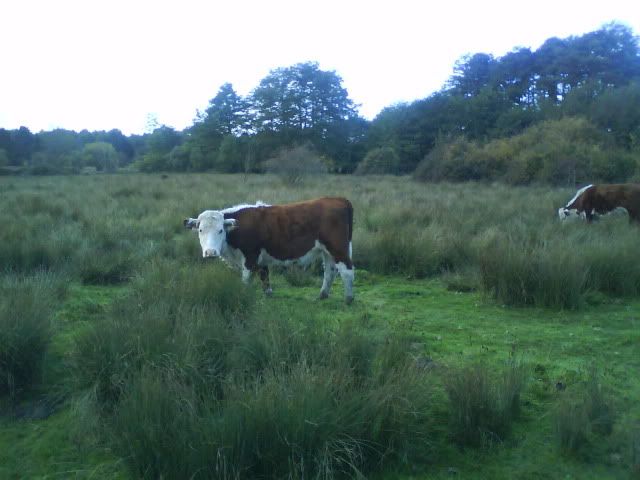
A small herd is maintained on the meadows; they keep down the grass and much of the scrub although the photo shows how much of  even the drier area is covered with low reeds. The herd roams into part of the marsh area as well. I could follow some of their tracks as far as the pond. Parts of the marsh may be too deep for them - the path crosses the main body of the marsh on a duckboard causeway and it looks decidedly wet underfoot. If you ever go - beware. I was wearing army boots and almost ended up pitching into the mire; the duckboards are decidedly slippy!

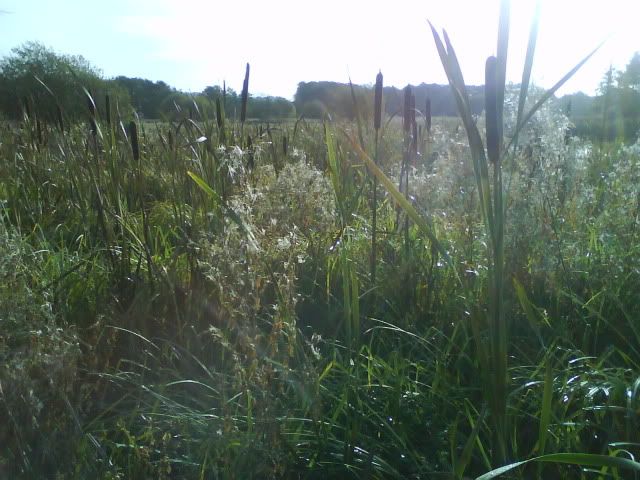
There are a couple of sizeable areas of open water surrounded by pretty dense reeds and bulrushes. Much of this is pretty tall.
Swampster in the bulrushes.


As for wargaming....
In DBMM terms I think I calculated that the marsh area would qualify as a 1 ME piece. Whether it is wet enough to be 'marsh' in rule terms is debateable though it is certainly far enough away from a river not to count as the marsh allowable adjacent to a water feature. It is certainly at least boggy ground. It did strike me that the rushes would be tall and dense enough to hide light infantry though their presence would likely to be revealed quite quickly if there was any movement.
The wet meadow is much drier (or was when I visited in October, though the autumn had been relatively dry) and might count as either open ground or some kind of rough going.

On a closing note... one of the reasons for the survival of this area of marsh (now an SSSI) was through the work of my father and his colleagues during the expansion of my town. Draining of the area had certainly been considered. He also helped to ensure that the route of the ancient and Roman road was preserved as the area was built up. Thanks, Dad.

Thursday, 11 November 2010

Plutarch's Wars: Romans of the Late Republic

The army of the Late Republic was led by a succession of generals who have made their mark on history. Julius Caesar is of course the most famous. But this is also the period of Marius and Sulla, Lucullus and Sertorius, Antony and Crassus. It is the time when the Republic's most deadly enemies were probably its own generals but it is also the time of Spartacus and Mithridates, Tigranes and Vercingetorix, Cleopatra and Surena.
 I wasn't particularly interested in this period when I was buidling armies 25 years ago, but I liked the look of the new (at the time) Freikorps Romans and I ended up buying a few. The metal was pretty brittle then, but most of them survived in my possession unpainted for the next couple of decades.
 
Once I had built a Pontic army I decided to start painting some Romans as an enemy for them. Since I had these Freikorps figures I decided to continue using them, especially as I wasn't keen on most of the others then available.
In the past year or so, the range has been redesigned so these figures are no longer available. Their replacements look pretty good though.

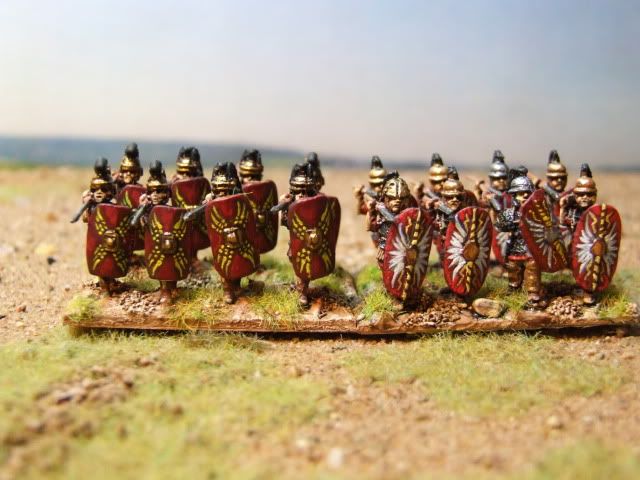
The figures were designed for the period covering the late Republic and into Augustus's reign. It isn't really clear how early the squared off oval shields began to be common, so I have included some with the others.
I painted the shield designs based on some from Armies and Enemies of Imperial Rome. Designs like this seem to have appeared on the monument to Actium so were probably used in the Civil Wars. Other shields may have been plainer and at least some seem to have had the name of their commander painted on. Actual colours are debateable though Amato's book shows a fresco with a red shield. I have some others painted with a blue background and some with black. (Incidentally, if you are interested in ancient paints, Pliny, book 35, goes into some details. Some paints would obviously be more common than others).

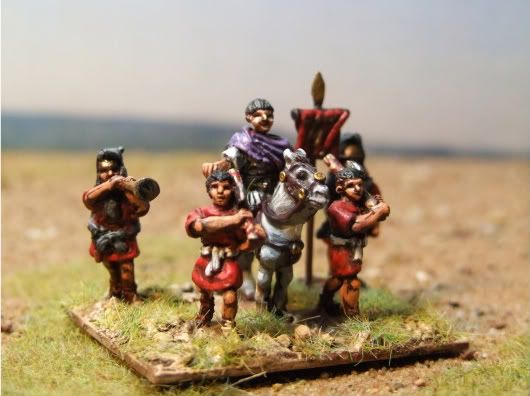
The Freikorps range includes some interesting looking generals for the Romans but unfortunately the horses are substantially smaller than most other ranges now avaible, so I have never painted mine. Instead, I have a variety of generals.

These are from the Warmodelling range. When I bought them, the company only produced Mid-Republican figures but these are equally suitable for the later period. The main feature of Warmodelling figures which lets them down a bit is that the horses tend to have stumpy legs, but from a normal wargamers viewpoint this is not as apparent. 
The legionaries from Warmodelling look pretty good although I think the shields are a bit too broad. I'm tempted by their 'auxilliaries' in the same range  for use in a Slave Revolt army which I am very slowly building.


These are from the Alain Touller range. They mix well with the other companies' figures. Their legionaries have pretty accurate looking shields although I'd prefer a wider variety in appearance.


I have a few of the Corvus Belli legionaries which will get painted some day. I'm not sure whether they will become the most experienced troops of a Slave army or a second Roman army for Civil War use. Either way, they are probably the most dynamic range of legionaries available for this period.

Plutarch's Wars: The Why and wherefore!

 Over the past couple of months I've returned to the period which first interested me in Ancient Wargaming - the Wars of Greece, pre-Imperial Rome and their neighbours.
My first ever ancient figures were 15mm Peter Laing hoplites and my first proper army were Carthaginians - again Peter Laing - put together originally using the old Airfix Guide (the so-called Purple Primer). I tried to read as much as I could about the period and my interest soon expanded to the whole Hellenistic period.

I pretty much stopped Ancient wargaming for about 10 years but when I restarted I still had quite a lot of figures which covered this same period.

One character who had interested me was Mithridates the Great. I read as much as I could about him (and managed to do a uni study on him) and as well as putting together a Pontic army, I began to have a lot more interest in this period of Roman history.

This meant that my main area of interest coincides pretty well with the period covered by Plutarch's parallel lives, most of which fall into a period just before 400BC to 1BC with the occasional later or earlier entry. Because of that, I've decided to label any posts from this older period as "Plutarch's Wars" and may well start a sister blog to help organise any links I put in.

Thursday, 14 October 2010

Marsh

I've been concentrating on non-Medieval stuff for the last month or two so I though I'd put this up.
I decided that it would be nice to have a go at making some swampy terrain pieces which could be either boggy ground or marsh in DBMM terms.

I did think about showing a step by step method, but forgot until part way through. I think it is pretty straightforward though.

This one is a trial run to see how it looked. It is a half sized feature for DBMM - roughly 20cm across.

The main base was cut from perspex bought as a sheet from Homebase (about 2' by 4'). This is a bit of a pain to do. Score as deeply as possible with a Stanley knife and then carefully snap away the excess. Experiment - it can easily start to split in the wrong direction. You can alternatively cut it with a bandsaw but the recommended method is to sandwich it between some wood first.


(EDIT: I cut some more today using a cutting wheel on a Dremel type tool. This was much easier (but wear goggles!) Even if you don't cut all the way through the gouge should be enough for an easy snap. The edges are smooth but there is a ridge of cut material most of the way around. This should get covered by the terraforming even if it isn't sanded off).


The perspex is actually a bit matt so needs help to give a water effect. I'm sure shinier stuff is available.


I then sprayed it on the reverse with a chocolate brown aerosol. Spraying helped to avoid brushmarks showing through.

Whn dry, I covered the top with a layer of shellac which I happened to have. This is a transparent darkish brown colour and dries gloss. It gave the colour I wanted and gave a bit more depth to the 'water'.


I then used some brown window sealant to form the dryish land. Read the label - some says it can be painted and some that it can't. Obviously the paintable stuff is wanted. Apparently it is acrylic and the rest is silicone. I found the best method was to splurge an area and the use a wet finger to spread it a bit. Trying to use a wooden spatula left smears which needed cleaning up - in some places this scratched away the shellac.

Next stage was to paint the sealant, though the original colour would have suited.

I then gave a coat of acrylic gloss over the water to give further depth (and cover over the areas where the shellac had been damaged).

When this had dried for 24 hours, I started adding the foliage. I have a whole load of different colours and lengths of Silflor tufts so I placed these first. One of the packs I bought with this marsh in mind was the one which has white and yellow 'flowers' which I thought might work for bog cotton or various wetland flowers.

I also bought some tacky glue called Scatter Grip. This goes on far more precisely than something like Scenic Cement and does hold the static grass very well. A bit of a shine is visible so I might have a go at matting it down in some way. I used Woodland Scenics 'Summer' mix for the majority of the area. I 'm not sure about it at the moment and might go for something shorter, perhaps even scatter rather than static grass.

The perspex does get enough static charge to attract the grass so a wet paint brush is needed to remove some of the excess. I still need to get some of it off!

Thursday, 2 September 2010

Flemish Crossbowmen and Knights


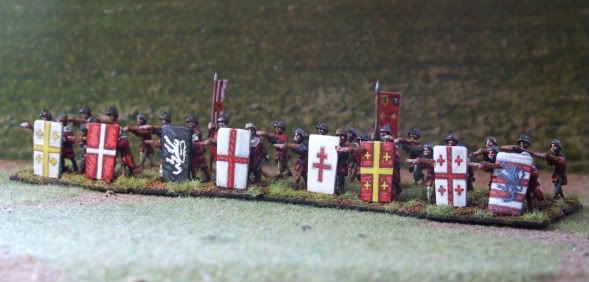
Common to a number of Low Countries cities were the guilds of crossbowmen - the Guild of Saint George. They were separate from the trade guilds and are shown in the Leugemeete fresco. There is still a Guild of St George in Ghent which has a nice bit of background.
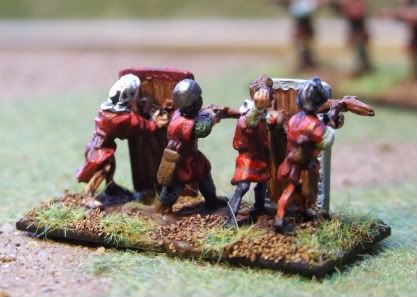
 As mentioned in this link as well as various other places such as Verbruggen, de Vigne and de Liebaart, the crossbowmen were accompanied by 'boys' who carried the pavises at a ratio of two crossbowmen to one pavise. The current draft of the DBMM Book 4 list covering the Low Countries actually suggests basing them in this way after a couple of us mentioned it on the DBMMlist.  I suspect that this ratio may have been common in Europe at the time in the period following the adoption of the pavise. David Nicolle's essay on the Genoese at Crecy suggests that the pavises left behind would have been carried by pavise bearers rather than on the back of the crossbowmen as often portrayed following a late 14th century picture.  I don't know of any evidence that the Low Countries bearers had any form of spear - certainly at the various battles where the Fleemish crossbowmen are mentioned they withdraw rather than facing hand to hand combat, suggesting a lack of defensive weaponry.

 I did try out two crossbowmen and one pavise per base but the effect was a bit sparser than I liked. It would really look best, I think, with a deeper base and one firing and one loading crossbowman per pavise. An Impetus or similar sized base would be a good place to do this, or a double depth DBMM base. After a bit of experimentation I decided to have a rank of bases with pavises and another without, giving a ratio of three crossbows per pavise.

 I spent quite a while looking for figures suitable for the pavise bearers. I actually converted a couple of Khurasan's Swiss halberdiers and would have used these but when I ordered some Welsh spearmen (bearer on the right if this picture) from Donnington I thought the pose and clothing would fit quite nicely.

 I hoped to have finished them for Britcon but ran out of time. This was quite good though, since I bought some Donnington peasants and some of those also made good bearers. 
 The figures wearing a hood actually come wielding a polearm in two hands in a sort of baseball pose. I cut off one arm and built another using green stuff in a pose as if the bearer is holding the pavise to his left.


The crossbowmen are mostly Donnington with some Touller figures, including the flag bearers. another factor which influenced my choice of basing was that I had exactly the right number of crossbowmen unpainted to do it this way, as long as I used the standard bearers.


The pavises show a mixture of arms, including those of Bruges, Ypres and Ghent.  The others are those of Guilds of St.George from various cities as well as those of Guilds of St. Sebastian. This was thoeretically a guild of archers although the fresco showed them with the same mix of weapons as other guildsmen. However I used a bit of licence and included some of their shields as I had the details and liked them.

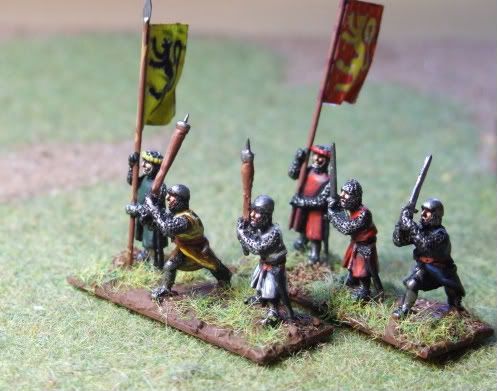
To finish off my pictures of Low Countries figures, here are some knights. First of all mounted:


The general is marked with a flag and represent Jan de Renesse, a nobleman from Holland who led the forces at Kortrijk - possibly he was experienced. For the other knights I used a variety of arms from the Gelre armorial and Rietstaap as well as a book of seals of 13th century Low Countries knights. I wasn't too careful about whether they had fought for or against the French though - time was pressing and the details were sketchy; sometimes I had names but no details of arms. The arms of the burghers or patrician class were even harder to come by for the 14th century. A few are mentioned such as de Conninck's and, for a later period,  van Artevelde's but I couldn't be sure of many others. The regulations have survived which show the expectations of these 'nouveaux riches' as far as equipment goes - the two richest classes were to have armoured horses as well as the rest of the men-at-arms' panoply.
 Some of the Donnington knights come with a bird crest  - I adapted some of these by cutting or adding Green Stuff so a few have the crest shown in the Gelre Armorial. Wearing crests in battle was becoming rarer as the 14th century progressed but I kept a few as traditionalists or show-offs.
The figures come with smaller shields than this but I got some of the slightly larger ones - partly as it made painting easier.

I have already posted some pictures of Old Glory dismounted knights but I also have some more specifically Low Countires ones. They are figures from Mirliton and IMO some of their best. They are actually designed for a period earlier than the mounted men-at-arms which I used but they match the figures on the Kortrijk chest pretty nicely apart from the ailettes. To get the real Low Countries look, I have converted some to carry gepinde stafs (or whatever the plural is!) You can see the unconverted ones alongside the converts. The staves were made from a dressmakers pin with a covering of greeen stuff or Milliput. Once I knew what I was doing they could be made pretty quickly. Note that I also put a Milliput cerveilliere on one of the knights as shown on the Chest. Overall, I think the central figure gives a nice effect of the picture I have linked to before

Sunday, 22 August 2010

Flemish Fortifications

 At the battle of Mons-en-Pévèle, the Low Countries forces used their wagons as protection. They deployed on a hill in a line which which wide and thick. Their camp was behind them. Between the troops and the camp were the wagons; wheels were taken off to make it difficult for the French to shift them. DeVries and Verbruggen discuss the battle in some depth.
 These are my attempt; I used Magister Militum's wagons (they have a huge range!). The tents are Baueda - the small straw ones have since been redesigned. The camp followers and (IIRC) the pavises are from Donnington.
Once I had painted and installed the pavises, I realised I had done the arms of Ypres in reverse - they should be a red cross on white. The modern arms with a section including vair date back to the late 14th century.

See the side bar for a great webpage with loads of links to pictures of medieval carts.

I used this in my first DBMM competition this month. It counts as TF. It is quite useful as it can be placed anywhere in your deployment area, not just around the camp, and successfully helped to defend my flanks in at least two battles.