Thursday, 11 November 2010

Plutarch's Wars: Romans of the Late Republic

The army of the Late Republic was led by a succession of generals who have made their mark on history. Julius Caesar is of course the most famous. But this is also the period of Marius and Sulla, Lucullus and Sertorius, Antony and Crassus. It is the time when the Republic's most deadly enemies were probably its own generals but it is also the time of Spartacus and Mithridates, Tigranes and Vercingetorix, Cleopatra and Surena.
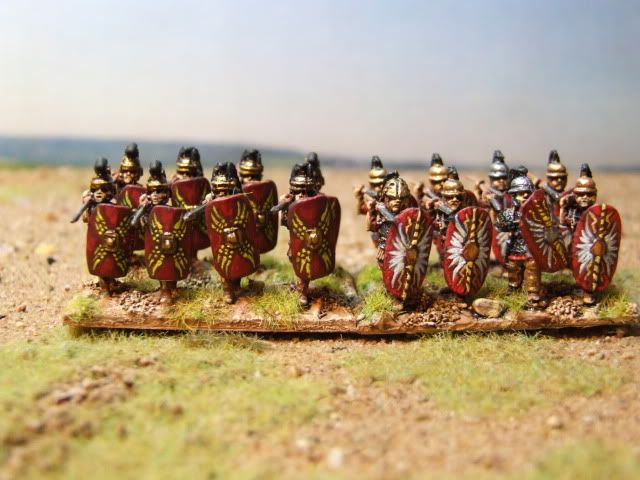
 I wasn't particularly interested in this period when I was buidling armies 25 years ago, but I liked the look of the new (at the time) Freikorps Romans and I ended up buying a few. The metal was pretty brittle then, but most of them survived in my possession unpainted for the next couple of decades.
 
Once I had built a Pontic army I decided to start painting some Romans as an enemy for them. Since I had these Freikorps figures I decided to continue using them, especially as I wasn't keen on most of the others then available.
In the past year or so, the range has been redesigned so these figures are no longer available. Their replacements look pretty good though.

The figures were designed for the period covering the late Republic and into Augustus's reign. It isn't really clear how early the squared off oval shields began to be common, so I have included some with the others.
I painted the shield designs based on some from Armies and Enemies of Imperial Rome. Designs like this seem to have appeared on the monument to Actium so were probably used in the Civil Wars. Other shields may have been plainer and at least some seem to have had the name of their commander painted on. Actual colours are debateable though Amato's book shows a fresco with a red shield. I have some others painted with a blue background and some with black. (Incidentally, if you are interested in ancient paints, Pliny, book 35, goes into some details. Some paints would obviously be more common than others).

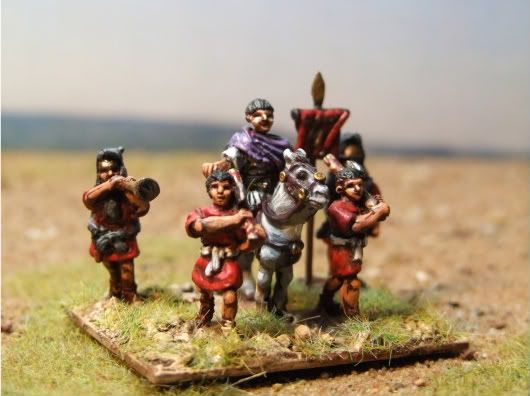
The Freikorps range includes some interesting looking generals for the Romans but unfortunately the horses are substantially smaller than most other ranges now avaible, so I have never painted mine. Instead, I have a variety of generals.

These are from the Warmodelling range. When I bought them, the company only produced Mid-Republican figures but these are equally suitable for the later period. The main feature of Warmodelling figures which lets them down a bit is that the horses tend to have stumpy legs, but from a normal wargamers viewpoint this is not as apparent. 
The legionaries from Warmodelling look pretty good although I think the shields are a bit too broad. I'm tempted by their 'auxilliaries' in the same range  for use in a Slave Revolt army which I am very slowly building.


These are from the Alain Touller range. They mix well with the other companies' figures. Their legionaries have pretty accurate looking shields although I'd prefer a wider variety in appearance.


I have a few of the Corvus Belli legionaries which will get painted some day. I'm not sure whether they will become the most experienced troops of a Slave army or a second Roman army for Civil War use. Either way, they are probably the most dynamic range of legionaries available for this period.

Plutarch's Wars: The Why and wherefore!

 Over the past couple of months I've returned to the period which first interested me in Ancient Wargaming - the Wars of Greece, pre-Imperial Rome and their neighbours.
My first ever ancient figures were 15mm Peter Laing hoplites and my first proper army were Carthaginians - again Peter Laing - put together originally using the old Airfix Guide (the so-called Purple Primer). I tried to read as much as I could about the period and my interest soon expanded to the whole Hellenistic period.

I pretty much stopped Ancient wargaming for about 10 years but when I restarted I still had quite a lot of figures which covered this same period.

One character who had interested me was Mithridates the Great. I read as much as I could about him (and managed to do a uni study on him) and as well as putting together a Pontic army, I began to have a lot more interest in this period of Roman history.

This meant that my main area of interest coincides pretty well with the period covered by Plutarch's parallel lives, most of which fall into a period just before 400BC to 1BC with the occasional later or earlier entry. Because of that, I've decided to label any posts from this older period as "Plutarch's Wars" and may well start a sister blog to help organise any links I put in.

Thursday, 14 October 2010

Marsh

I've been concentrating on non-Medieval stuff for the last month or two so I though I'd put this up.
I decided that it would be nice to have a go at making some swampy terrain pieces which could be either boggy ground or marsh in DBMM terms.

I did think about showing a step by step method, but forgot until part way through. I think it is pretty straightforward though.

This one is a trial run to see how it looked. It is a half sized feature for DBMM - roughly 20cm across.

The main base was cut from perspex bought as a sheet from Homebase (about 2' by 4'). This is a bit of a pain to do. Score as deeply as possible with a Stanley knife and then carefully snap away the excess. Experiment - it can easily start to split in the wrong direction. You can alternatively cut it with a bandsaw but the recommended method is to sandwich it between some wood first.


(EDIT: I cut some more today using a cutting wheel on a Dremel type tool. This was much easier (but wear goggles!) Even if you don't cut all the way through the gouge should be enough for an easy snap. The edges are smooth but there is a ridge of cut material most of the way around. This should get covered by the terraforming even if it isn't sanded off).


The perspex is actually a bit matt so needs help to give a water effect. I'm sure shinier stuff is available.


I then sprayed it on the reverse with a chocolate brown aerosol. Spraying helped to avoid brushmarks showing through.

Whn dry, I covered the top with a layer of shellac which I happened to have. This is a transparent darkish brown colour and dries gloss. It gave the colour I wanted and gave a bit more depth to the 'water'.


I then used some brown window sealant to form the dryish land. Read the label - some says it can be painted and some that it can't. Obviously the paintable stuff is wanted. Apparently it is acrylic and the rest is silicone. I found the best method was to splurge an area and the use a wet finger to spread it a bit. Trying to use a wooden spatula left smears which needed cleaning up - in some places this scratched away the shellac.

Next stage was to paint the sealant, though the original colour would have suited.

I then gave a coat of acrylic gloss over the water to give further depth (and cover over the areas where the shellac had been damaged).

When this had dried for 24 hours, I started adding the foliage. I have a whole load of different colours and lengths of Silflor tufts so I placed these first. One of the packs I bought with this marsh in mind was the one which has white and yellow 'flowers' which I thought might work for bog cotton or various wetland flowers.

I also bought some tacky glue called Scatter Grip. This goes on far more precisely than something like Scenic Cement and does hold the static grass very well. A bit of a shine is visible so I might have a go at matting it down in some way. I used Woodland Scenics 'Summer' mix for the majority of the area. I 'm not sure about it at the moment and might go for something shorter, perhaps even scatter rather than static grass.

The perspex does get enough static charge to attract the grass so a wet paint brush is needed to remove some of the excess. I still need to get some of it off!

Thursday, 2 September 2010

Flemish Crossbowmen and Knights


Common to a number of Low Countries cities were the guilds of crossbowmen - the Guild of Saint George. They were separate from the trade guilds and are shown in the Leugemeete fresco. There is still a Guild of St George in Ghent which has a nice bit of background.
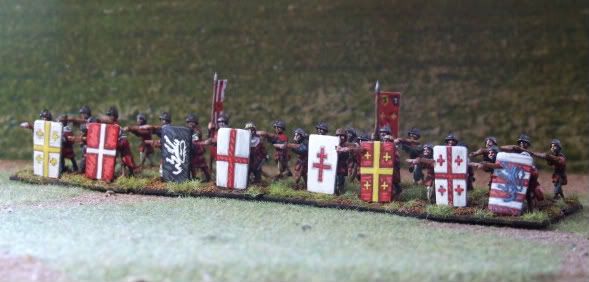
 As mentioned in this link as well as various other places such as Verbruggen, de Vigne and de Liebaart, the crossbowmen were accompanied by 'boys' who carried the pavises at a ratio of two crossbowmen to one pavise. The current draft of the DBMM Book 4 list covering the Low Countries actually suggests basing them in this way after a couple of us mentioned it on the DBMMlist.  I suspect that this ratio may have been common in Europe at the time in the period following the adoption of the pavise. David Nicolle's essay on the Genoese at Crecy suggests that the pavises left behind would have been carried by pavise bearers rather than on the back of the crossbowmen as often portrayed following a late 14th century picture.  I don't know of any evidence that the Low Countries bearers had any form of spear - certainly at the various battles where the Fleemish crossbowmen are mentioned they withdraw rather than facing hand to hand combat, suggesting a lack of defensive weaponry.

 I did try out two crossbowmen and one pavise per base but the effect was a bit sparser than I liked. It would really look best, I think, with a deeper base and one firing and one loading crossbowman per pavise. An Impetus or similar sized base would be a good place to do this, or a double depth DBMM base. After a bit of experimentation I decided to have a rank of bases with pavises and another without, giving a ratio of three crossbows per pavise.

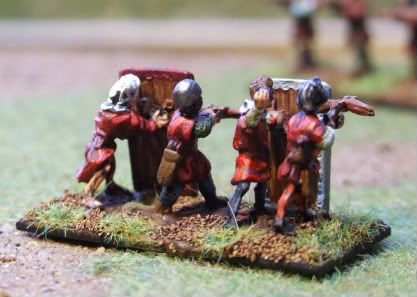
 I spent quite a while looking for figures suitable for the pavise bearers. I actually converted a couple of Khurasan's Swiss halberdiers and would have used these but when I ordered some Welsh spearmen (bearer on the right if this picture) from Donnington I thought the pose and clothing would fit quite nicely.

 I hoped to have finished them for Britcon but ran out of time. This was quite good though, since I bought some Donnington peasants and some of those also made good bearers. 
 The figures wearing a hood actually come wielding a polearm in two hands in a sort of baseball pose. I cut off one arm and built another using green stuff in a pose as if the bearer is holding the pavise to his left.


The crossbowmen are mostly Donnington with some Touller figures, including the flag bearers. another factor which influenced my choice of basing was that I had exactly the right number of crossbowmen unpainted to do it this way, as long as I used the standard bearers.


The pavises show a mixture of arms, including those of Bruges, Ypres and Ghent.  The others are those of Guilds of St.George from various cities as well as those of Guilds of St. Sebastian. This was thoeretically a guild of archers although the fresco showed them with the same mix of weapons as other guildsmen. However I used a bit of licence and included some of their shields as I had the details and liked them.

To finish off my pictures of Low Countries figures, here are some knights. First of all mounted:


The general is marked with a flag and represent Jan de Renesse, a nobleman from Holland who led the forces at Kortrijk - possibly he was experienced. For the other knights I used a variety of arms from the Gelre armorial and Rietstaap as well as a book of seals of 13th century Low Countries knights. I wasn't too careful about whether they had fought for or against the French though - time was pressing and the details were sketchy; sometimes I had names but no details of arms. The arms of the burghers or patrician class were even harder to come by for the 14th century. A few are mentioned such as de Conninck's and, for a later period,  van Artevelde's but I couldn't be sure of many others. The regulations have survived which show the expectations of these 'nouveaux riches' as far as equipment goes - the two richest classes were to have armoured horses as well as the rest of the men-at-arms' panoply.
 Some of the Donnington knights come with a bird crest  - I adapted some of these by cutting or adding Green Stuff so a few have the crest shown in the Gelre Armorial. Wearing crests in battle was becoming rarer as the 14th century progressed but I kept a few as traditionalists or show-offs.
The figures come with smaller shields than this but I got some of the slightly larger ones - partly as it made painting easier.

I have already posted some pictures of Old Glory dismounted knights but I also have some more specifically Low Countires ones. They are figures from Mirliton and IMO some of their best. They are actually designed for a period earlier than the mounted men-at-arms which I used but they match the figures on the Kortrijk chest pretty nicely apart from the ailettes. To get the real Low Countries look, I have converted some to carry gepinde stafs (or whatever the plural is!) You can see the unconverted ones alongside the converts. The staves were made from a dressmakers pin with a covering of greeen stuff or Milliput. Once I knew what I was doing they could be made pretty quickly. Note that I also put a Milliput cerveilliere on one of the knights as shown on the Chest. Overall, I think the central figure gives a nice effect of the picture I have linked to before

Sunday, 22 August 2010

Flemish Fortifications

 At the battle of Mons-en-Pévèle, the Low Countries forces used their wagons as protection. They deployed on a hill in a line which which wide and thick. Their camp was behind them. Between the troops and the camp were the wagons; wheels were taken off to make it difficult for the French to shift them. DeVries and Verbruggen discuss the battle in some depth.
 These are my attempt; I used Magister Militum's wagons (they have a huge range!). The tents are Baueda - the small straw ones have since been redesigned. The camp followers and (IIRC) the pavises are from Donnington.
Once I had painted and installed the pavises, I realised I had done the arms of Ypres in reverse - they should be a red cross on white. The modern arms with a section including vair date back to the late 14th century.

See the side bar for a great webpage with loads of links to pictures of medieval carts.

I used this in my first DBMM competition this month. It counts as TF. It is quite useful as it can be placed anywhere in your deployment area, not just around the camp, and successfully helped to defend my flanks in at least two battles.

Monday, 16 August 2010

Scratchbuilding a 15mm Rural Church

  When I went to Henley last month, I also visited a couple of old local churches. One of these was at Wootton Wawen. The exterior of the church has continued to evolve since it was first built so the original form is hidden, but it has a an area withn the church which is Saxon. This is used for an historical display about the area including some great pictures of how the village and church probably looked at various points in history. Well worth a 10 or 20 minute visit if you are in the area - they also sell a nice little booklet.

 I also went to the church at Morton Bagot. This is a Warwickshire hamlet which has never been large. The church has remained almost untouched since the 13th century. There is a description of its history and likely alterations in the very useful British History Online site.


 The first thing that struck me was how small the church is. Building most churches in actual 15mm scale (roughly 1:120 or 1:100) results in a very big building but I thought this one would probably work on a table. The description in the above link gives the width and length. I had to try to calculate the height from the photos. Even though the church was quite small, as there is evidence that it was slightly extended in the past I took this as licence to make it slightly shorter than it is now.

View approaching the west end of the church. It is on a spur which also seems to have been built up into a mound. The belfry is only a couple of hundred years old!


The south side of the nave. Some rendering is on the wall next to the (relatively recent) porch. The land on this side has built up by over a metre. This may have been the effect of centuries of burials as I believe the south was the favoured side although there are actually burials around all faces of the church.


The east wall. You can see how much higher the land is here. It could be the original level. However, about 10 metres to the south the land drops vertically by 5 or so metres where there are farm buildings and the driveway to another farm which I think is on the site of the old manor - you can see its earthworks from the church.

Note how there are no buttresses along the length of the south wall.


The north wall.
The buttresses were apparently added sometime after the church was built. There is a noticeable lean on this wall which they guard against. What I was pleased to see was the rendering here. It has obviously been painted using modern materials but it gives a good idea of how many medieval buildings - including castles - once looked. We are so used to imagining them as hulking grey bastions that it is difficult to picture the effect of rendered walls. How frequently they would get limewashed is another matter but I suspect many churches would get the treatment as a priority. The render itself could also be very pale once dry. The reddish stones of the mullions are exactly the same as used at my local abbey - I know because the chief archaeologist gave me a piece as a momento when I worked on the dig there.

 As an experiment, I had a go at using Google's CAD, Sketchup. There is a program called Pepakura which will convert a CAD design into the net for making a paper model. This wasn't really necessary for a simple design like this church, but it might be useful one day for me.

I used this as a maquette for making the church using plastic card and a stuff which I think is called Depron. I bought it last year from Antenociti's Workshop for something else and never used it. It is a thin polystyrene foam which cuts easily but can have detail etched in quite easily.

The first attempt came out quite well but I wasn't happy with the height. It could well be right, but it is one of those instances where something which is right looks wrong. We are so used to looking up at a church roof that the angle looks foreshortened.

I then thought I would see how it looked in roughly 10mm scale (about 1:180). This came out quite well, though I rushed the window details a bit. I haven't painted it, but I think I might take it if I enter any more competitions with a Medieval army.

That should have been the end of it, especially as I had to get my Flemish finished for Britcon but I thought I'd have one more go, especially as I'd got used to working with Depron.


These are the main pieces cut to size. The walls are plastic card with a layer of Depron on top. The windows are cut out of the Depron to reveal the plastic card. Stone work is etched around the doors and windows.


I used Green Stuff to make the window details and doors. I had only used Milliput before and had assumed that Green Stuff would be reasonably similar. However, as I'd just bought some Green Stuff on impulse I thought I'd give it a go. I found it was much better for this kind of work - it is stickier which means that it stays where you put it (as long as it doesn't stick to your knife!) Putting the metal work on the doors took very little time and I was pleased with my results with this being my first effort.


I hadn't intended to put on the buttresses; the church was built without them and I thought they'd be awkward. Howver, I experimented by using some blue foam which I have. Stone work was carved in and all in all it didn't take a long time. The render is simply tile grout mixed with some ivory coloured paint.

This is the finished article. Rather than the Georgian belfry I put on a stone equivalent as found on various other old churches. I also had a go at giving it a thatched roof - I was surprised to find that not only was it very common in smaller churches but that some English churches are still thatched. I thought of using the various methods described on a number of websites and experimented by etching into the Depron roof and using short static grass. However, pictures of most European thatched buildings show very little texture. I did think that it could be another of those things where you show something as you expect it to be, rather than as it is, but I thought I would go with a different method. This is made out of grey felt, wrapped under the plastic card roof to give depth.

A second layer of felt was used for the apex. I wondered how to do the ties across the roof but luckily I had bought some very thin florist wire. It was cut into lengths which could then be poked into the felt.

The religious chaps celebrating and consecrating the new construction are Donnington, left over from the Papal project.

I have some crosses and headstones so I will probably make a small  base - perhaps a low mound with a graveyard, some kind of boundary and perhaps a yew tree.

Wednesday, 7 July 2010

The de Montforts

The name of De Montfort is effectively synonymous with the 2nd Barons' War.

There were actually two families of that name prominent in the conflict, both on the same side. One branch had come over with the Conqueror and were soon given the manor of Beaudesert in Warwickshire. The other branch was headed by Simon de Montfort. They had recently arrived in England - rather ironically one of the main complaints of the party headed by Simon was the influence of foreigners on the King.

First, the de Montforts of Beaudesert. 


The head of the family was Peter de Montfort. His arms are still used by the local high school as their badge. He was a major player in the 1250s and was apparently involved in various embassies. He could also be claimed to have been the first to hold the office which became the Speaker of Parliament.

He was a leader of the party which opposed much of the King's policy and his seeming dominance by his half-brothers and other foreigners.

He and his son were captured at Northampton and so missed the fighting at Lewes. He was with Simon de Montfort at Evesham, dying in the battle there. His son, Piers, was wounded but survived, regaining his father's lands after the treaty made at Kenilworth.

Beaudesert has now effectively been absorbed by Henley in Arden, a small but pleasant town in Warwickshire near where I live. The parish of Beaudesert still exists and rather oddly the parish churches of Henley and Beaudesert are little more than 100 yards apart. The Beaudesert church still contains much of its Norman structure. (I went there for a wedding once!) It sits at the foot of a fairly long ridge which is now pretty much hidden from view by the town. However, once past the houses you can see it rise abruptly above the surroundings.

This ridge was the site of Beaudesert Castle, long since disappeared. It is, however, possible to see the earthworks which formed part of the defences and may even date back to pre-Roman times.


Here is a photo I took a couple of days ago (this was in July).
What looks like a slight depression is a substantial ditch. You can only see about half of the steps (and the treads of each one are far too high, and I'm not short!) The grass is kept short by rabbits and the main area of the castle is covered by scrub and wild flowers. A nice walk :)


This is a view of what once would have been the park around the castle. The area was once far more heavily wooded. It is quite rolling (and IMHO the best countryside in the world!) The grass looks short but was around two feet deep.


This was a patch of marsh at the foot of the ridge which I though would be useful for modelling. At least, it would be marsh if we weren't having a long dry spell round here.


The Time Team carried out an excavation of the castle which is available on 4oD, though you have to forgive them the references to the prevalence of the longbow in the Barons' Wars. I think they must have mown the whole hill top which wasn't exactly environmentally friendly!

I've added a link to the Gatehouse site, a great resource for castle hunters. It shows the position of a large number of fortifications in England and Wales, and their state of preservation as well as some pictures. I found out that a place where I used to sit around on an escaprment as a teenager was actually the site of the Beauchamp castle just outside Alcester.


The other de Montfort family was headed by Simon. 


He had come to England as a young man to claim his father's English lands - his elder brother received the French inheritance. He soon married the king's sister. Henry later claimed that Simon had seduced her and that the marriage was to prevent scandal. He certainly managed to gain  a great deal of influence at court. His career is covered by a number of websites and various books, so I won't go into detail.

Interestingly, his arms are shown by Matthew Paris as the reverse of these, as are the ones showing his gruesome end at Evesham. I have kept to the ones shown in most of the rolls and the picture of his father linked to below.
The banner is shown in a picture of his father and is said to be borne in honour of the lands at Hinckley. Some of the rolls of arms give these as the de Montfort arms.

A while before Lewes, Simon had been injured in an accident and had needed to travel in some kind of carriage. Various accounts mention this as he cunningly placed this conveyance in view while deploying for Lewes, with his banner displayed next to it. The histories say that the Royalists focussed their attentions here although the only souls contained in the carriage were three Londoners who had opposed his entry into the city. They were held inside the carriage and some accounts say that they were killed by their own side as their entreaties could not be heard.

The actual type of vehicle is debateable. At least one author believed it was suspended between two horses. Another, almost contemporary account, said it was made of iron specifically to hold the Londoners. I decided to scratchbuild a canopy on top of a Magister Militum base and wheels to create a similar effect to the one in the Lutrell Psalter. I think I have overdone shape of the top and it could perhaps do with being longer. It currently looks a bit too much like a Romany caravan!  However, it is pretty similar to this later carriage.

EDIT:
I've found a picture of a carriage which looks very similar to mine. It's in a 19th century book - the pictures aren't originals but are to help painters with getting the right look and are based on earlier source material. It was written by the same man who produced the book I used for my Flemish. The book is available as a full view in Google books here.
NEW EDIT: I passed this on to someone else and scratchbuilt a new wagon which is on another post.


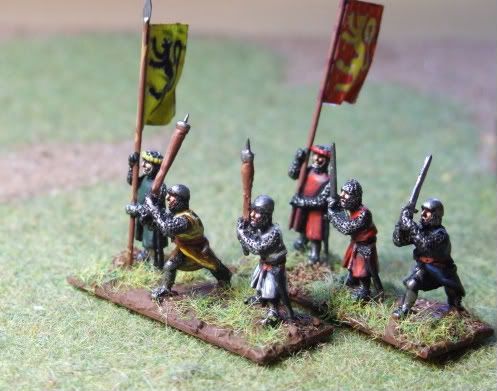
Advancing on the carriage are some Legio Heroica peasants. One banner is that of St. Edward, the other is St. Edmund's. Henry had a particular reverence for these English saints, hence his choice of names for his sons. There are some nice pictures of these banners used in decoration at the now lost royal chambers of Westminster. There is a picture of them in 'A Great and Terrible King' - copies were made after the rediscovery in the early 19th century which was just before the palace was damaged by fire.


One of the only 'names' killed on the Barons' side was Simon's standard bearer, Blount. He commanded the guard left around the carriage and banner. I've put him on the same base as Simon, as I liked the heraldry :)


I don't have any pictures, but I've also painted a couple of de Montfort's (with Mirliton figures) to use with my French and Florentines. Two of Simon's sons, Guy and Simon the younger escaped from England after Evesham. They joined Charles of Anjou's invasion. Guy became Charles' Vicar-General in Tuscany and led some forces alongside a Florentine army. He gained the title of Count of Nola. However, their cousin Henry of Almain, son of Edmund of Cornwall and grandson of Henry III, passed into Italy while Edward carried on to the Holy Land. He may have had a mission to repair relations with the de Montforts but it ended in tragedy. While he was praying, the de Montfort brothers stormed into the church and hacked at him even as he clutched the altar. Pleas for mercy were met with the response that their father and brothers had been given no mercy - though it seems that Edward had actaully tried to save Simon the Elder at Evesham. While Henry lay on the church floor dying, the brothers left, but once outside they were reminded of the mutilation meted out on their father, so they returned to do the same. Henry's bones and heart were returned to England

 The two were excommunicated and forced to flee, though there are suggestions that they were not pursued as vigourously as they might have been. Simon soon died, but Guy soon returned to the favour of Charles of Anjou. He continued to work for the king though he was later captured in the war of the Sicilian Vespers and died in an Aragonese prison. For his crime against Henry, Dante placed Guy in the Seventh Circle of Hell, up to his neck in boiling blood: "Within God's bosom he impaled the heart that still drips blood beside the Thames"