Monday, 22 March 2010

The Nobility of England


For a few months, I have concentrated on English knights of the reign of Henry III.

The reign was a period which saw some conflict in France and Wales as well as the Second Barons' War. Many of the same characters saw action in the next reign as Henry's son, Edward Longshanks, fought in Wales and Scotland.


 The figures are all 15mm by Legio Heroica. I used a mix of the early 13th century and mid 13th century ranges. The early period helmets would have been obsolete by the time of the Barons' War, so unlikely to have been worn by the nobility, but the figures are nice and it gives me more variety plus some of the poorer knights may have still used them. By Edward I's wars, helmet styles had evolved even further.

 I originally decided to just do a few English, representing my local area. However, the more I read and researched, the more carried away I became so that I have ended up with a full size army.

 A major resource which I used was British History Online. This includes many county histories. I live on the border of Worcestershire and Warwickshire and luckily these two are covered. The histories give a great deal of detail of who owned land where through most of recorded history. I think that at times the heraldry is inaccurate but it is a very useful starting point. Early Rolls is very useful for checking the heraldry though be sure to cross check as some arms vary from roll to roll. I also used Grazebrook's Heraldry of Worcestershire, trawling through to find places which were local to me and arms which were carried in Henry or Edward's reigns.

 Over the next couple of weeks I'll upload a series of photos of various figures, with a bit of gossip about many of them.


To start, here's Humphrey de Bohun, 2nd Earl of Hereford and Constable of England.
He was at times in opposition to the king, but was in the King's army at Lewes. Some books put him on the Barons' side at Evesham but this is probably a confusion with his son - also called Humphrey. The younger Humphrey can be seen to the rear. He was a commander for the Barons at Lewes and again at Evesham. He seems to have earned de Montfort's displeasure at Evesham for choosing to remain in command of the Welsh. He probably did not flee with them immediately - he was mortally wounded and died soon after the battle.


 The arms in black are those carried by the de Spineto family who held land at Coughton, about 5 miles from where I live.


Monday, 8 March 2010

Henry of Winchester

Henry of Winchester - Henry III of England - became king at a young age, crowned with a simple circlet as the crown jewels had been sold or lost in the Wash. His father, John, died while still at war with many of his barons. In some ways, this set the tone of the next fifty odd years, with frequent disagreements between the King and many of the most powerful men of the realm. Frequent political strife broke out into open warfare - the Second Barons' War. Much of the strife was down to the King's failure to recover land lost in France; the Saintoge War being the main example. Another cause of tension was Henry's attempt to buy the Kingdom of Sicily for his younger son. The cost was huge - Henry's brother had already declined the offer - and the chance of success was low. In the end, the only result was that the King was desparate for money.
 The various twists and turn of the Barons' War can be followed in many place. One old but seemingly useful source can be found here. One useful section is the appendix where participants of the two factions are named. I think there are a few errors, but handy nonetheless.
 This has a variety of primary and near secondary sources covering the War.
 Dante mentions Henry as one of the group at the base of the mountain of Purgatory, alongside some of the other characters I've covered.
  "You see the king who led the simple life

    seated alone: Henry of England—he
    has better fortune with his progeny."


  I hadn't originally intended painting an English army, but decided I'd just do a few of the local lords. I already had a fair number of Legio Heroica's figures which I started to paint as French, but I quickly decided that they wouldn't work too well alongside the French I'd already done.
 I soon found myself researching the various nobles of England and within a short time I'd commited myself to paint up a full army. I'll go into some of the sources I used another time.

 Legio Heroica do two kingly figures. The one which I used for Henry is designed for the early part of the 13th century and in theory is too early for Henry, especially for the Barons' War period. His seal show him in a full helm and riding a horse with no caparison but artistic licence was mine to take! I especially liked the pose - in DBMM Henry is an inert general and this pose leant itself to a level of inertia.

I was heavily influence by the style of painting used for this figure on the Legio Heroica site - I even copied the ermine trim.


I was intruiged by the description of a dragon standard used at Lewes. Hobilar (the magazine of the Lance and Longbow society) had a bit of a debate about whether this would have been a flag or a windsock style. After a bit of deliberation, I decided on the windsock. This was for a couple of reasons. The first was that Henry seemed interested in his Saxon predecessors - using the names Edward and Edmund for his sons was very unusual at the time. It was their saintliness which was their main draw, but he may have been aware that the Saxon kings probably carried dragon standards, as shown on the Bayeux Tapestry.

What swayed my decision finally was coming across this picture. It seems to have been from the time of Edward I, who is also known to have used a dragon standard. The picture is an illustration of the story of King Arthur, another subject which was of interest to Henry - he probably ordered the construction of the Winchester Round Table.
 I scratchbuilt the dragon using fuse wire and milliput. The first attempt was okay but I decided to try again and even then had to rebuild the head.

The arms of his standard bearer are, I think, those of the knight who held the land where our wargaming club meets.

I shall post some more pictures of the flower of English chivalry once I get the basing done!

Wednesday, 27 January 2010

The Song Dynasty


Once the Mongols had conquered the Jin Dynasty in Northern China, they were faced with the prospect of conquering the Song Dynasty.

A good (I think!) history of the Song and its neighbours and successors can be found in Mote's "Imperial China".

The Song (or Sung) Dynasty had emerged from the Five Dynasties and Ten Kingdoms period and fairly rapidly subdued the majority of China. However, on the northern border the Liao Dynasty had been founded by the Khitan. The last of the states to fall to the Song, the Northern Han,  was a client of the Liao so its conquest created tension between the two states. Further tension was created by Liao occupation of lands once held by the Tang, which the Song claimed.

 The Song attempted to regain these lands by force but were rebuffed with great losses - the emperor fleeing the battle in an ox cart. There were several further campaigns over the next twenty years. The Liao invasion of 1004 was bought off with what the Song called gifts and the Liao called tribute - a massive 200000 bolts of silk and 100000 ounces of silver per year.

 The war party in the Song court thought that the Liao could have been defeated but the peace party prevailed. The policy has divided opinion ever since - the cost was high but less than would have been needed for defensive troops. However, it also encouraged a military decline which would make future defence more difficult.

 This was shown to some extent with the rise of the Tanguts or Xi Xia. They were neighbours of the Song and the Liao. Initial Xia success led the Liao to again threaten to invade. The Song renegotiated the tribute to the Liao - the Tanguts were seemingly disgruntled that their hard work had produced gains for the Liao. The Song used this to their advantage - the Xi Xia were persuaded to attack their erstwhile allies, receiving substantial gifts from the Song as a reward. Over the next century, Xi Xia and Liao relations veered between war and negotiation - Song diplomacy seems to have help to manipulate the states to cut down on the threat of a new alliance between these two states.

 The Song had further conflict with the Xi Xia. During one of these wars, the Chinese infantry are said to have begun to use a large sword for killing horses, the zhan ma dao  - also see here.

 The Liao became increasingly settled and apparently unaggressive, so that when their subjects, the Jurchen, revolted the Liao armies rapidly crumbled. The Song tried to take advantage by occupying the land they claimed but this led to war with the Jurchen. This time, the Song lost all of their northern territories. The period before this is therefore known as the Northern Song, the period after as the Southern Song.

 The Jurchen estabished a  new dynasty known as the Chin or Jin (depending on which system you are using). There were a number of wars between Song and Jin including a massive waterbourne assault by the Jurchen across the Yangtze. This was repelled with massive losses and led to most of the remainder of Song-Jin relations being pretty peaceful. Just before the Mongol invasions began, a Song invasion of Jin was defeated and a further invasion in alliance with the Mongols ended up annoying the nomads.

 The Mongol invasion of Song went through several phases, interrupted due to the death of the Khan. The final invasion began with a siege - this webpage has some very useful information about Song armies.


 A major problem with putting together a wargames army for the Song is that 15mm figures covering this dynasty are few and far between. Those which are available are generally based on the WRG 'Armies and Enemies of Ancient China' which is very patchy in its accuracy. Eureka Miniatures has the Song in its '300' club and probably only needs a few more subscribers to reach its magic number. The Song's southern neighbours - the Nanzhao - are also in the '300' club and rumour has it that sculpting is in progress.

 I used mostly 'Grumpy' miniatures available from Eureka and East Riding Miniatures. These are pretty nice figures and easy to paint. They are produced for the Ming and Koreans rather than the Song so I took some liberties and did a bit of conversion.

The cavalry in the picture at the top of this post have very distinctive horse armour which would be nice to see. I made do with unarmoured horses except for a couple of SHQ horses I have. The Central Asian Turkish armoured horses from Outpost are also pretty suitable. I cut away the plumes and flags from the Grumpy cavalry and replaced them with Milliput plumes. Most also have little wings added to the helmets which gives a more Song profile.


 The armour on the figures is textile covered. While appropriate for the Ming, this would seem to have been rare for the Song period or even non-existant. Lamellar or 'mountain pattern' armour would be better.

The flag is homemade. The Chinese had a system which used symbols standing for the five cardinal directions - you can see examples on Wikipedia.


These infantry represent poorly equipped militia with some better equipped troops in front. I use the better ones to represent foot generals.
I also use some of the Grumpy figures with helmets so that I can distinguish regular and irregular troops.


A major feature of the Song army was its use of artillery.
The fire lance troops are conversions from Grumpy figures. Fire lances were apparently popular with  peasants although in an Imperial force they would probably have been better armoured.

The bolt shooter is a double crossbow from Outpost's Tang range.

The man-powered catapults are mostly Donnington - I replaced the arm with a bundle of florists' wire to give the impression of bamboo.

A very useful source for artillery and other aspects of the  later Chinese military is here. Most of the pictures are Ming or later but they draw on earlier texts.

Monday, 4 January 2010

Comparisons of Knights

Here's a comparison between the knights from various companies.


First, the horses. From the left
Legio Heroica, Essex, Mirliton, Black Hat, Alain Touller.

The Touller horses have been redesigned since I bought mine and I haven't seen them.


Again, from the left
Legio Heroica, Essex, Mirliton, Black Hat, Touller
The Black Hat knights aren't quite as versatile as their infantry, being noticeably smaller than other ranges. The Legio figures are a bit taller but it is their bulk which makes them stand out next to other figures. Their shields are just about identical in size to the ones from Mirliton though a little thicker. The Mirliton figure is one of the later ones in this range. Some of the earlier ones are a little smaller though not so much that it couldn't be natural variation. The Essex figure is one of their Spanish range wearing obsolete gear for the mid- to late-13th century.
From some pictures I've seen elsewhere, the Old Glory 'Crusader' range is a pretty good match for size and build of the Mirliton figures. Most of this range carry heater shields more typical of the mid 13th century than the 3rd Crusade. The ones in the 'Holy Order' range have larger shields which are of an earlier form though still more early 13th than late 12th century. The range seems to have a mix of early 13th century 'face mask' helms and mid century full helms. Both of these were found earlier, but full helms in particular seem to have been extremely uncommon pre-1200 and not predominant for another generation or more. The Old Glory figures also have most of the knights on barded horses which were probably uncommon before 1200.

I've used Mirliton figures for my Italians as well as French and German forces which are in progress. I used Touller figures for the Spanish. My current project is a Feudal English army of roughly the time of Simon de Montfort. I've had the urge for a while to paint a few figures bearing the arms of the nobility who held lands close to where I live. I've found even more information than I hoped and so now I shall do a whole army. About a dozen figures done so far so watch this space.

EDIT: Since writing this, Touller are out of production and unlikely to return, Black Hat/Gladiator/Metal Magic have just gone out of production and Legio Heroica are hard to get if at all.

On the positive side, Donnington have a range of 12th and 13th century figures. Mirliton have a range of  14th century figures, most of which will be suitable for the early part of the century. There are a few companies producing STLs for 3d printing though most are designed for 28mm rather than 15mm. They can be scaled but this can result in very fine detail which is harder to pick out. My favourite range is the March to Hell figures though the 13th century Feudal Europe mounted figures are very short in the leg. 

Tuesday, 29 December 2009

The Horde from the East


 Incursions into Europe by the people of the great Eurasian steppes had been happening since before the end of the Roman Empire. The Kingdom of Hungary traced its roots to the Magyars who settled in the Carpathian basin in the 10th century. Cumans, the western part of the Kipchak group, arrived in Hungary and the Balkans in the early part of the 13th century. They were refugees, fleeing a threat from the East.

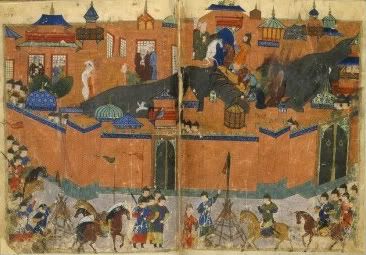
 The meteoric rise of the Mongol Empire is covered by many websites. Their own account can be read in the Secret History. In short, a combination of absorption through alliance and conquest created a force which was strong enough to take on a succession of settled empires. The Xi Xia, of what is now Western China, were one of the first to feel the strength of Ghengis's force. They fought a series of wars against the Mongols. They eventually submitted but did not send forces to aid the Mongols when called upon. Further war resulted - Ghengis died during the final war of conquest.  The Jin dynasty of northern China was also under attack during this early period and although losses in territory and life were huge, the resistance was sufficient for the Jin to retain some of their lands until after the death of the Khan. 

Ogedei, Ghengis's successor, continued the process of conquest. There was something of a pattern - Mongol emissaries or traders in various places seem to have got themselves killed by the local authorities and an army was sent to wreak terrible vengeance. The Song dynasty, rulers of Southern China, managed to incur the wrath of Ogedei while allied with the Mongols against the Jin. The Song forces tried to retake land which had been lost a century or so earlier and killed a Mongol emissary who presumably voiced the Khan's displeasure.


To the west, a series of campaigns conquered the Islamic lands - eventually conquering as far as Mesopotamia with incursions into Syria. The impact on Central Asia was immense and may well have caused a permanent decline in the economy of the area through the destruction of cities and even the grazing of huge numbers of horses. In this campaign, and others, locals were driven in advance of the Mongols as a human shield - especially during sieges. Catapults of various sorts were used extensively. During the campaigns in the Islamic region, the Mongols seems to have acquired the means to build counterweight catapults - the hui hui pao.


A relatively small force was sent to conquer the Kipchaks in what is now Russia - this expedition continued through the various Rus lands forcing them to become vassals of the Khan. Again, it continued to the west. It split into three, one part defeating a Polish/German army at Liegnitz - the involvement of Teutonic Knights at this battle was probably minimal and may have been non-existant despite many claims to the contrary. Even today the city of Krakow commemorates the attack of the 'Tartars' with a midday bugle call which cuts off short, as if the musician has been hit by an arrow.

The main part of the army confronted the Hungarians as a punishment for the King allowing the Cuman refugees to enter the country. Ironically tensions between Hungarians and Cumans led to the death of the Cuman king, most of the Cumans fleeing to the south.
The Hungarians met the Mongols at Mohi. The battle was hard fought but it resulted in the destruction of the Hungarian army and the death of much of the royal family and nobility. The Mongols pillaged the country though guerilla tactics by the populace meant that the kingdom remained unpacified.

These forces left Europe on hearing of the death of Ogedei. Tradition meant that the new khan should be chosen by the whole army. Further attacks on Hungary occurred but, importantly, they tended to lack the same ability to conquer cities.

The campaign against the Song dynasty proceeded in stages - again the death of a khan resulted in a hiatus. The nature of these wars was far more of a slog, characterised by long sieges, compared to the campaign in Russia and the rest of Europe. Even the succession of sieges in the Islamic areas were short by comparison. There is an essay about one of the longest here. It also gives some insight into the Song dynasty and its army. I'll post some more about the Song fairly soon.

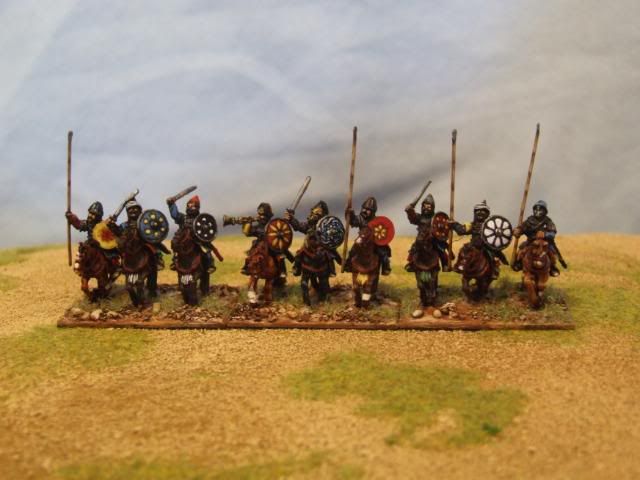
I used Old Glory figures for my Mongols.


These are some of their Heavy Cavalry with Melee weapons. There are certainly references to Mongols with shields but there is debate as to whether they would use them on horseback. Portrayals of earlier troops in this area do lack shields, so I decided to cut away the ones moulded onto the figures. This was not quite as daunting as it seems and it was possible to create the arm  fairly easily from the remains of the shield.


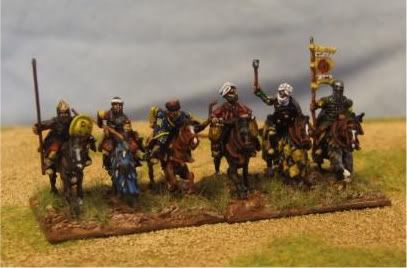
These are a mix of the heavy cavalry and medium cavalry archers. The main difference is really that the heavy cavalry are slightly bulkier figures, including the horses.


These are the Old Glory light cavalry with bows. I did these around the same time as the Turcoman cavalry and again I've overdone it when it comes to making them look as if they are firing sideways. It makes it confusing in the table-top!


The Mongol armies was made up of troops from a number of origins. Overtime, the appearance probably showed increasing degrees of homogeneity but I still have some which preserve the differences.


I use these as Jurchen cavalry. They are from the Outpost Manchu range. This is actually designed for a period about 400 years after the one I want, which shows mostly in the bowcases. At least some of the Jurchen had armoured horses - I may well use some of the Outpost Turkish horses which I have sitting around as the armour is pretty suitable. I could have just used the same figures as the Mongols but it lets me see which are which more easily and I liked the figures!
About half of the Outpost range are wearing the fabric covered 'brigandine' armour which became popular especially during the Manchu period. However, some seems to have been worn during the Mongol Yuan period. Even so, I asked Outpost to just send figures in lamellar armour after my initial order and I've even made some of the fabric covered armour into lamellar using milliput.


These are Black Hat light cavalry - a mix of Cumans, Hungarians and the occasional Lithuanian.


They mix pretty well with the Old Glory figures though the horses are smaller


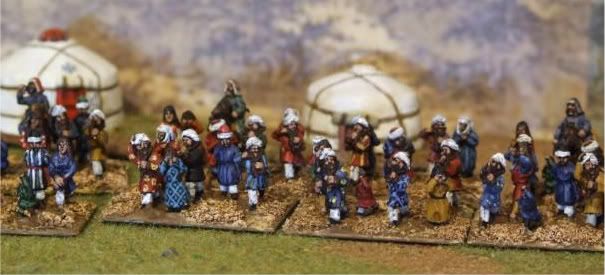
The 'human shield' figures  are a mix of Donnington and Alain Touller figures. The AT packs come complete with a Mongol 'herder'. The Touller range looks pretty nice and I might well have gone with them if I hadn't already bought OG15s. The ponies do look very small compared to other companies' figures. This may well be accurate but the difference may be offputting. Since I bought mine, the horses have been redesigned so could be larger. I did buy the Korean infantry from Touller, which are based on the figures from the Invasion Scrolls. These may actually be Southern Chinese rather than Korean but either way they will find a place in my Yuan Dynasty army once they are painted. (edit: - they may even be Northern Chinese. The Yuan hadn't conquered the Song at the time of the first invasion of Japan. However, apparently some Southern Chinese troops had transferred to the Mongols even at this point, so it is hard to be sure who they are!)

Saturday, 31 October 2009

Schild en Vriend

The title of this post is a shibboleth, a phrase which Flemish revolters against the King of France demanded that those they encountered said - if they couldn't pronounce the words correctly they would be taken to be French and killed.
This happened as part of the Flemish revolt against the rule of Philip IV 'the fair' of France.


The build up to the revolt is fairly complex but in a nutshell the King had placed Flanders under his personal rule due to a dispute with the Count. The royal appointee in charge of Bruges made himself unpopular through such matters as tax and eventually this led to the outbreak of open war. Not all of the cities of Flanders were initially involved and some, such as Ghent, had some history of loyalty to the French crown.

The first major battle was outside Kortrijk/Courtrai. It bacame known as the Battle of the Golden Spurs. This is covered in depth at the excellent Liebaart site (Liebaart being a nickname for the anti-French party). The battle is also covered in various levels of detail by a number of books including Verbruggen's and Fegley's. See also the account from the Annals of Ghent. The battle is a major part of Flemish culture, commemorated at a museum in Kortrijk
 The war continued with some more minor battles, the next major one being at Mons en Pevele. More cities sent their troops here, with Ghent's contribution being greater than at Kortrijk. The battle is an interesting contrast with Kortrijk as it shows the Flemish pikemen taking the offensive. The battle was a victory for the French but was a close run thing, with Philip being nearly killed or captured.
 A peace treaty was signed soon which showed  how close the French thought the battle  - some cities remained under French rule but the majority of Flanders achieved de facto independence.

The Flemish revolt is often seen as being part of a major change in warfare in Western Europe with infantry achieving greater success on the battlefield. This also helped to alter the political balance between nobility and commoner. To see it as a peasants revolt is probably overstating the case - the equipment used by the Flemish infantry was expensive, representing many months wages of a skilled craftsmen. Most of the men were organised by guild, representing the various crafts and trades within the cities. They distinguished themselves by wearing uniform liveries and by carrying guild flags - more on this later. The weapons were less uniform though this may have been deliberate - one of the accounts describes how the men were placed so that a pikeman was alongside a goedendag wielder.

I won't enter into the debate about the nature of the goedendag - you can read more here. The illustrations are taken from the Kortrijk Chest which can be seen on the same website. I think it is likely that, while the common term for the weapon was a 'gepinde staf' or 'plancon a picot', a chronicler picked up on a nickname for the same weapon and referred to it in his history.

Here is another illustration, taken from the French Grande Chroniques. The way in which the plancon can be wielded as a club is obvious, while the spike allows it to poked as a short spear.


There are times when a spontaneous purchase can lead you to spending a lot of time and money on something you hadn't intended! As I mentioned in some previous posts, I liked the look of Donnington's new era figures and bought a few. I originally thought I'd just use a few of the Low Countries figures in German or French armies, but with a bit of reading I decided to take the plunge and start another new army. I already have some knights painted as Flemish since these appear in various other armies- though going by the Kortrijk Chest I really ought to have knights wearing cone topped helms and ailettes.
  I originally only bought a few plancon wielders as, in the DBM list, these are separated out as Blade(X). However, after reading the various acounts where the majority of these troops were side by side with the pikemen I decided to mix them in. I did a couple of bases as an experiment and liked the look. The Chest also shows some with falchion and buckler, so I mixed some of these in too.
 The mixing had the benefit of increasing the variety on each base. I also found that the  plancon wielders can easily be converted to using pikes. The figure carrying his weapon over the shoulder can be fitted with a pike at various angles. The other, with his plancon horizontal, can have his hand drilled out to give another pikeman at the ready. The left hand is a bit ill-defined to look as if it holding a pike, but I decided not to bother adding any milliput.
 I used the figures with vertical spears as flag bearers and I'll also use some if I want a fourth rank of pikes, though the Flemish don't seem to have used their pikes in as great a depth as some. For the third rank, it is a mix of plancon wielders, some refitted with pikes, and swordsmen. I still wanted more variety. I had bought some of the figures using their spears overarm so I experimented with bending these to look as if they were holding a vertical pike. I liked the result, so added these into the mix. I also had some Alain Touller spearmen which were a bit big to mix with Black Hat figures and I found that they mixed nicely with the Donnington figures. I decided against putting any Mirliton spearmen into the mix - I wanted the pikemen to all have surcoats and most of the Mirliton ones don't have them.
 The othe minor conversion I've made is to round off the helmets of figures wearing bascinets to give the appearance of an earlier helmet. The figures are designed for the mid 14th century and the bascinets match this period well. I'd have preferred to have seen more of the figures in these rather than kettle hats though, as the Chest and Leeguemeete paintings show a lot of uniformity in the headgear.
  The majority of figures and reacreations I've seen of placon wielders have been based on the Ian Heath pictures in Armies of Medieval Europe v.1. He based his on the Leugemeete paintings of Ghentish militia. When I looked at these, the shields all seem to be carried by men with spears, not plancons, so I left the shields off. I don't know how possible it was to use a shield with a spear like this, but I put a few on pikemen at the ready. They'd probably be more accurate if they were hanging on their backs, like some re-enactors I've seen.


 I painted my first few bases using a yellow and blue livery mentioned by Heath (from Froissart's mid 14th century description). Rune's description of the Flemish guild flags mentioned the use of de Vigne's book. When I read a review of this, it mentioned that it had colour versions of the Leugemeete paintings, so I bought it. It does have some great plates - though none of the guildsmen are in yellow and blue. The liveries are either red, white, red and white or red and yellow. However, the text mentions that various other colours were worn by various guilds and cities and the availability of cloth seems to have been a factor. The shield of the vieux wariers guild (basically second hand clothes dealers!) shows a tunic in yellow and blue, so I gave the figures I'd already painted a flag based on the shield.


Apart from the blue and yellow livery , the others are based on the paintings. De Vigne identifies one with a damaged flag as the butchers, based on the cleavers which some carry instead of spears or plancons.

I made the flags by drawing free hand a much larger version, scanning and colouring using Corel. I used a texture to give the effect of creases in the material, though I still need to play with the settings to get the highlights rights.
Rune has doem some very nice flags on the Krigsspil site but I wanted to include some guilds he hasn't covered and so for consistency I decided not to use any of his.
Note that at this earlier period the flags are still much taller than they are wide. Within a generation or so they became more or less square.

For the generals on foot, I am going to use some of Mirltons dismounted knights. These are wearing either coifs or a cervelliere which fits the look on the Chest nicely. I've added a milliput cervelliere over the coif of one which took very little time. So far, I've also convereted two of them to carry plancons. I cut away the swords, drilled out the hands and put a pin in place. The point of the pin forms the spike of the plancon and then I built up the body of the weapon with milliput and much cursing. I'm pleased with the result, giving a similar pose to the one in the illumination above. I'll post a photo when I've painted them. I may do some more when I start painting the bases which just have plancon wielding Bd(X).

One of the slightly disappointing things about this army is the heraldry of the commanders. I looked at who commanded the various sections of the army at Mons and then looked up their heraldry. They were very closely related and their heraldry shows it - most have the lion of Flanders with some kind of distinguishing label.

Sunday, 11 October 2009

Syria and the Turks

The period I'm covering saw the last gasp of the Crusades in Egypt and Syria, with later efforts being concentrated elsewhere such as Spain and Prussia.

Part of the reason why the remanants of the Crusader states lasted for as long as they did was that their Muslim opponents could be as fractious as their European counterparts. After Saladin's death his territories were divided amongst his sons and other family members. At various times, one of these coud claim to be the overall leader but conflict between the cities was frequent. One result of this internecine warfare was the hiring of Khwarizmians, refugees from the Mongol Conquest. These were employed by first one side and then another in the wars between the Ayyubid Sultan in Egypt and his uncle and others. While crossing Palestine, the Khwarizmians took Jerusalem from the Christians, resulting in Muslim rule of the city for the next 7 centuries.

As might be expected for a 14th century Christian, Dante consigned Muhammed and Ali to one of the lower regions of the Inferno. Saladin is also in the Inferno, but on the first level, the region for those who
"did not sin; and yet, though they have merits,
that's not enough, because they lacked baptism,
the portal of the faith that you embrace.
And if they lived before Christianity,
they did not worship God in fitting ways;"
Saladin is notable as the others are almost all Classical figures, ranging from heroes of the Trojan Wars , through the philosphers and writers of Greece to renowned figures of Ancient Rome. Indeed, Saladin is noted as standing slightly apart from the others.


These are some 15mm Old Glory figures which I use as Ayyubid Syrians. They are a mix including not only their Syrian figures but also some OG Seljuks. Spears have been replaced by wire - the last few ranges from OG have seen them switch to very thin lances instead of the open hands on other ranges.
 This OG range has some nice figures but others are nowhere near as good. The size of riders and horses varies greatly and details such as bowcases and quivers are often far too small. I think the Syrians and Bedouins are probably the best of this range. The Seljuk range is generally much more consistent and better detailed.


These are Outpost Ghilman (with and Old Glory drummer - the Outpost one is very big).
The horse of the man with the mace has had a bard made of a J-cloth added.
When I first got the Outpost figures they seemed much smaller than most ranges but placed side by side the difference is due to the more natural proportions. Some of the horses are very nice, others aren't quite so good.


Turcoman cavalry - Outpost on the left, Old Glory on the right.
I tried for a dynamic basing with the OG figures, with most of them looking as if they are charging across the opponents front, firing as they go. Trouble is, it gets confusing as to which way they are actually facing, despite the base width and depth being different. I may well rebase these.